


Among the world’s many maritime shipping routes, few hold as much influence as the Strait of Hormuz. This narrow waterway serves as one of the main “arteries” of the global energy system, as a large portion of the world’s oil trade depends on this route.
Data from the U.S. Energy Information Administration (EIA) shows that about 73 million barrels of oil per day passed through major maritime chokepoints around the world in the first half of 2025. Among these routes, the Strait of Hormuz remains the most vital.
During the same period, around 20.9 million barrels of oil per day moved through this strait—equivalent to roughly one-fifth of global oil consumption. In terms of seaborne oil trade, the volume accounts for about 27% of total global oil shipments.
It is therefore not surprising that the Strait of Hormuz is often described as the most important energy chokepoint on the planet.
Read also: The Most Important Straits in the World
A Narrow but Vital Global Energy Route
The Strait of Hormuz lies between Iran to the north and Oman and the United Arab Emirates to the south. The strait connects the Persian Gulf to the Gulf of Oman and the Arabian Sea, making it the primary outlet for oil and gas exports from the Gulf region to global markets.
Despite its importance, the strait is actually relatively narrow. It measures about 50 kilometers wide at its entrance and exit points, and only around 33 kilometers at its narrowest section. However, it is deep enough to accommodate the world’s largest oil tankers.
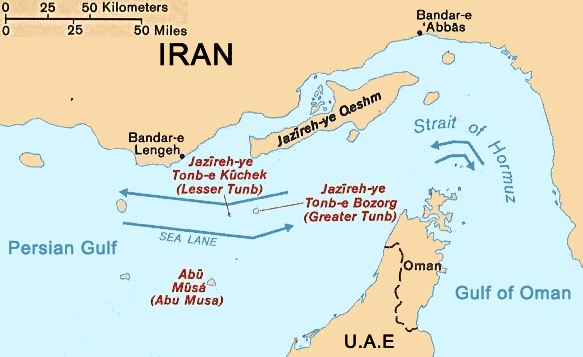
Every day, roughly 100 cargo ships pass through these waters. Around 60–70% of them are oil tankers and gas carriers, reflecting the Gulf region’s role as a major global energy export hub.
The oil passing through the strait originates from several major Middle Eastern producers, including Saudi Arabia, Iraq, the United Arab Emirates, Kuwait, Qatar, and Iran. Much of the oil produced by these countries is transported through this route before reaching markets around the world.
Asia’s Heavy Dependence on the Strait of Hormuz
The region most dependent on this route is Asia. High energy demand combined with limited domestic resources has made many Asian countries heavily reliant on oil flows from the Gulf.
Around 84–89% of the crude oil and condensate that passes through the Strait of Hormuz is shipped to Asian markets. Countries such as China, India, Japan, and South Korea are the primary destinations for these shipments.
In addition to oil, the strait is also a crucial route for the global trade of liquefied natural gas (LNG). About 20% of global LNG trade passes through this corridor. Even more striking, roughly 83% of the LNG that moves through the Strait of Hormuz is also destined for Asian markets, highlighting how deeply the region depends on this energy route.
By contrast, the dependence of the United States on this route is relatively small. Only about 7% of U.S. crude oil imports come from shipments passing through the Strait of Hormuz, while roughly 2% of the country’s liquid petroleum consumption depends on flows through this passage.
Impact on the Global Energy Market
The enormous volume of energy that passes through the Strait of Hormuz means that any disruption to this route can quickly affect global markets. On average, more than 20 million barrels of crude oil, condensate, and fuel move through the strait every day, with the value of energy trade reaching around $600 billion per year.
When energy flows through this corridor are disrupted, the impact is quickly reflected in global oil prices. In early 2026, crude oil prices had been relatively stable, fluctuating between about $55 and $70 per barrel.
However, in early March, prices surged sharply amid escalating geopolitical tensions. Brent crude oil rose to about $79.38 per barrel, while West Texas Intermediate climbed to around $72.41 per barrel.
This spike illustrates just how sensitive the global energy market is to this narrow waterway. With roughly 20% of the world’s oil consumption and a significant share of international LNG trade relying on the Strait of Hormuz, the maritime corridor remains one of the most strategic points in the global energy trade system.


