

When we think about ASEAN today, a regional powerhouse of 10 countries united by shared interests, we often imagine grand summits, economic deals, and cultural exchange. But the very beginning of this organization wasn’t forged by presidents or kings.
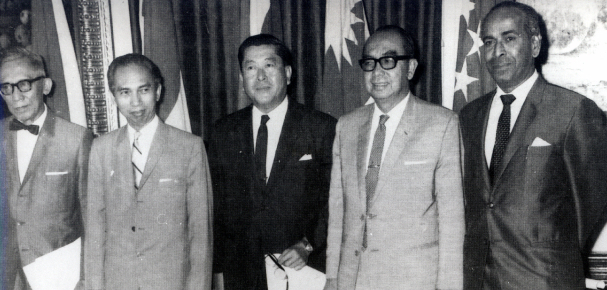
It started with just five men. Five diplomats, sitting together in Bangkok on August 8, 1967, chose dialogue over division and laid the foundation for what would become Southeast Asia’s most enduring alliance.
Southeast Asia in 1967: A Region at a Crossroads
In the late 1960s, Southeast Asia was still reeling from colonialism, grappling with ideological rifts, and navigating the global Cold War.
Many nations were newly independent and struggling to stabilize their governments while avoiding the spread of communism or falling back into external influence. Amidst the turbulence, there was a shared vision, to build a region that valued cooperation over confrontation.
This vision became reality through the Bangkok Declaration, signed by five founding states: Indonesia, Malaysia, the Philippines, Singapore, and Thailand.
Let’s meet the five diplomats who made it happen.
Adam Malik (Indonesia)
Known for his firm diplomacy in the aftermath of the Indonesia-Malaysia confrontation, Adam Malik was a seasoned journalist turned foreign minister.
He served as Indonesia’s 11th Minister of Foreign Affairs and played a critical role in aligning Indonesia’s foreign policy with regional peace efforts.
Malik was instrumental in shifting Indonesia from a confrontational stance to one that embraced regional unity. His participation in signing the Bangkok Declaration symbolized Indonesia’s renewed commitment to peace and cooperation in Southeast Asia.
Tun Abdul Razak (Malaysia)
Malaysia’s second Prime Minister and a fierce advocate of development, Tun Abdul Razak was also Deputy Prime Minister and Foreign Minister at the time of ASEAN’s founding.
Often remembered as Malaysia’s “Father of Development,” he sought not just national progress, but regional harmony.
His leadership reflected a deep belief that Southeast Asia could rise above division. By signing the declaration, Razak helped position Malaysia as a key player in regional diplomacy and a builder of bridges between nations.
Narciso R. Ramos (Philippines)
A former journalist, lawyer, and seasoned public servant, Narciso R. Ramos was the Foreign Minister of the Philippines during ASEAN’s founding. His wide-ranging experience gave him a unique perspective on both domestic and regional issues.
Ramos believed that diplomacy was a force for peace and development. His role in shaping ASEAN reflected the Philippines’ aspiration to be a part of a stable, cooperative Southeast Asia that prioritizes dialogue over domination.
Sinnathamby Rajaratnam (Singapore)
Known affectionately as S. Rajaratnam, Singapore’s first Foreign Minister brought visionary thinking to the ASEAN table. He is often credited with laying the groundwork for Singapore’s modern diplomacy and promoting the city-state’s identity as a peace-oriented nation.
Rajaratnam was a key voice in advocating for non-alignment and regional solidarity. His signature on the Bangkok Declaration wasn’t just a formality, it was a clear statement that Singapore, despite its size, would be a proactive contributor to Southeast Asian unity.
Thanat Khoman (Thailand)
As Thailand’s Foreign Minister during ASEAN’s founding, Thanat Khoman was a diplomatic veteran. He played host to the historic meeting in Bangkok and was a strong advocate for multilateralism and regional peace.
Khoman’s leadership helped steer ASEAN away from military alliances and toward a non-block, consensus-driven model of cooperation. His statesmanship ensured that Thailand would not just be a member, but a moral compass in the new organization.
A Legacy That Lives On
Today, ASEAN comprises ten countries, Brunei, Cambodia, Indonesia, Laos, Malaysia, Myanmar, the Philippines, Singapore, Thailand, and Viet Nam and continues to shape the region’s economic and political future.
The principles championed by the five founding fathers still guide the bloc: non-interference, mutual respect, consensus-based decision-making, and peaceful cooperation.
From post-colonial uncertainty to one of the most resilient regional organizations in the world, ASEAN’s journey is a testament to what thoughtful diplomacy can achieve.
From Five Men to a United Region
In a world too often divided by conflict, it’s worth remembering that ASEAN began not with power plays, but with conversations. Five men, representing five very different nations, chose peace, trust, and a shared future.
Their legacy lives not just in documents or declarations, but in the everyday cooperation that defines Southeast Asia today. And as ASEAN moves toward its future, the spirit of 1967 still echoes, with relevance, resilience, and hope.



