In 2022, Fourtwnty, an Indonesian indie folk-pop band, released “Mangu” (lit. “Silent”), featuring Charita Utami. Three years later, around May to June 2025 – just a few months after the three-person band announced a hiatus – the tune went absolutely viral, even entering Spotify's Global Top 10 chart.
The song became widely used in TikToks and video edits. The reason: many Indonesian youths relate to the mellow tune, which features the story of an interfaith couple in the trenches. Charita's part of the song, “Cerita kita sulit dicerna/Tak lagi sama cara berdoa” (“Our story is quite difficult to comprehend/The way we pray is no longer the same”) has, apparently, touched the hearts of many.
In Indonesia, interfaith relationships are more than just song lyrics, though – they're a rampant phenomenon.
Rising (and Surprising) Statistics
According to the Supreme Court Directory, the first interfaith marriage in Indonesia occurred in Surakarta (Solo) in 2007. Up to 2022, Surakarta is the city with the highest rates of interfaith marriages in Indonesia, followed by other municipalities, such as South Jakarta.
A vast majority of interfaith marriages were between Muslims and Christians. 68% interfaith marriages were held between Muslims and Protestants, while 30% were held between Muslims and Catholics. This leaves only 2% of interfaith marriages done between people of other faiths.
Data from the ICRP (Indonesian Conference on Religion and Peace) also reveals a rising trend in interfaith marriages in Indonesia. From 111 couples in 2018, the amount of interfaith marriages has increased up to 177 couples in 2022. Considering these numbers, it is no surprise that interfaith romantic relationships have become a major social event in Indonesia.
Religion before Relationships?
In other countries, religion may not be a determining factor in starting a romantic relationship. Research conducted in 2023 at the University of Göttingen revealed that both men and women across several countries – such as Germany, France, Mexico, Japan, and the USA – did not consider religious similarity as an important trait for a partner. Criteria like kindness and supportiveness were instead more preferred.
Yet, in Indonesia, it's the other way round. Ask an Indonesian what they look for in a partner, and most would probably reply that the most important thing is religious similarity, especially if they’re dating for marriage.
In Indonesia, where 98% of the population considers religion as an important factor in their daily lives (as stated by research from Pew), this is highly understandable. Religious similarity is often linked to a sameness in values and objectives in life, which is desirable in a long-term partner.
In addition, religions tend to encourage its adherents to marry those who share the same faith. Islam, for example, obligates Muslim men to marry Muslim women. Meanwhile, Catholicism obligates its adherents to baptize their children in the Catholic Church, even if their spouses hail from a different denomination or religion.
Culturally speaking, families also tend to accept their children’s spouses-to-be if they are of the same faith. Most parents raise their children in their faith, and therefore expect their children to identify with the religion they were born with even after adulthood and marriage.
Law and Difficulties
Aside from religious and cultural difficulties, Indonesians also face a crucial obstacle in registering interfaith marriages: law. In general, the Indonesian law prohibits interfaith couples from getting married, except if one of them officially converts to their spouse's faith.
In 2023, the Supreme Court published a SEMA, short for Surat Edaran Mahkamah Agung (lit. “Supreme Court Circular Letter”) which prohibited interfaith marriages. Though it is legally non-binding, generally, it is prohibited to marry someone with a different faith.
The initial legal basis of marriages, released in 1974, remains unclear regarding its stance towards on interfaith marriages. Often, it is the judge who determines whether interfaith couples can marry.
Technically, people could get married with their spouses even if the two of them are from different religions. However, they won't be able to register the bond in the civil registry, making the marriage unrecognized by law.
This leads to several other implications. In Indonesia, it is obligated for a couple to be lawfully married, proven through a marriage certificate, to apply for a birth certificate for their children. A child born from an interfaith marriage, then, can not have a birth certificate, as their parents’ marriage is not recognized by the law.
A child born in an interfaith marriage, thus, has the same status as a child born out of wedlock. This may lead to difficulties in enrolling in a school, receiving social security benefits, and others.
Many law specialists have criticized this regulation. In a religiously plural country like Indonesia, it seems quite strange to prohibit interfaith marriage. It also goes against basic human rights, which allow people to get married with whoever they want however they want.
More Than Just Romance
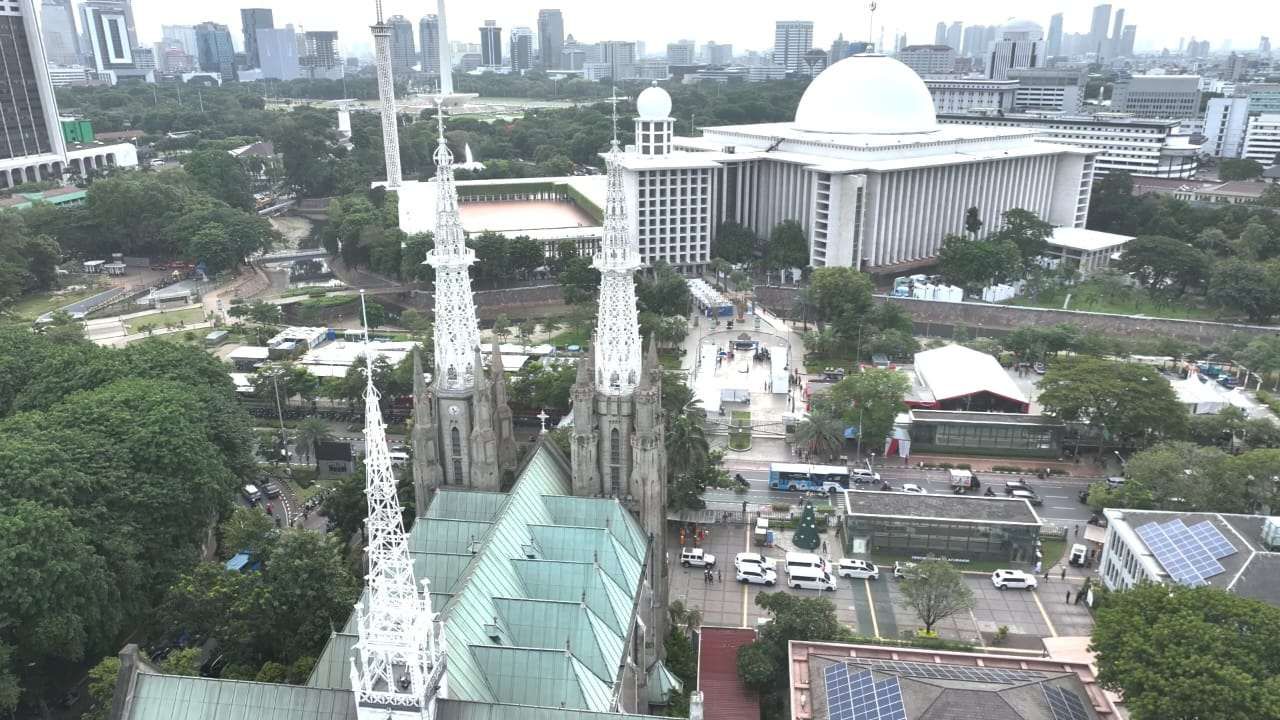
It seems that from the start, young Indonesians have been destined to be in interfaith relationships, at least once in their lives. This takes us back to Mangu’s legendary lyrics: “Kau di sana, aku di seberangmu” (“you're there, while I'm across you”) which many netizens relate to Istiqlal Mosque and the Our Lady of the Assumption Cathedral being across from each other in Jakarta.
Interfaith relationships in Indonesia are not just a matter of the heart. They also reflect how cultural values, religious teachings, and even the government get in the way of romance sometimes. Perhaps, without any major change in culture and state policies, many interfaith couples will remain like Istiqlal and the Cathedral – always across from each other, without ever uniting.
References
- Clue. Ideal Partner Survey Results. 2018.
- Larasati, Maria Jessica. Negosiasi Identitas pada Pasangan Suami Istri Beda Agama. Thesis. Bandung, Telkom University: 2024. https://repositori.telkomuniversity.ac.id/pustaka/215066/negosiasi-identitas-pada-pasangan-suami-istri-beda-agama-dalam-bentuk-buku-karya-ilmiah.html.
- Mahkamah Agung. Surat Edaran Nomor 2 Tahun 2023 tentang Petunjuk Bagi Hakim Dalam Mengadili Perkara Permohonan Pencatatan Perkawinan Antar-Umat yang Berbeda Agama dan Kepercayaan. 2023. https://jdih.mahkamahagung.go.id/legal-product/sema-nomor-2-tahun-2023/detail.
- Salma, Cut dan Tri Vosa Ginting. “Nikah Beda Agama Ternyata Paling Banyak Terjadi di Surakarta, Kok Bisa?” kumparanNEWS. Published on September 16, 2022. Accessed on July 23, 2025. https://kumparan.com/kumparannews/nikah-beda-agama-ternyata-paling-banyak-terjadi-di-surakarta-kok-bisa-1yryRUvdrtg/full.