


Hinduism, one of the world’s oldest religions, has inspired the construction of awe-inspiring temples across the globe.
While India is home to the majority of these sacred structures, several magnificent temples stand proudly outside its borders, showcasing the global reach of Hindu culture and devotion.
From the ancient stone marvels of Southeast Asia to modern architectural wonders in the West, these temples reflect both spiritual heritage and artistic mastery.
We will talk about the largest Hindu temples outside of India, celebrating their scale, significance, and the communities that brought them to life.
Angkor Wat, Cambodia

Spanning an extraordinary 162.6 hectares (about 400 acres), Angkor Wat in Cambodia famously holds the title of the world’s largest religious monument.
Constructed in the early 12th century under King Suryavarman II, it was originally dedicated to Vishnu before gradually transforming into a Buddhist site.
Its magnificence lies not only in its sheer size but also in the intricacy of its bas-reliefs, soaring towers, and harmonious layout, all emblematic of Khmer architectural genius.
As the central feature etched on Cambodia’s national flag, Angkor Wat stands as both a spiritual landmark and a cultural icon.
BAPS Swaminarayan Akshardham, United States

One of the most impressive contemporary Hindu temple complexes, the BAPS Swaminarayan Akshardham in Robbinsville, New Jersey, spans around 183 acres, making it the largest Hindu temple complex outside India in the modern era.
Designed according to ancient Vedic architectural principles, the main mandir rises to 191 feet in height, with dimensions of 255 by 345 feet, crowned by a 213‑feet central shikhar.
Its construction involved over 12,500 volunteers, who together contributed approximately 4.7 million hours of labor, shaping nearly 2 million cubic feet of stone in a worldwide effort.
The complex also includes a welcome center, museum, stepwell (Brahma Kund), and even sustainable elements like solar panels and heated stone floors.
Despite controversies over labor practices, the temple remains a testament to community-driven devotion and cross-cultural craftsmanship.
Prambanan Temple, Indonesia

Nestled in Central Java, the Prambanan Temple Complex stands as the most significant Hindu monument in Indonesia.
This UNESCO World Heritage site, built in the 9th century under the Sanjaya Dynasty, consists of 240 temples, with three primary sanctuaries dedicated to the Hindu Trimurti, Brahma, Vishnu, and Shiva.
Although its overall land area is more modest compared to Akshardham or Angkor Wat, its architectural brilliance, tall central tower, and detailed reliefs depicting scenes from the Ramayana make it a jewel of ancient Hindu-Javanese culture.
Besakih Temple, Indonesia
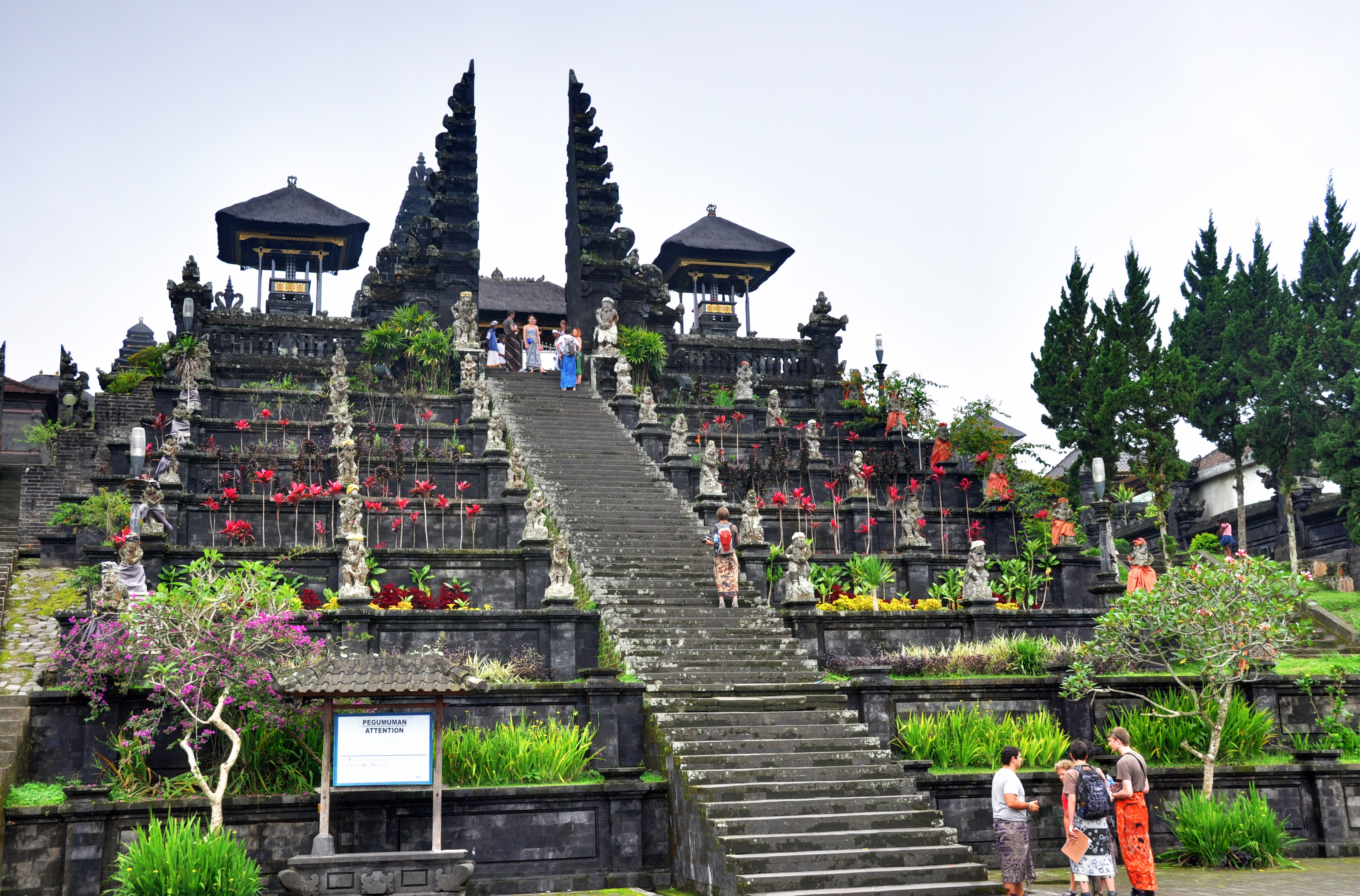
Known as Pura Besakih, this is the largest and holiest Hindu temple complex in Bali. Perched on the slopes of Mount Agung, it comprises 23 interconnected temples arranged across multiple terraces.
The main shrine, Pura Penataran Agung, is dedicated to Shiva and commands both spiritual reverence and architectural grandeur.
As the spiritual heart of Balinese Hinduism, Besakih draws pilgrims and visitors for its panoramic mountain vistas and for ceremonies weaving together natural surroundings and sacred tradition.
BAPS Shri Swaminarayan Mandir, United Kingdom

In the heart of London’s Neasden area stands the BAPS Shri Swaminarayan Mandir, often referred to simply as the Neasden Temple.
Covering approximately 1.5 acres, it was constructed without steel, using over 35,000 cubic feet of Bulgarian limestone and 25,000 cubic feet of Indian and Italian marble.
Rising to a height of 21 meters (70 feet), the structure contains seven shikhars, six domes, nearly 1,700 carved pillars, and over 26,300 ornamental stone pieces.
Each echoing the timeless beauty of traditional craftsmanship. National Geographic aptly dubbed it “A London Landmark”.
Pashupatinath Temple, Nepal

Across in Nepal, the revered Pashupatinath Temple complex in Kathmandu spans 246 hectares (2,460,000 m²).
Comprising the main pagoda-style shrine to Shiva (Pashupati) alongside over 500 subsidiary temples, ashrams, and sacred inscriptions lining the banks of the Bagmati River.
Regarded as one of Hinduism’s most sacred pilgrimage sites, it is also a UNESCO World Heritage Site, revered for its spiritual legacy, architectural cohesion, and cultural depth.


