


Imagine a frog that refuses to settle for just hopping from one branch to another. Nope, this little daredevil wants more—it dreams of soaring through the rainforest like a bird. That’s Wallace’s flying frog (Rhacophorus nigropalmatus), one of the most magical creatures you’ll ever meet in Southeast Asia’s jungles.
With its neon-green body, oversized webbed feet, and acrobatic moves, it looks like something straight out of a fantasy film.
Life in the Treetops
This frog is a true canopy resident. Found in the rainforests of Malaysia, Borneo, Indonesia, and Thailand, it spends nearly all of its life high up in the trees.
The only time it bothers coming down to the forest floor? When it’s time to mate or lay eggs. Its favorite hangout spots are moist, leafy lowland rainforests, though you might also catch it near shallow pools.
How It “Flies”

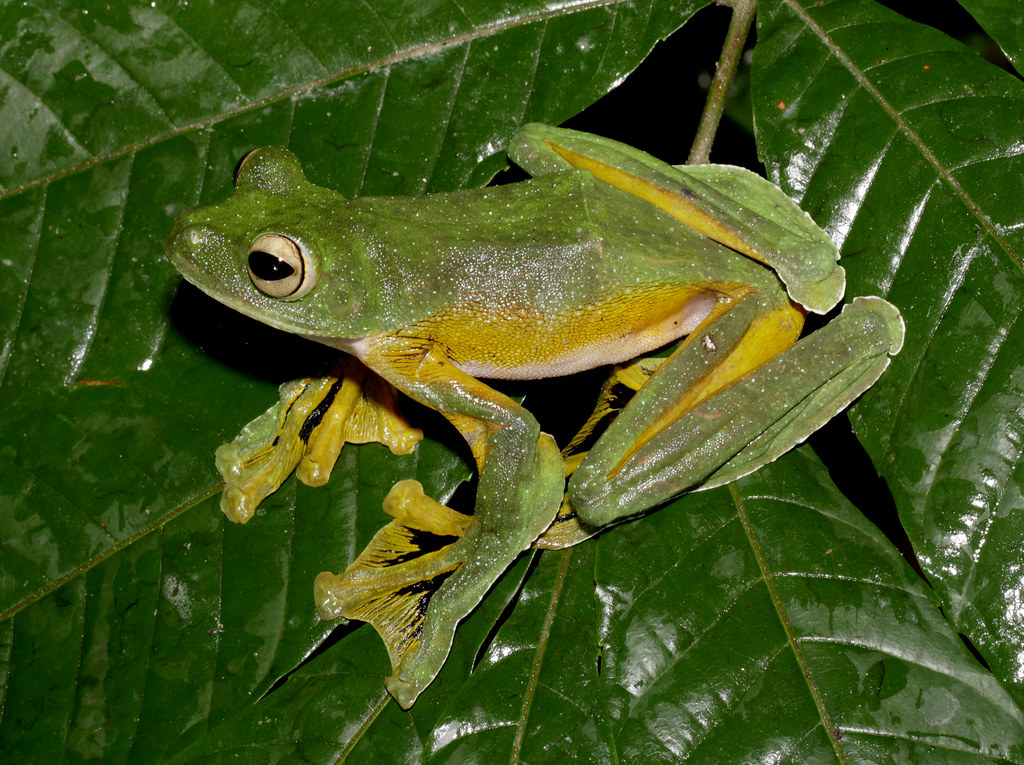
Now, let’s be clear: despite the name, Wallace’s flying frog doesn’t actually fly like a bird. What it does is glide, using its big black-webbed feet and stretchy skin flaps along its body that work like built-in parachutes.
Picture this: when threatened or simply wanting to switch trees, the frog leaps from a high branch, spreads out all four limbs, and sails smoothly through the air—sometimes covering up to 15 meters (that’s about 50 feet!).
It lands with the help of its soft, sticky toe pads, which act like little suction cups. Think of it as the Buzz Lightyear of the rainforest: falling, but with serious style.
A Frog With Flair
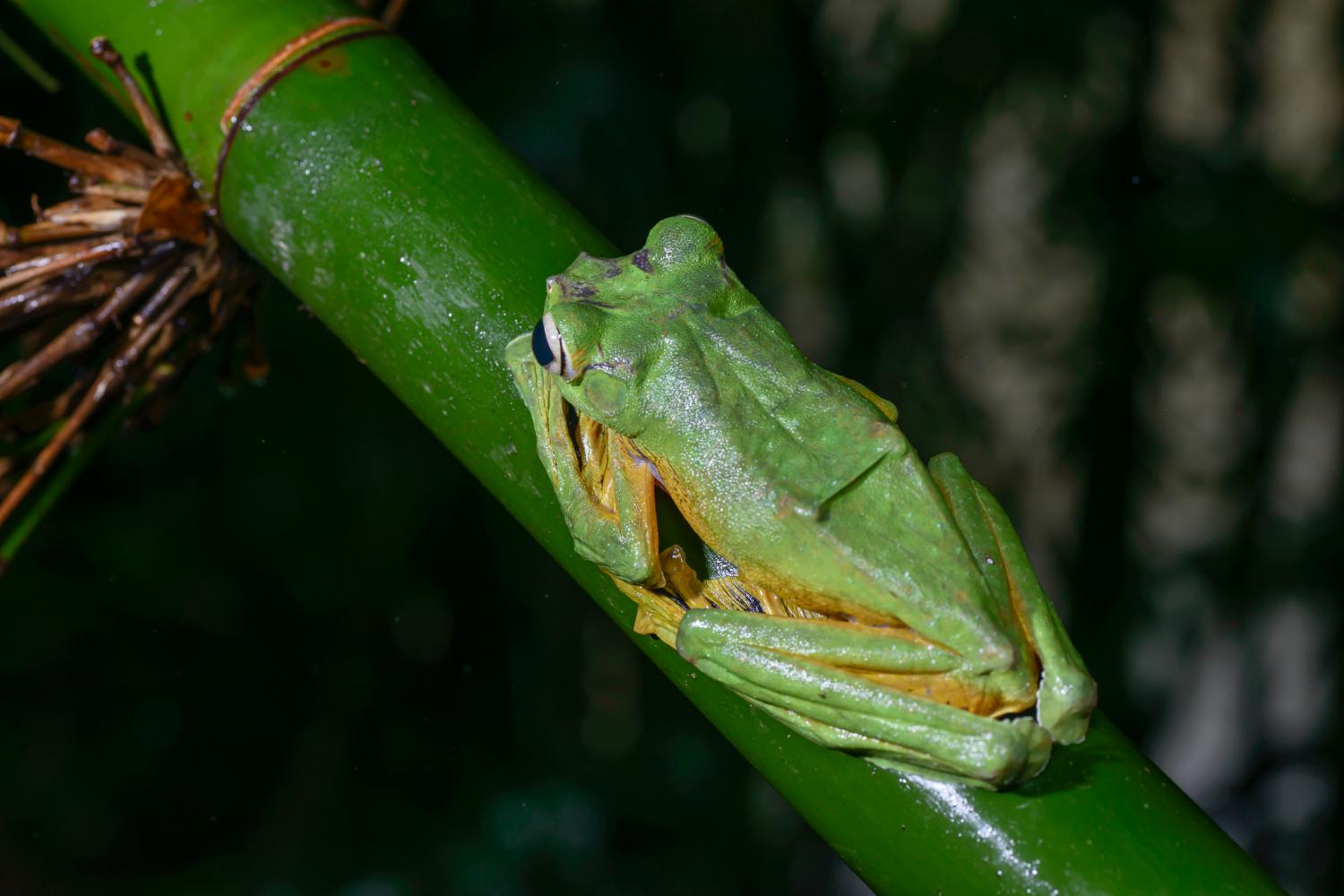
Wallace’s flying frog isn’t exactly small. It can grow 7–10 cm long, weigh about 30 grams, and live over 12 years. Its looks are just as impressive as its aerial stunts: a shimmering green back, bright yellow sides, a whitish-yellow belly, and bold black webbing on its toes that makes it stand out from other gliding frogs.
Its long legs give it incredible jumping power, while its big toe pads let it cling to tree trunks with ease. And those huge, horizontal eyes? They give it a gaze that’s equal parts sharp and mesmerizing.
Fun fact: females are usually bigger than males—because during mating, the female has to carry the male piggyback-style.
What’s on the Menu (and Who’s After Them)
Wallace’s flying frog may look like a rainforest acrobat, but at heart, it’s still a carnivore. Most of the time, it snacks on insects. Every now and then, though, it gets bolder—going after small vertebrates like other frogs, or even tiny birds.
But here’s the twist: for all its gliding tricks, this frog isn’t invincible. Up in the canopy, tree snakes and cat snakes are the real bosses. Agile climbers themselves, they can easily turn our little sky-frog into dinner.
Life, Froggy Style
When the rainy season rolls in, love is in the air—literally. Female Wallace’s frogs whip up a frothy nest out of a special secretion, beating it into foam with their powerful hind legs.
Inside this bubble bed, they lay hundreds of eggs, which the males then fertilize. These nests usually hang off leaves or branches right above water.
When the tadpoles hatch, the foam breaks apart, dropping them straight into the water below like tiny parachutists. There, they grow, swim, and eventually transform into young frogs.
In their early land-dwelling days, the juveniles sport speckled brown skin—perfect camouflage against the forest floor. But once they’re big enough, they climb back up into the trees, where they’ll spend the rest of their airborne lives.
Trouble in Paradise
On paper, Wallace’s flying frog isn’t in critical danger—it’s listed as “Least Concern.” But that label hides a worrying truth: their numbers are shrinking.
The main culprit? Deforestation, especially from palm oil plantations that are eating away at Southeast Asia’s rainforests. The lush lowland homes these frogs rely on are disappearing fast.
There’s also the pet trade, which adds a bit of extra pressure—though nothing compares to the damage done by habitat loss.
And here’s an unexpected twist: these frogs often lay eggs in mud pools once used by Asian rhinos. Fewer rhinos mean fewer wallows, and fewer wallows mean fewer places for the frogs to breed. In a strange way, their survival is tied to another species on the brink of extinction.
Living Proof of Evolution
This frog owes its name to Alfred Russel Wallace, the British naturalist who first described it in the 19th century. For him, seeing a frog glide through the air wasn’t just cool—it was scientific gold. It showed how animals adapt in surprising ways, fitting neatly into his ideas about natural selection.
Wallace’s flying frog isn’t quite a bird, and it isn’t just an ordinary frog either. It’s something beautifully in-between—a living reminder of evolution’s creativity.


