


If asked to draw the Sun, almost everyone would immediately grab a yellow crayon. Since childhood, we’ve been taught to think of the Sun as a big yellow ball in the sky. But science tells a different story: the Sun’s true color is actually white, not yellow.
The yellow we see every day is merely an illusion created by Earth’s atmosphere scattering light. In reality, from outer space, the Sun appears as a dazzling white.
Let’s explore why this happens, the role of the atmosphere, and even how Elon Musk once sparked a debate over whether the Sun might actually be… green.
Why Does the Sun Look Yellow on Earth?
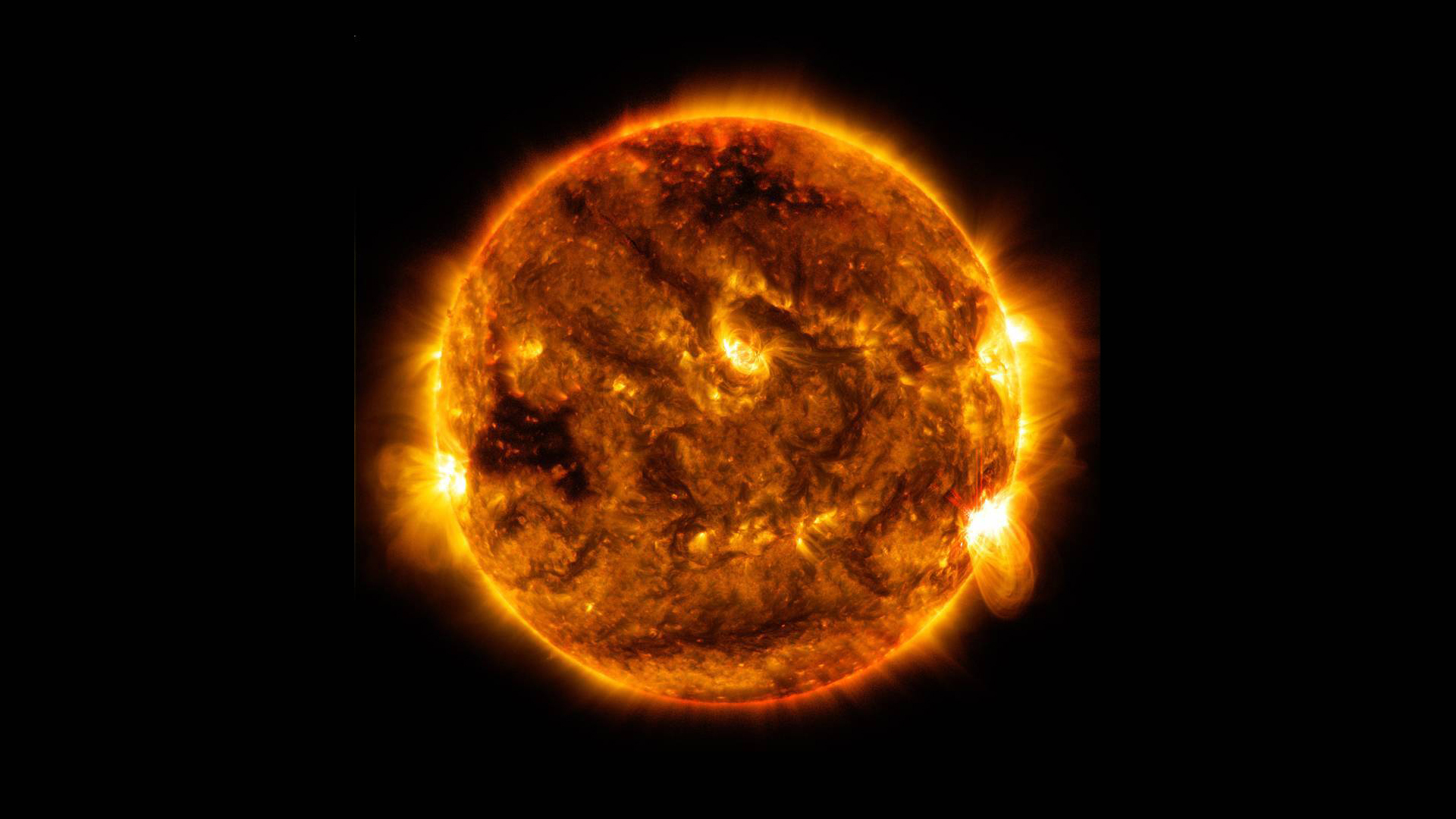
Sunlight is made up of many colors, much like a rainbow. When this light enters Earth’s atmosphere, shorter wavelengths—blue and violet—scatter more easily in all directions. This phenomenon is called Rayleigh scattering.
That’s also why the sky looks blue. But because some of the blue light gets scattered away, the direct sunlight reaching our eyes loses part of that spectrum. What remains is a mix of the other colors, making the Sun appear yellow.
So, it’s not the Sun that’s yellow—it’s the atmosphere that makes it look that way.
Why Does the Sun Turn Orange or Red at Sunset?

Take a look at the Sun when it rises or sets. Its color often shifts to golden orange or even fiery red.
This happens because the Sun is low on the horizon, and its light has to travel through a longer path in the atmosphere. The longer the path, the more blue light gets scattered, leaving only the longer wavelengths—red and orange—to pass through. The result: the dramatic sunsets that leave us in awe.
If the air is filled with dust or haze, the color deepens even more into a rich red.
The Sun’s True Color: White-Hot

The Sun’s surface temperature is about 5,800 Kelvin (around 5,500°C). At such extreme heat, an object emits all visible colors of light at once. When combined, these colors produce white.
Think of heating a piece of iron: it first glows red, then orange, yellow, and finally turns white when it becomes extremely hot.
That’s essentially what the Sun is like. Out in space, without Earth’s atmosphere interfering, the Sun shines as a brilliant, blinding white.
Is the Sun Really Green? (Elon Musk Joined the Chat)
Here’s where Elon Musk added some spice to the debate. In 2022, he tweeted that the question “what color is the Sun?” is basically a “trick question.” Musk explained that while the Sun looks white in space, from the perspective of its peak photon radiation, it could technically be considered green.
What does that mean? Scientifically, if we look at the Sun’s energy distribution or blackbody spectrum, its peak radiation falls around 500 nanometers—right in the blue-green range of visible light. In technical terms, this means the Sun emits its strongest intensity at a green wavelength.
However, the human eye doesn’t see just one wavelength in isolation. Since the Sun also emits plenty of other colors, the combined effect still appears white to us.
So, while the graph may say “green,” the Sun that we actually see remains dazzling white.
Other Planets Have Similar Effects
The atmosphere’s influence on color doesn’t just apply to the Sun—it also shapes how we see planets.
- Mars looks red because its surface is rich in iron oxide, and its thin atmosphere doesn’t alter that much.
- Venus appears pale yellow thanks to its dense, carbon dioxide–heavy atmosphere.
- Neptune and Uranus look blue because their methane-rich atmospheres absorb red light.
In other words, what we see from afar is often not the object’s “true” color, but rather the result of atmospheric interference.
Strange Colors in Solar Photos?
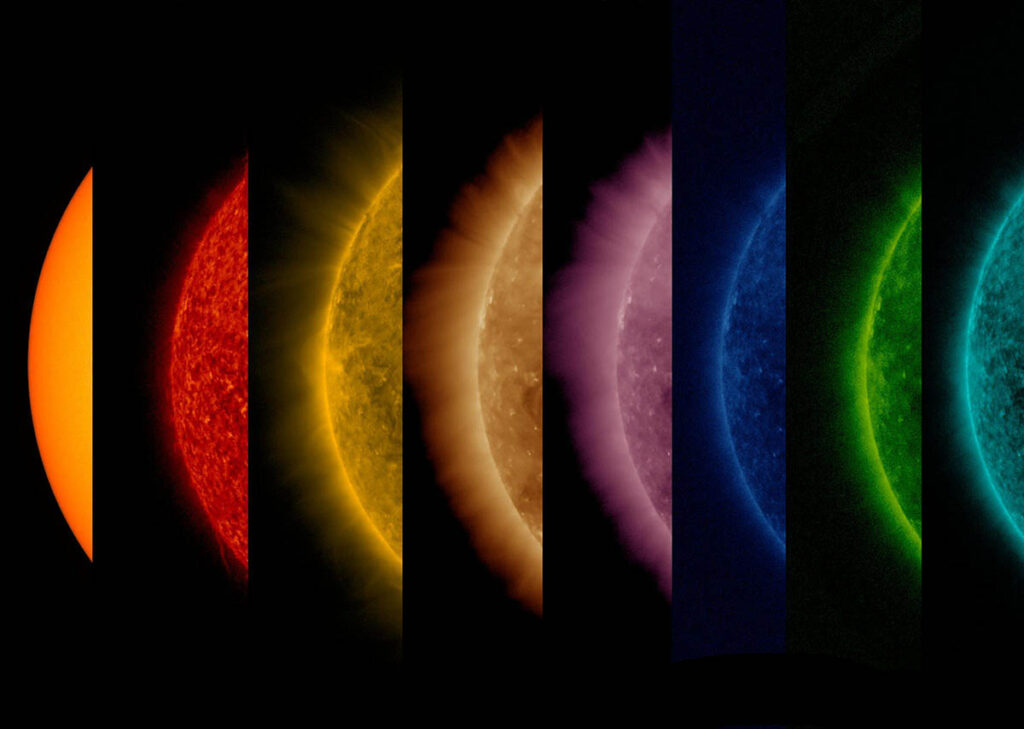
If you’ve ever seen photos of the Sun glowing purple, neon green, or electric blue, don’t be confused—that’s not its real color. NASA often captures the Sun with instruments that detect wavelengths outside human vision, such as ultraviolet or X-rays.
To make these images analyzable, scientists assign false colors to represent different wavelengths. That’s why NASA’s Sun photos sometimes look like psychedelic fireballs.
Conclusion: Earth’s Atmosphere Changes What We See
In short, if you could look at the Sun directly from space, you wouldn’t see the yellow orb from your elementary school textbooks. You’d see a massive, blindingly white star radiating light across the entire spectrum.