

Titanoboa, a name that sparks awe and fear in equal measure, was the largest snake ever to roam the Earth. Estimated to have measured up to 12.8 meters long, and possibly as long as 14.6 meters, this prehistoric giant left a lasting impression on both paleontology and our imagination.
For those curious about its size and the ancient environment that allowed such a creature to exist, let’s dive deeper into the world of Titanoboa, its paleoclimatic conditions, and its remarkable existence.
The Size and Discovery of Titanoboa
Titanoboa lived around 60 million years ago, during the Paleocene epoch, just after the dinosaur extinction. This snake, which has earned its place in the records as the largest snake in history, was not only long but also incredibly massive, with some estimates suggesting it could have weighed over 1,100 kilograms (1.1 metric tons).
In comparison, the anaconda, one of the largest snakes today, can grow up to 6.1 meters long and weigh 227 kilograms, making Titanoboa about five times the size of an anaconda.
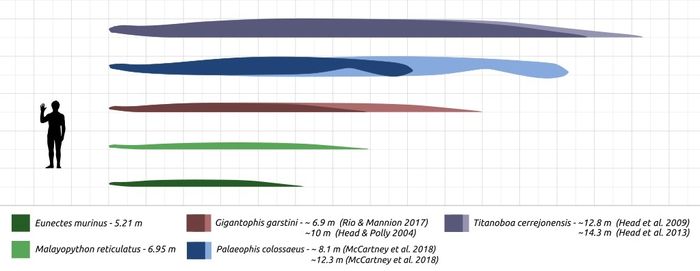
The first significant fossils of Titanoboa were discovered in Cerrejón, a coal mine in Colombia, South America. These findings provided enough evidence for paleontologists to reconstruct the size and shape of this ancient reptile. With this data, scientists were able to model Titanoboa in real-life scale, showing the jaw-dropping size of this ancient predator.
Why Was Titanoboa So Large?
One of the most intriguing aspects of Titanoboa’s size is its connection to the Paleocene climate. Reptiles, including snakes, are ectothermic (cold-blooded), meaning their body temperature is regulated by external sources of heat, primarily from their surroundings.
During the Paleocene, Earth’s climate was significantly warmer than today, providing ideal conditions for reptiles to grow to immense sizes.The warm temperatures of this era would have allowed Titanoboa to have an efficient metabolism, helping it to digest food quickly and grow larger.
Additionally, the extended active periods due to the constant warmth would have provided more opportunities to hunt, further contributing to its gigantic size.
Another fascinating feature is that Titanoboa was likely a terrestrial snake, unlike today’s semi-aquatic anaconda. While it may have lived near water sources like rivers and marshes, Titanoboa primarily hunted and slithered across land, utilizing its immense strength to capture prey and maintain dominance in its environment.
Titanoboa's Place in the Prehistoric World
Titanoboa is not the only giant snake to have roamed Earth, though. Before it, there was Gigantophis, which lived about 40 to 38 million years ago in what is now North Africa. Gigantophis, which reached lengths of around 10 meters, was an earlier relative of Titanoboa but not quite as massive.
What makes Titanoboa so remarkable, aside from its sheer size, is how it reflects the conditions of Earth right after the extinction of the dinosaurs.
The Paleocene climate played a key role in fostering the growth of massive reptiles, making it an exciting period for paleontologists to explore.
Titanoboa’s Impact on Paleontology and Popular Culture
While Titanoboa’s fossil records provide scientific insight into the paleoclimatic conditions of the Paleocene era, the snake’s cultural impact is equally significant. Its discovery has inspired documentaries, films, and various pop culture references that help bring the prehistoric world to life.
For example, the documentary "Smithsonian Titanoboa: Monster Snake" showcased the potential scale of Titanoboa and brought its staggering size to the screen, captivating audiences with its prehistoric majesty.
Despite being long extinct, Titanoboa continues to fascinate and inspire scientific curiosity, encouraging people to learn more about Earth’s ancient past.
Its discovery and the subsequent reconstructions of its body size allow us to better understand not only the animals that existed in the Paleocene but also how climate and environmental factors influenced evolution.
Titanoboa’s Legacy
The Titanoboa represents an era when Earth was far warmer than it is today, a time when giant creatures roamed the planet. Its discovery not only provides us with a glimpse into Earth’s prehistoric ecosystems but also underscores the importance of understanding the relationship between climate and evolution.
By studying these ancient creatures, we can better understand the forces that shaped life on Earth and how climate change can influence the evolution of species.
Though Titanoboa has long since disappeared, its story continues to captivate the world, both scientifically and culturally, reminding us of the vast diversity and magnitude of life that once existed.