


When you hear the word surgery, what comes to mind? Probably a bright, sterile operating room, gleaming instruments, and a full team of doctors in scrubs.
But here’s a twist: thousands of years before hospitals, anesthesia, or modern medical technology existed, prehistoric humans in the jungles of Borneo were already performing complex amputations and their patients survived.
This groundbreaking discovery comes from Liang Tebo, a cave deep in East Kalimantan, best known for its ancient rock paintings.

The cave has three main chambers: stunning artwork decorates the upper walls, while the lower section is where archaeologists dig into the past. It was there that researchers unearthed a story that would rewrite what we thought we knew about prehistoric medicine.
The Skeleton with a Missing Leg
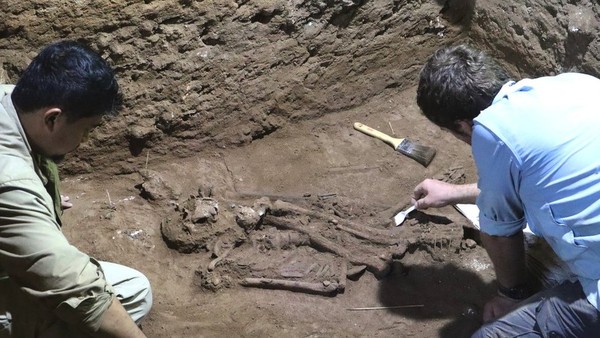
An Indonesian-Australian team, including experts from BRIN, ITB, Griffith University, and the University of Western Australia, uncovered a partial human skeleton. Most of the bones were intact, but the left foot and lower leg were gone. At first, the scene seemed tragic: perhaps the person was attacked by a wild animal or suffered a fatal accident.

But the bones told a very different story. Paleopathologist Melandri Vlok from the University of Sydney noticed signs of new bone growth around the missing area. This meant the injury had healed, the person didn’t just survive, they recovered.
Surgery, Not Tragedy
Further analysis confirmed the astonishing truth: this was no accident. The limb had been intentionally removed in a controlled procedure, the world’s earliest known surgical amputation.
Even more remarkable, the patient didn’t die from the operation. In fact, they lived for at least six to nine more years. The ends of the leg bones had fully healed, and their smaller size suggested the procedure happened during childhood, before the leg could finish growing.
In other words, thousands of years ago, deep in the rainforest, someone had both the skill and the knowledge to save a child’s life through surgery, long before anyone even dreamed of a hospital.
Prehistoric Surgery That Defies Imagination
Just imagining what surgery must have been like in the Stone Age is enough to give you goosebumps. No anesthesia. No sterile tools. No formal knowledge of anatomy.
And yet, thousands of years ago, someone in Borneo managed to perform an amputation so precise that the patient survived.
The bones themselves tell the story: the cut was clean, and the vital tissues—blood vessels, veins, and nerves—were carefully managed.
Without that level of precision, the patient would have died from blood loss or infection. Instead, the wound healed perfectly. Scar tissue formed, bone closed, and the individual went on living, though likely with limited mobility.
This discovery suggests that prehistoric hunter-gatherers in Kalimantan had a surprisingly advanced understanding of the human body, far beyond what scientists once believed possible for that era.
Signs of Compassion
The find also sheds light on something equally profound: the social lives of these early people. As paleopathologist Melandri Vlok points out, the amputee would not have been able to move as freely as the rest of the group. And yet, they lived for years after the operation.
That means their community must have cared for them, providing food, protection, and support despite their limited mobility. It’s a rare and moving glimpse into empathy and social bonds among prehistoric humans, who are often thought of as living in a harsh, survival-of-the-fittest world.
The World’s Oldest Amputation
Before this discovery, the earliest evidence of surgical amputation came from a 7,000-year-old skeleton of a Stone Age farmer in France who survived the removal of an arm. There is also evidence of trepanation, prehistoric skull drilling, in parts of Eurasia and the Americas.
But this Borneo skeleton is much older: about 31,000 years old. That makes it the oldest known evidence of a successful surgical procedure in the world.
Archaeologist Tim Maloney calls this a major breakthrough. For years, researchers assumed that medical skills like amputation only appeared tens of thousands of years later, after humans began farming and living in permanent villages about 10,000 years ago. The Liang Tebo discovery completely rewrites that timeline, showing that hunter-gatherers in Borneo were capable of complex surgery far earlier than anyone expected.
The full findings have been published in the journal Nature.


