In recent years, Indonesia has experienced a remarkable resurgence in reading habits, especially among the younger generation such as Gen Z. This renewed interest in books is driven by the rise of digital platforms, online book clubs, reading events, and a growing appetite for diverse genres, including history and human rights.
According to CEOWORLD Magazine’s 2024 report, Indonesians spend an average of 129 hours per year reading books, equivalent to roughly 20 minutes per day. While this figure is still lower than in some neighboring countries, such as Singapore which leads with 155 hours annually, it still reflects a steady rise in reading activity.
Meanwhile, the 2024 Indonesian Library Research Publication revealed that the Reading Interest Index increased from 66.70 to 72.44 compared to the previous year, as reported by Sindonews. This upward trend suggests that young readers, supported by digital platforms and community initiatives, are becoming more engaged with books than before. Alongside the changing traditional reading culture, this new trend signals a healthy shift towards a more literate and intellectually active society.
Digital Platforms Reviving Reading Culture
Digital media plays a crucial role in reshaping how young people engage with books. A 2025 survey conducted by Goodstats found that 62.5% of respondents reported discovering new books through social media.
One example of this can be seen in Indonesia, where BookTok accounts often share book recommendations with creative visuals and relatable storytelling, making reading more engaging and more accessible.
BookTok, a TikTok community focused on books, grew rapidly during the COVID-19 lockdowns in 2020–2021 and has since had a significant influence on Gen Z’s reading habits worldwide, including in Indonesia.
BookTok, along with Bookstagram on Instagram, has transformed reading into a social and aesthetic experience. Reading is no longer a solitary and quiet activity, but has become expressive, shareable, and fun, thanks to short videos paired with popular music and viral visual styles.
According to The Guardian, a 2022 survey from the UK by the Publishers Association found that nearly 59% of young people aged 16–25 said BookTok helped them rediscover their passion for reading, and 55% use the platform for book recommendations. Although the survey was conducted in the UK, it highlights the global influence of TikTok on young readers and the trend is increasingly visible in Indonesia as well.
Community Reading Initiatives
In various major cities across Indonesia, shared reading movements are growing. In Jakarta, the capital city of Indonesia, the Baca Bareng Silent Book Club Jakarta, part of the global Silent Book Club movement, regularly hosts reading sessions in parks and other public spaces. These events often collaborate with cultural organizations, creating a reading culture that is both inclusive and visually appealing.
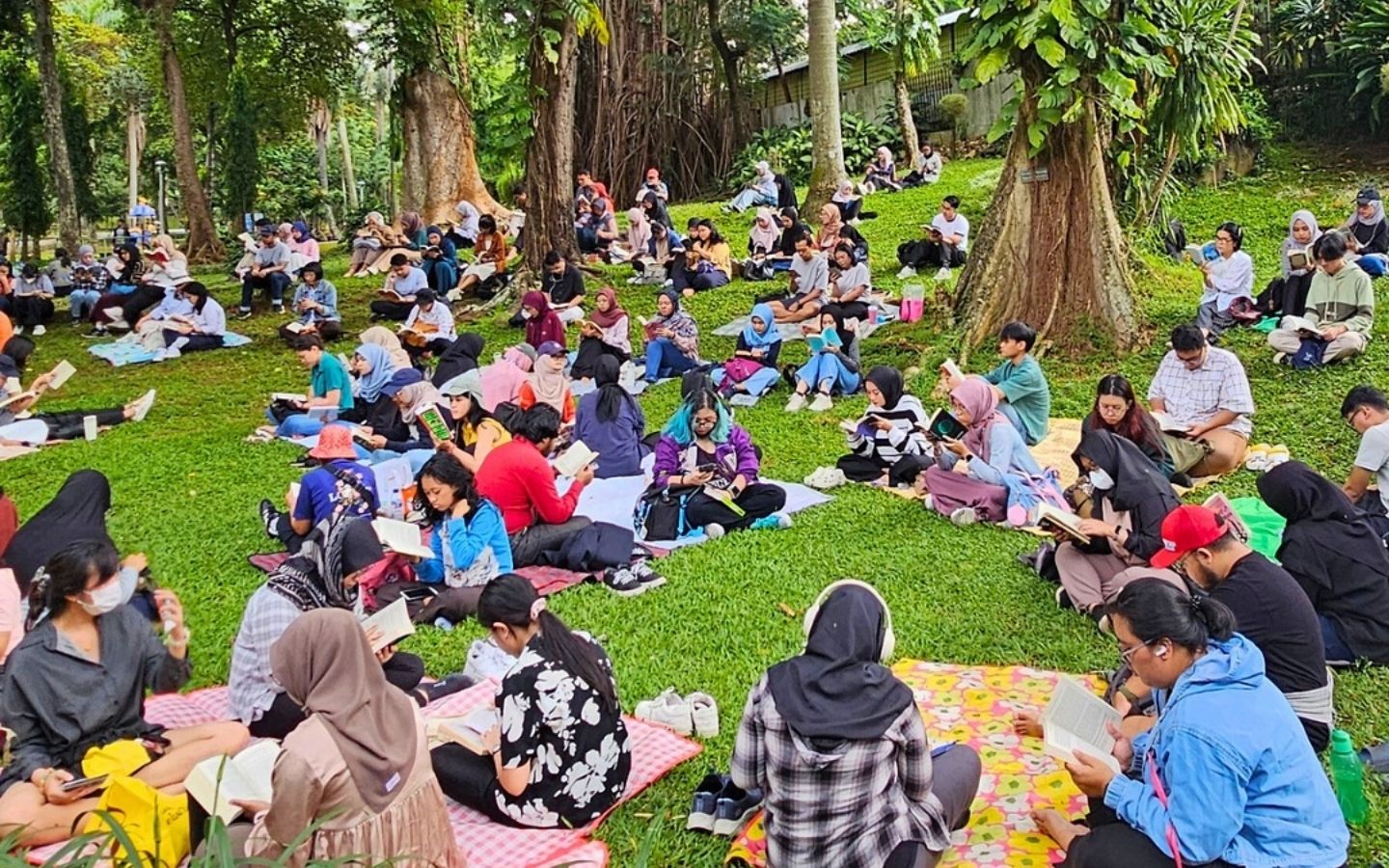
The widespread sharing of information about silent reading clubs on social media has also encouraged similar activities in other cities. For example, in Yogyakarta, a city in Indonesia widely known as the “City of Education”, various reading events are held regularly in public parks and book cafes almost every week.
Meanwhile, some BookTok influencers have extended their influence beyond the digital world by organizing in-person meet-ups, book swaps, and reading parties. These activities turn online enthusiasm into real-world connections, with Gen Z at the heart of this cultural shift.
Gen Z’s Growing Interest in History and Human Rights
There are signs that young readers are increasingly drawn to works on history and human rights. Social media has amplified this shift, drawing more Gen Z to works that explore themes of memory, justice, and identity.
A notable example is Laut Bercerita (The Sea Speaks by Its Name) by Leila S. Chudori. This historical novel, which reflects on Indonesia’s authoritarian past, has gained remarkable popularity among Gen Z readers, with its 100th reprint in 2025 highlighting this growing demand.
Other works such as Chudori’s Pulang (Home) and Pramoedya Ananta Toer’s classic Buru Quartet have also found renewed readership among younger audiences.
Shared widely on BookTok and Bookstagram communities, these novels show how fiction goes beyond entertainment to become a medium for learning, reflection, and even subtle forms of intellectual resistance.
Challenges in Building a Reading Culture
Although many young readers are now more engaged, access to books remains uneven across Indonesia. According to Indonesia’s 2023 Education Statistics (Data Pokok Pendidikan), only about 199,000 out of 443,000 schools have a library, and many of these lack qualified librarians.
Additionally, digital distractions compete for readers’ attention, which may limit the time young people spend on deep, focused reading. Separately, data also point to challenges in comprehension.
Tempo.co reports that while 75 percent of Indonesian 15-year-olds are able to read, many struggle to understand what they read. Their performance falls below Level 2 of the Programme for International Student Assessment (PISA), indicating difficulty in identifying the main ideas in longer texts.
Despite these challenges, the enthusiasm for reading among Indonesia’s youth continues to grow. With the right support, this momentum could nurture a stronger, more inclusive reading culture for the future.
This article was created by Seasians in accordance with the writing rules on Seasia. The content of this article is entirely the responsibility of the author.