For most flowers, people come close to admire their beauty or enjoy their fragrance. But with Titan Arum (Amorphophallus titanum) or the corpse flower, the exact opposite happens.
When this gigantic plant finally blooms, sometimes after years or even a decade of waiting, it unleashes a stench often compared to rotting meat or garbage.
Strangely, instead of driving people away, the smell of Titan Arum attracts massive crowds. From Sumatra’s jungles to the world’s great botanical gardens, thousands line up for hours just to experience one of nature’s rarest and most shocking spectacles.
So, what makes the corpse flower so special and unique? This article will reveal why people are willing to wait years just to smell it, and why it has earned the title of the smelliest flower in the world.
The Corpse Flower’s Rare Phenomenon
One reason people are willing to wait in line to see this corpse flower is its incredibly short blooming period. It can take anywhere from four to ten years for a single Titan Arum to flower, and when it does, the spectacle lasts only one or two days before the bloom collapses. That’s why many feel they have to see it when it blooms, or miss the chance forever.
Amorphophallus titanum belongs to the Araceae family and is famous for producing one of the largest and smelliest blooms in the plant kingdom. This species is endemic to the rainforests of Sumatra, Indonesia, although it is now cultivated in botanical gardens across the world.
In the wild, Titan Arum thrives in the lowland tropical rainforests of Sumatra, particularly on steep limestone hillsides between 120 and 365 meters above sea level. It prefers humid soils and partially open areas, where clusters of plants can be found at various stages of growth, from young shoots to the towering inflorescence that makes headlines worldwide.
The Smelliest Flower on Earth
During its brief flowering, the corpse flower releases a powerful stench that can be detected from as far as 800 meters away. This foul odor serves an essential purpose: it sends out a chemical “message” to carrion beetles and flesh flies, the natural pollinators of the Titan Arum.
The smell attracts these insects because they think it’s rotting meat, but instead they end up carrying pollen between flowers so the plant can reproduce. Even though it looks strange and attracts many flies, the Titan Arum is not a carnivorous plant.
Scientists at the Royal Botanic Gardens, Kew, have studied the source of this odor and found that it comes mainly from sulfur compounds, the same type of chemicals that make rotten food smell bad.
For humans, the smell is unforgettable in a very different way. Experts at the Huntington Library in California describe it as “a combination of limburger cheese, garlic, rotting fish, and smelly feet.”
Inside the Life of the World’s Largest Flower
The Titan Arum is not really a flower; technically it’s the largest unbranched inflorescence in the world, which can grow up to three meters tall, about ten feet. Its enormous size makes it one of the largest floral structures known to science.
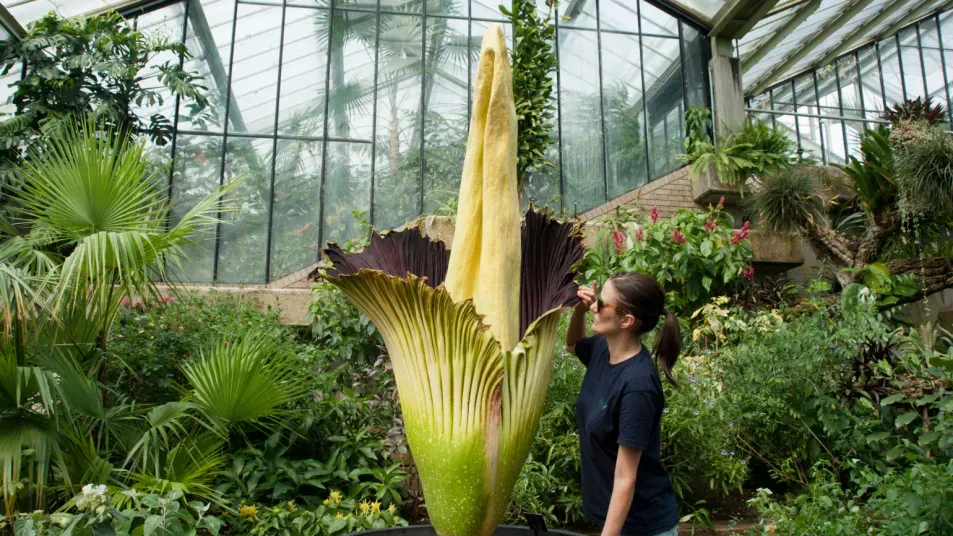
Almost every part of Amorphophallus titanum is oversized. Its flower stalk rises high, its single leaf can spread like a small tree, and its underground corm can swell to more than one hundred pounds in weight. From this giant corm the spadix, or flowering spike, emerges and creates the spectacular bloom.
The life cycle of the Titan Arum is equally remarkable. The plant alternates between two main phases, a vegetative phase and a generative or flowering phase.
In the vegetative stage, it produces only one massive leaf that resembles a small tree and can survive for up to a year before withering. During this time, the corm stores large amounts of energy underground. After several years of building up reserves, the Titan Arum finally enters the generative phase, when it produces the colossal inflorescence that never fails to capture global attention.
Discovery of Titan Arum and Its Global Fame
Amorphophallus titanum was first described scientifically in 1878 by the Italian botanist Odoardo Beccari. He discovered the plant on August 6, 1878, in the rainforests of the hills above Pariaman, West Sumatra, and brought back a dried inflorescence, a corm, and seeds to Europe.
The Titan Arum first bloomed outside its native habitat after being cultivated at the Royal Botanic Gardens, Kew, in 1889. Since then, it has attracted global curiosity, with people fascinated by its strange appearance. As a result, the plant has been cultivated in many botanical gardens around the world.
Interestingly, after that first bloom in 1889, flowering events remained extremely rare for the next one hundred years. Until 1989, only 21 recorded flowerings of the Titan Arum had occurred in botanical gardens worldwide.
Is the Corpse Flower Endangered?
Despite its fame, Amorphophallus titanum is listed as an endangered plant. According to the IUCN Red List assessment in 2018, fewer than one thousand mature individuals are estimated to remain in the wild.
The Titan Arum depends on very specific climate and soil conditions, which makes it vulnerable to environmental changes. Climate change, with rising temperatures and shifting rainfall patterns, further affects its growth and reproduction.
In its native habitat in Sumatra, the plant is also threatened by deforestation and land conversion. Large areas of rainforest have been cleared for logging and palm oil plantations.
Overharvesting adds to the problem. Because of its size and uniqueness, some plants are taken from the wild for trade or private collections, reducing natural populations even further.
The Titan Arum is more than a flower. It is a story of survival, rooted deep in the forests of Sumatra. If these forests fall, so too will this giant. To protect it is to honor the richness of life on our planet, and to ensure that this rare wonder continues to bloom, even if only once in a decade.
This article was created by Seasians in accordance with the writing rules on Seasia. The content of this article is entirely the responsibility of the author.