

Imagine ancient humans standing by the shores of Sulawesi over a million years ago, gazing at the vast ocean before them. They were not merely toolmakers or gatherers; they were early voyagers daring to cross uncharted waters in search of survival.
Today, a groundbreaking discovery on the island reveals more about this extraordinary chapter of human history.
A team of researchers from Griffith University and Indonesia’s National Research and Innovation Agency (BRIN) has uncovered stone tools dating back around 1.04 million years at the Calio site in Wallacea, Indonesia.
This finding suggests that early hominins ventured across open seas much earlier than scientists previously believed, long before Homo sapiens even emerged in Africa.
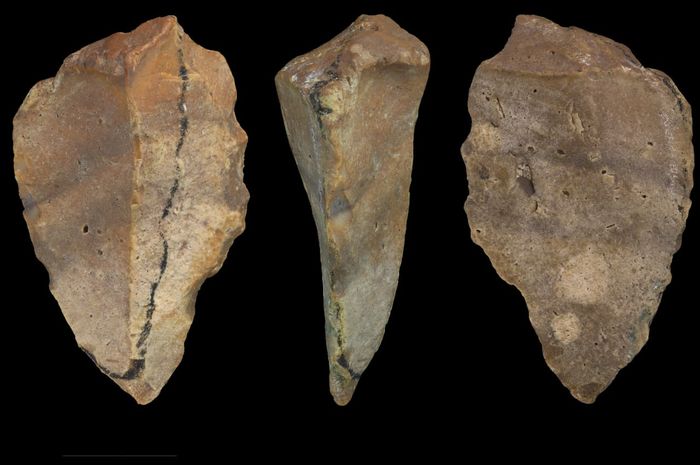
Credit: RATNO SARDI/BRIN
A Discovery That Rewrites the Timeline
The artifacts from Calio consist of small, sharp-edged stone fragments shaped through intentional flaking. These tools were likely made from river pebbles collected nearby, indicating that early humans already understood how to select and craft the right materials.
The team applied paleomagnetic dating on the sandstone layer, along with direct dating of a fossilized pig bone found at the site. The results revealed an age of at least 1.04 million years, making Calio one of the oldest archaeological sites in Southeast Asia.
According to Professor Adam Brumm of Griffith University, this discovery aligns with earlier evidence of ancient habitation in Wallacea, such as at Wolo Sege in Flores (1.02 million years old) and Talepu in Sulawesi (around 194,000 years old).
Together, these findings strengthen the view that Wallacea has long been a hub of early human activity.
Wallacea: Nature’s Evolutionary Laboratory
Named after 19th-century naturalist Alfred Russel Wallace, the Wallacea region lies between Asia and Australia, a transitional zone of islands including Sulawesi, Flores, and Timor. It’s where species from both continents met, adapted, and evolved.
For scientists, Wallacea is not just a group of islands, it’s a natural laboratory of evolution.
Here, isolated ecosystems gave rise to the phenomenon of “island dwarfism,” where limited resources led species, including early humans, to evolve smaller body sizes.
The discovery of Homo floresiensis, the so-called “hobbit” from Flores—proved that this phenomenon also occurred in humans.
The Sulawesi stone tools now add another layer of mystery: were they made by Homo erectus, or perhaps by an entirely unknown species of ancient humans? Either way, the evidence of seafaring suggests remarkable intelligence and adaptability for their time.
Challenging the Old Story of Human Origins
For decades, the “Out of Africa” theory dominated our understanding of human evolution. It proposed that all humans originated from Africa before dispersing worldwide. Yet, discoveries across Wallacea now challenge that view, indicating that Southeast Asia also played a vital role in the story of humanity.
These million-year-old stone tools from Sulawesi reveal that ancient civilizations in this region were not passive recipients of migration from Africa.
Instead, they might have been active pioneers in early human dispersal. In other words, the Indonesian archipelago was not just a crossroads, it was a cradle of human innovation.
Digging Our Past, Discovering Our Identity
For Indonesia, this discovery represents more than just a scientific breakthrough. It is a story of national pride. The involvement of Dr. Budianto Hakim from BRIN highlights how Indonesian scientists are leading world-class research on their own soil.
Each excavation in Sulawesi or Flores doesn’t just unearth fossils, it reconnects us with a deeper sense of identity as part of the human journey.
The discovery of these ancient tools reminds us that the spirit of exploration has always been part of our DNA. Over a million years ago, our ancestors dared to cross the sea. Today, it’s our turn to cross new frontiers in knowledge.
Wallacea is more than a relic of the past, it’s the key to understanding the human story of Southeast Asia.



