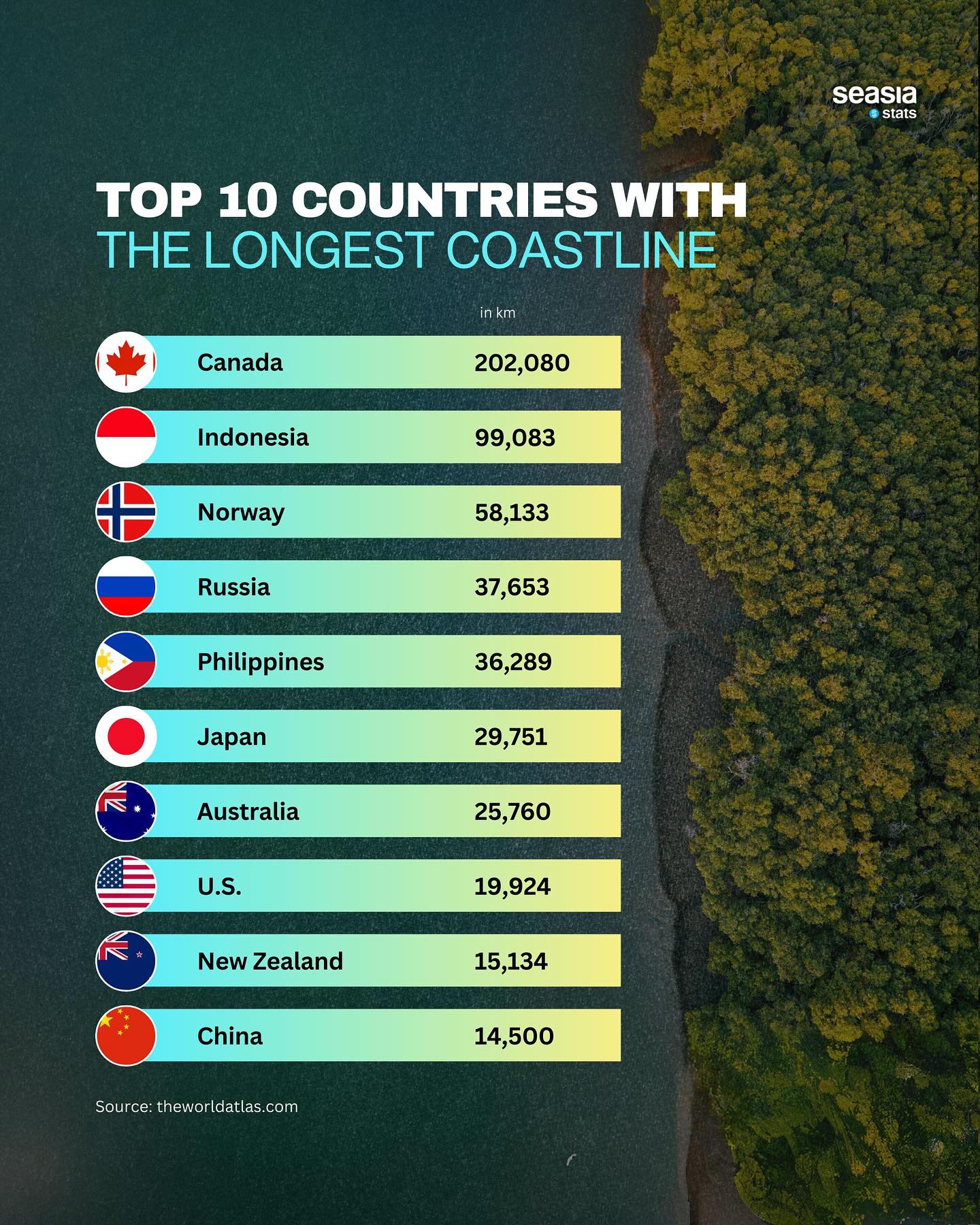
When it comes to coastlines, Southeast Asia is home to two of the world’s most ocean-connected nations. According to The World Atlas, Indonesia and the Philippines rank among the top five countries with the longest shorelines, highlighting not just their geography but also their deep maritime heritage.
These coastlines are more than numbers on a map. They are lifelines for millions, shaping local economies, ecosystems, and cultural identities across generations.
Indonesia: The Maritime Giant of Asia
Stretching across 99,083 kilometers of coastline, Indonesia holds the second-longest shoreline in the world, after Canada. As the world’s largest archipelago, the country’s geography spans over 17,000 islands, creating a vast network of beaches, mangrove forests, coral reefs, and fishing villages.
From the mangrove swamps of Kalimantan and Papua to the vibrant beaches of Bali, Lombok, and the Maluku Islands, Indonesia’s coasts are incredibly diverse. These regions sustain millions of people through fishing, aquaculture, and tourism, while also playing a vital role in global biodiversity.
Coastal areas such as Bali, Makassar, and Surabaya thrive as maritime and cultural hubs. The sea has long been part of Indonesia’s identity, from the ancient kingdoms that traded across the Indian Ocean to modern-day shipping routes that connect Asia to the world.
The archipelago’s vast shoreline also positions it as a key guardian of marine ecosystems, home to one of the richest coral and fish populations on Earth.
The Philippines: An Archipelago of Endless Shores
Ranking fifth in the world, the Philippines boasts a coastline of 36,289 kilometers, wrapping around more than 7,600 islands scattered across the western Pacific Ocean. Its shores are marked by countless inlets, gulfs, and bays that make the country’s coastline one of the most intricate on the planet.
Nearly 60% of the Filipino population lives along coastal areas, and the sea provides both livelihood and identity. Coastal fishing contributes up to 60% of the nation’s total fish catch, sustaining families across generations.
The Philippines’ coastal regions, from Cebu to Palawan, are also tourism magnets, drawing millions of visitors each year with their crystal-clear waters and white-sand beaches.
The country’s close relationship with the ocean is not just economic but deeply cultural. From traditional boats known as balangay to community festivals celebrating the sea, the Philippines’ maritime life reflects a heritage shaped by centuries of coexistence with the waves.
Guardians of Southeast Asia’s Blue Frontier
Together, Indonesia and the Philippines define Southeast Asia’s maritime strength. Their combined coastlines make up a significant portion of the region’s total shoreline, linking tropical biodiversity with human livelihoods. These two nations are also at the forefront of global discussions on marine conservation, sustainable fisheries, and climate adaptation.
Both face similar challenges, from rising sea levels and coral reef degradation to coastal urbanization. Yet they also hold immense potential to lead the way in blue economy initiatives, eco-tourism, and marine sustainability.
As nations built upon the sea, their future depends on how they protect and manage these waters for the generations to come.
In the end, Southeast Asia’s story is one written on the waves. From Indonesia’s sprawling islands to the Philippines’ intricate shores, the ocean remains both a symbol of connection and a reminder of responsibility, a shared blue heritage that continues to define the region’s identity.