


FIFA has officially introduced a new tournament called the FIFA ASEAN Cup, a regional competition among Southeast Asian nations involving all 11 ASEAN member states. The announcement was made directly by FIFA President Gianni Infantino during the 47th ASEAN Summit in Kuala Lumpur, Malaysia (October 26).
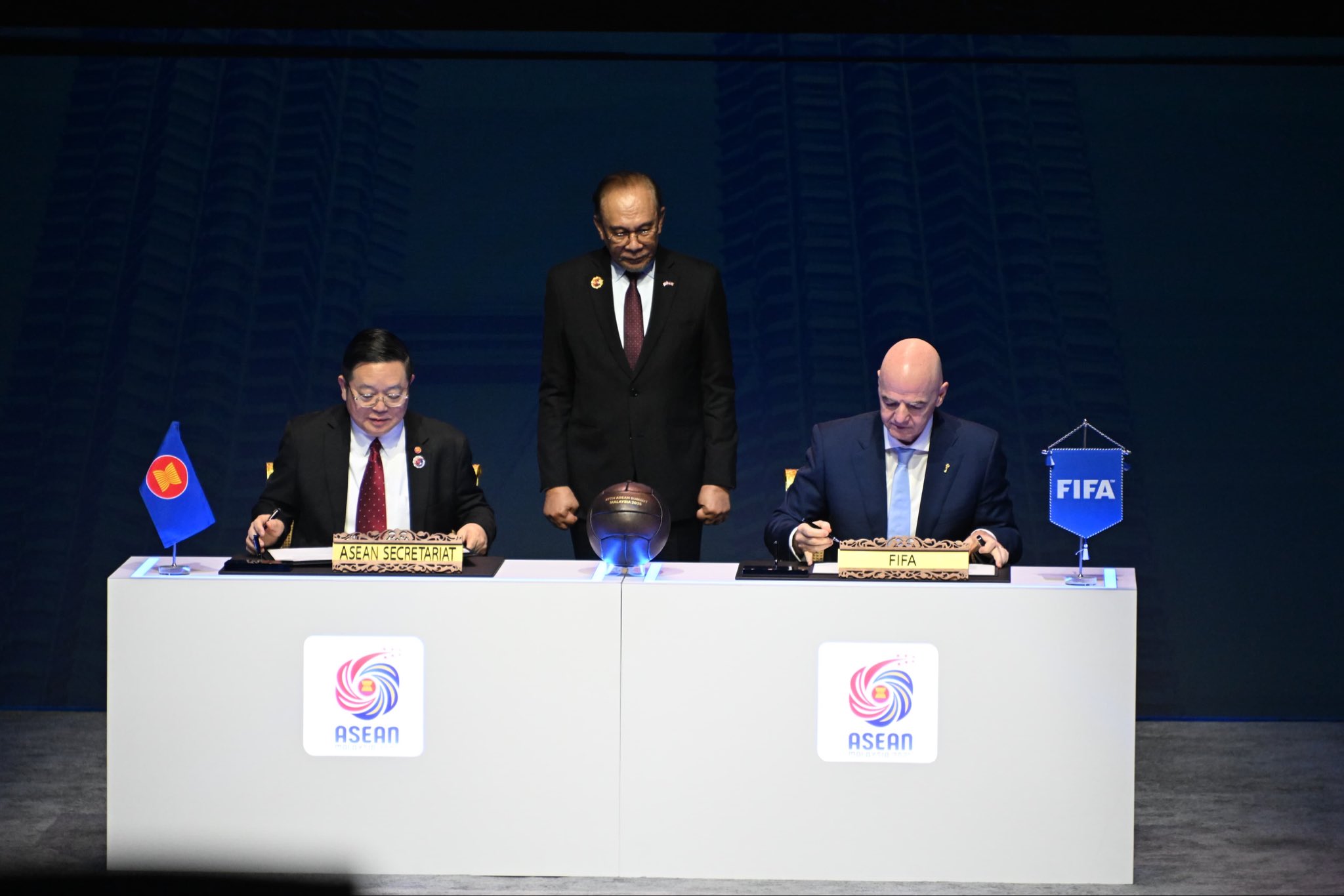
Infantino signed a Memorandum of Understanding (MoU) with ASEAN Secretary-General Dr. Kao Kim Hourn, witnessed by Malaysian Prime Minister Dato’ Seri Anwar Ibrahim. Through this agreement, FIFA and ASEAN pledged to use football as a platform to strengthen regional cooperation and promote social development across Southeast Asia.
“Through the FIFA ASEAN Cup, we are uniting countries together, and this competition will be a huge success as it will help boost national team football in the ASEAN region and support the development of our sport across all of Southeast Asia,” Infantino stated in his Instagram post.
Uniting 11 Nations Through Football
The FIFA ASEAN Cup is expected to mark a new momentum for collaboration among ASEAN nations. The tournament will feature Indonesia, Malaysia, Thailand, Singapore, Vietnam, the Philippines, Myanmar, Laos, Cambodia, Brunei Darussalam, and Timor-Leste.
Infantino emphasized that the number 11, representing the participating nations, is not a coincidence but a symbol of unity in football.
“The number 11 is a symbolic one in the footballing world as each team has 11 players,” he stated.
According to him, ASEAN is now "complete" as a major player on the world stage.
Southeast Asia is widely known for its massive football fan base, with more than 700 million active supporters. This immense potential makes the region increasingly attractive for FIFA, not only to expand its influence but also to support the development of a sustainable football ecosystem throughout Southeast Asia.
A New Milestone After the AFF Cup
For nearly three decades, Southeast Asia has had the AFF Cup (ASEAN Football Federation Cup), a biennial tournament first held in 1996 and later renamed the ASEAN Championship.
However, unlike the AFF Cup, the FIFA ASEAN Cup operates directly under FIFA’s authority, granting it an international legitimacy that the AFF Cup never officially possessed.
This official status under FIFA could bring major changes. One of the most significant is the potential involvement of diaspora players and the recognition of the tournament within the official FIFA match calendar, which would allow participating nations to call up their best players from around the world.
This directly addresses a long-standing limitation of the AFF Cup, which often saw the absence of overseas-based players since it was not part of the official FIFA calendar.
That said, it remains unclear whether the FIFA ASEAN Cup will replace the AFF Cup or exist as a separate tournament running alongside it. FIFA stated that the tournament’s format and official schedule will be announced later, following coordination with the Asian Football Confederation (AFC), the ASEAN Football Federation (AFF), and all FIFA member associations in the region.
Tournament Format: Following the FIFA Arab Cup
According to FIFA’s official statement, the FIFA ASEAN Cup will adopt the format of the FIFA Arab Cup, which was first held under FIFA’s supervision in 2021 in Qatar. In this system, participating teams are divided based on their FIFA rankings, some qualify directly for the group stage, while others must compete in a preliminary qualification round.
The tournament will then proceed with a group stage in a round-robin format, where the top two teams from each group advance to the knockout phase leading up to the final.
If this model is applied in the ASEAN context, the competition will likely feature 11 main participants with a light qualification round preceding the group stage.
Similar to the Arab Cup, the event could be held every four years and serve as an official regional stage under FIFA, providing ASEAN nations with both a competitive platform and a strategic opportunity to enhance their international standing in world football.