


A soft morning mist rolled over the rice terraces of Ubud as writers, readers, thinkers, and dreamers gathered once more for the Ubud Writers & Readers Festival (UWRF)— Southeast Asia’s most beloved celebration of literature and ideas. The 22nd edition of the festival opened today beneath the luminous theme “Aham Brahmasmi – I Am the Universe,” a Sanskrit phrase reminding humanity of its deep, cosmic interconnectedness.
Festival founder and director Janet DeNeefe welcomed guests at Indus Restaurant, the festival’s iconic hilltop venue overlooking the lush Campuhan Valley. With a Balinese blessing ceremony, traditional music, and an audience of hundreds, DeNeefe reflected on the theme’s resonance in an age of technological transformation and environmental crisis.
“This theme reminds us that our intelligence, imagination, and creativity are reflections of something infinite,” DeNeefe said. “If we are the universe, then our stories — and our responsibilities — are universal too.”
A Theme That Binds Worlds
The 2025 theme, Aham Brahmasmi, invites reflection on unity between self and cosmos, human and environment, creator and creation. The festival’s program for opening day embodied this philosophy — each session weaving together questions of identity, power, history, and imagination, mirroring the very fabric of the universe itself.
Morning: Opening Keynote and the Power of Revolution
After DeNeefe’s welcome, the festival’s keynote was delivered by David Van Reybrouck, the acclaimed Belgian historian and author of Indonesia and the Birth of the Modern World. His talk, “I Am the Universe,” explored how postcolonial nations like Indonesia shaped not just their own destinies but the consciousness of the modern world.
Van Reybrouck argued that independence movements, often dismissed as local, were in fact “cosmic acts — assertions of universal belonging.” His reflections echoed the festival’s mission to place Indonesian and Southeast Asian narratives at the center of global conversations.
Meanwhile, as the sun rose higher over Ubud’s palm groves, the Valley Stage hosted “Reflections on Writing a Family Memoir,” featuring Indonesia’s own Dee Lestari alongside Lech Blaine, Ingrid Rojas Contreras, and Kirsti Melville. The discussion delved into the personal as political — how memory, lineage, and loss intertwine in storytelling. “Every family story,” Dee Lestari said, “is a small universe of emotion and history.”
Mid-Morning: History, Identity, and the Cosmic Self
At 10:00 a.m., historian William Dalrymple took the Alang-Alang Stage for “The Anarchy,” captivating the audience with his signature blend of wit and historical insight. He traced the rise of the East India Company — “the world’s first multinational corporation” — and reflected on the empire’s impact on Asia’s political and moral landscape. His talk was both a masterclass in narrative history and a meditation on power, greed, and the human capacity for both creation and destruction.
Simultaneously, “Writers Behind Bars” gathered voices of resistance and resilience — Ece Temelkuran, Ma Thida, Peter Greste, and Krishna Sen — exploring censorship, imprisonment, and the courage to write under threat. “The human spirit,” said Ma Thida, “is bigger than any cell. Writing is how we keep expanding, even when confined.”
By 11:15, the festival’s central theme took center stage with “Aham Brahmasmi – I Am the Universe”, moderated by Sarah Macdonald and featuring I Ketut Suardana, Julia Baird, and Srijan Pal Singh. This panel offered a philosophical deep dive into the meaning of consciousness and interconnectedness in contemporary life. Suradana, a Balinese philosopher, linked the concept to Tri Hita Karana — the Balinese principle of harmony between people, nature, and the divine. “To be the universe,” he said, “is to remember that what happens to a tree, a river, or a stranger also happens to us.”
Afternoon: New Voices and New Frontiers
After a lively lunch break — nasi campur and cold coffee shared among strangers who felt like old friends — the program resumed with “The First Book” at 12:30 p.m., where debut authors Juhea Kim, S. Shakthidharan, Thammika Songkaeo, and Janak Rogers discussed the challenges of publishing and perseverance. “Your first book isn’t your introduction to the world,” said Kim. “It’s your conversation with it.”
At the same time, “Antoinette Lattouf: How to Lose Friends and Influence White People” drew laughter and applause as the Lebanese-Australian journalist unpacked the politics of diversity and advocacy in the media industry. Lattouf’s candid humor and vulnerability resonated with audiences seeking both honesty and hope.
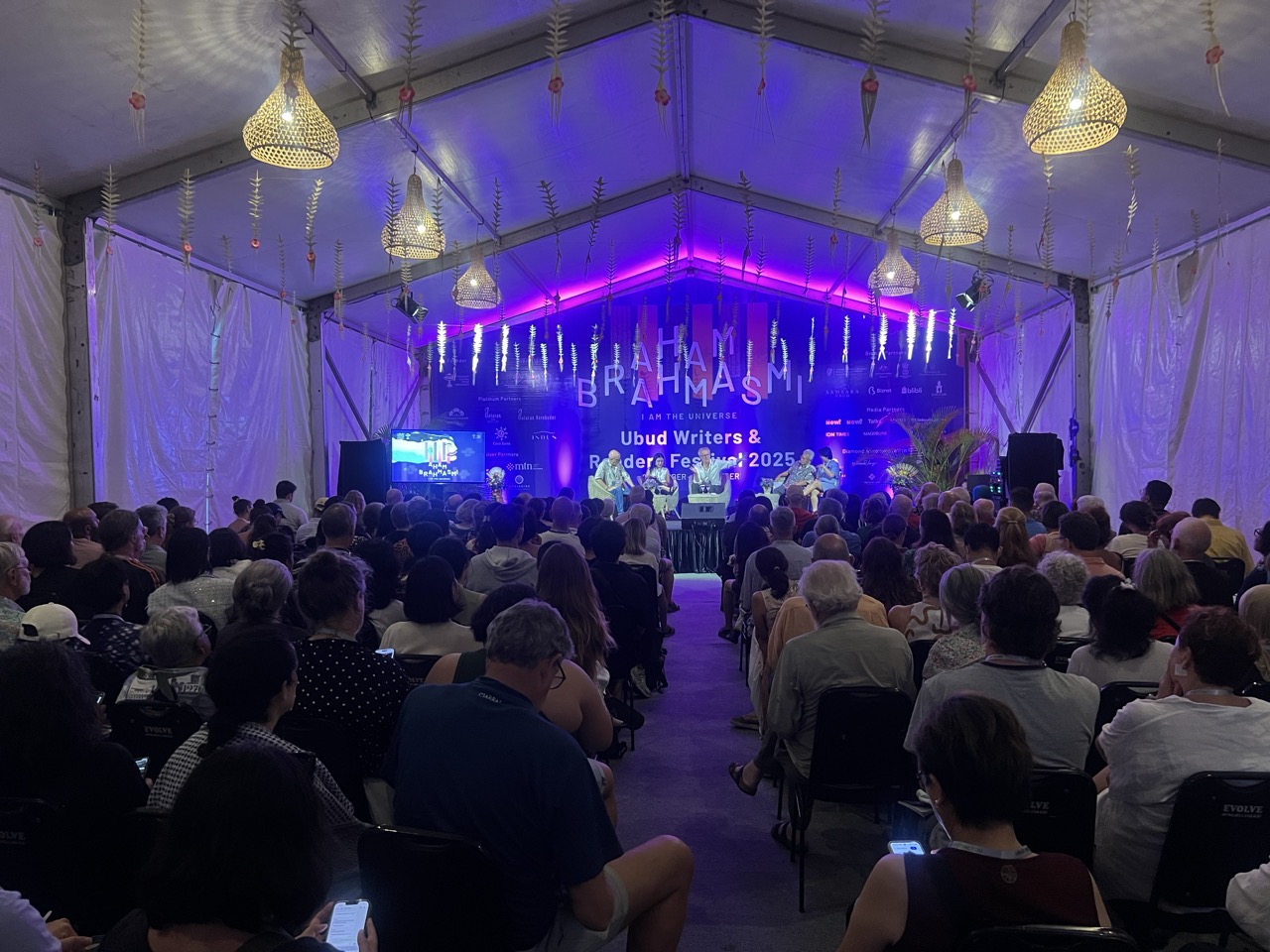
Ubud Writers & Readers Festival 2025 (Seasia)
Over at the Valley Stage, “Deconstructing Colonialism” examined the unfinished legacies of empire. Alex Chula, Annisa R. Beta, Thomas Mayo, and Eva Fernandes debated how colonial ideologies persist subtly in art, academia, and governance. “Colonialism,” Beta observed, “is not an event in the past but a mindset we must keep unlearning.”
Late Afternoon: From Grief to Cinema
As golden light filtered through palm fronds, afternoon sessions transitioned into themes of remembrance and imagination. The hauntingly titled “The Gravity of Grief” with Andreas Kurniawan, Rob Waters, and Jewell Topstfield explored how loss shapes art. “Grief is the black hole of the soul,” Kurniawan reflected. “It pulls us in, but from its darkness, we learn to see light again.”
At 4:15, Gail Jones, in conversation with Bri Lee, discussed her latest novel The Name of the Sister — a meditation on memory and the spaces between facts. Jones, one of Australia’s most lyrical writers, spoke about writing as “an act of reassembling fragments — of language, of life, of love.”
The day culminated at 5:30 with “The Cinema of Garin Nugroho,” a visual and emotional feast. Indonesia’s visionary filmmaker joined academic Krishna Sen to reflect on his decades-long career, from Opera Jawa to Setan Jawa. “Cinema,” Garin said, “is a ritual of light — each frame a prayer to the unseen.” The audience responded with a standing ovation, closing the first day with both awe and gratitude.
The Festival Heartbeat: Los Buku patjarmerah
Throughout the day, the Los Buku patjarmerah book market remained a hive of creativity. Independent Indonesian publishers offered everything from contemporary poetry to philosophical essays. Young readers lingered over zines while established authors signed books under banyan trees. The free market, open from 9 a.m. to 9 p.m., embodied the festival’s democratic spirit — a universe of stories available to all.
A Participant’s Voice
As twilight fell over Ubud, festivalgoers gathered for evening performances and spontaneous conversations in nearby cafés. Among them was Rama Prabowo, a 27-year-old reader from Yogyakarta attending for the first time.
“It’s my first time here,” Rama said, eyes bright. “Hearing Gail Jones and Garin Nugroho in one afternoon — it’s overwhelming in the best way. The theme ‘I Am the Universe’ makes sense now. Every story today felt like a constellation — different, but all shining in the same sky.”
Closing Reflections
Day one of the Ubud Writers & Readers Festival 2025 unfolded like a meditation in motion — grounded in Indonesia’s cultural soil yet reaching for cosmic understanding. The sessions, from Dalrymple’s history of empire to Suradana’s philosophy of unity, threaded together the personal and the planetary.
As the evening breeze carried the scent of frangipani across the festival grounds, one truth lingered: in Ubud, stories do not just describe the universe — they help us remember that we are part of it.


