


If Day 2 of the Ubud Writers & Readers Festival (UWRF 2025) was a symphony of words, Day 3 was its crescendo. The festival’s third day, unfolding across Ubud’s lush valleys, open-air venues, and art-filled cafés, carried the heartbeat of its theme — Aham Brahmasmi – I Am the Universe.
On this day, writers and readers stepped boldly into conversations about freedom, diaspora, and the creative act itself — from the politics of censorship to the art of world-building and the resilience of Southeast Asian storytelling.
Morning: Writing Chaos and Finding Calm
The day opened on the Alang-Alang Stage with “Heart Lamp”, a lyrical session featuring Banu Mushtaq and Gil Westaway, exploring faith, memory, and the luminous spaces between grief and hope.
At 10:15, “Writing Through Chaos” brought together Neal Hall, Omar El Akkad, and Pera Mohan — writers who have lived through turmoil and turned it into art.
“Writers don’t escape chaos,” said Omar El Akkad. “We navigate through it, trying to find a language that can survive.”
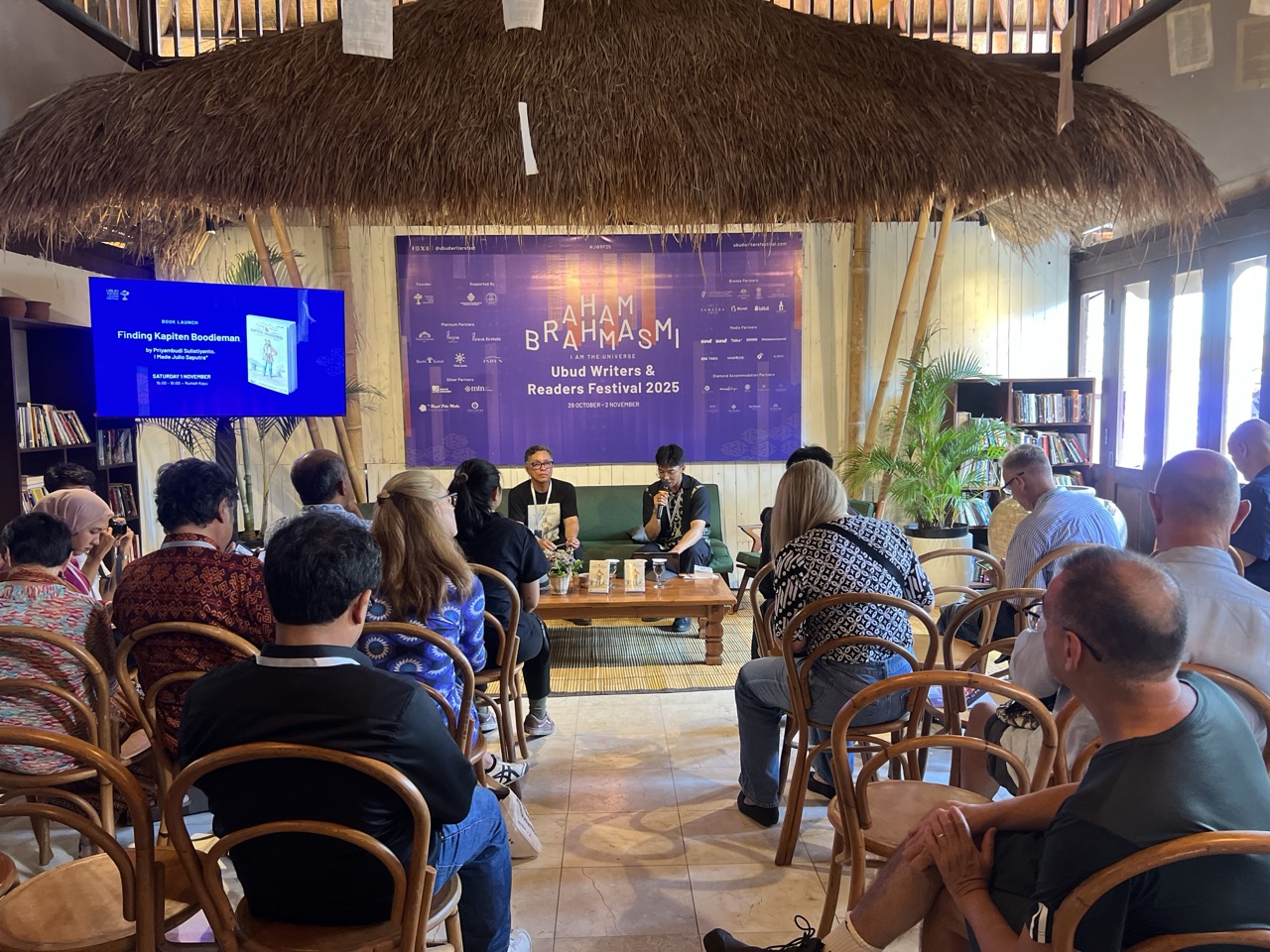
Meanwhile, Patrick Winn’s talk “Narcotopia” at Indus Restaurant gripped listeners with true stories from Southeast Asia’s hidden wars and resilience — a sharp reminder that truth is often stranger, and braver, than fiction.
Midday: Freedom, Resistance, and the Power of Women
By late morning, the festival’s focus widened to the social and political fabric of Indonesia and beyond.
At 11:30, “Rewriting Indonesia’s History” with Janet Steele and Tri Lubis unpacked post-colonial narratives, while “World Building in a World Breaking” with De Lestari, Bret Lee, and Kate Sawyer offered creative counterpoints to crisis.
“World-building isn’t escapism,” said De Lestari. “It’s rehearsal for resilience.”
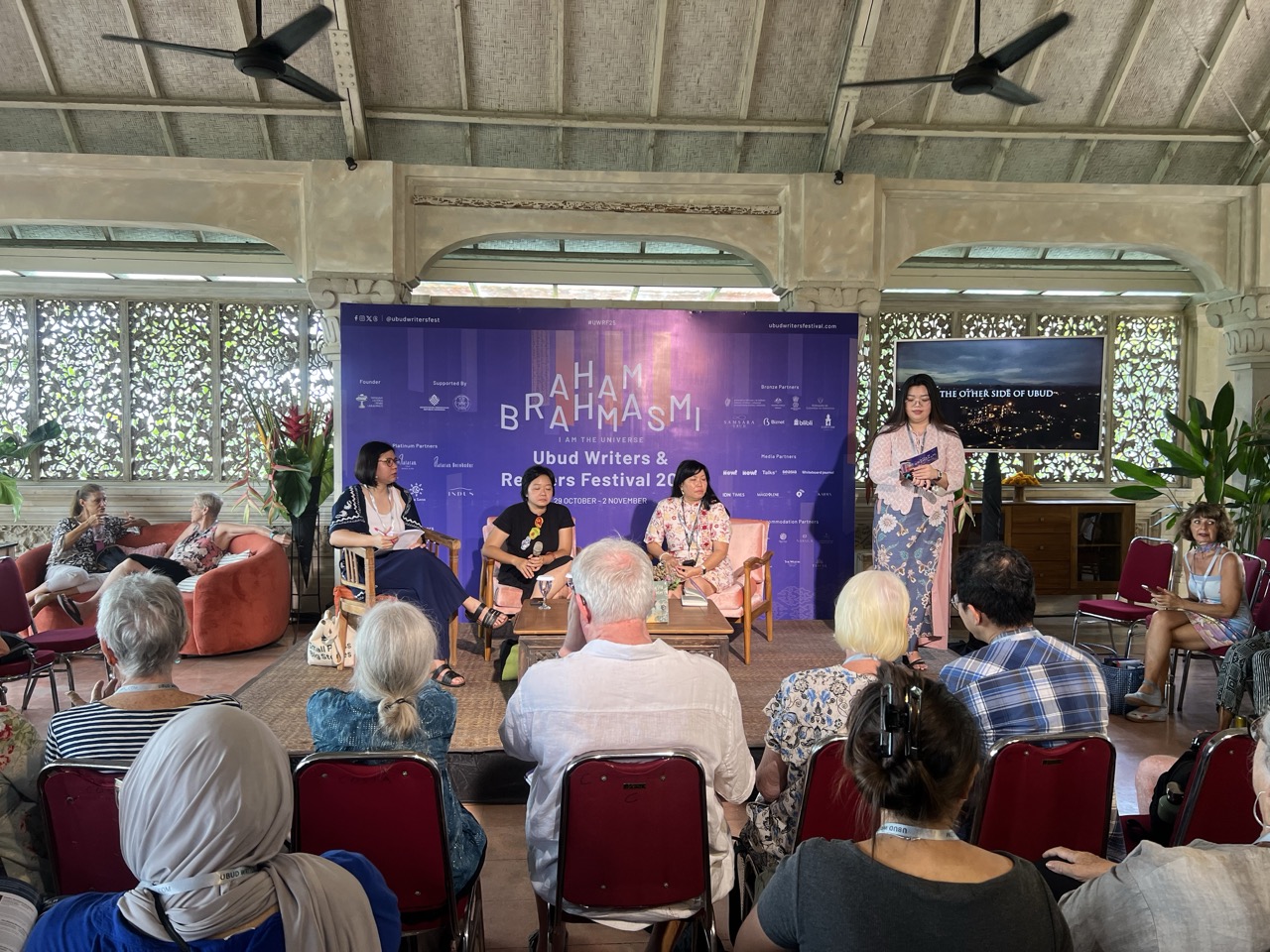
At the same time, “The Tension Between Artistic Freedom and Censorship” — featuring Erwin Arnada, Okky Madasari, and Brigid Delaney — sparked impassioned debate about creative freedom in today’s shifting media climate.
The Valley Stage also came alive with “The Power of Women” (with Devi Asmarani and Virginia Haussegger), drawing one of the day’s most attentive crowds.
An attendee from Jakarta summed up the spirit perfectly: “What makes Ubud special is how every story feels local and global at once. You can be from Jakarta, or from Dublin — and still find your own reflection here.”
Afternoon: Imagination Across Borders
The Alang-Alang Stage continued its momentum with “Chinese Indonesian Women and the Forgotten History”, where Angela Emy, Agnes Christina, and Marissa Saraswati reflected on identity and invisibility — giving voice to the women who carried untold histories.

Meanwhile, David Van Reybrouck, Agustinus Wibowo, and Craig Leeson led “The Reconciliation of Spirituality and Capitalism”, examining how faith and commerce intersect in the modern age.
At Rumah Kayu, “The Director: Penguasa dan Penata Bumi” with Ana Filomena Amaral and Kodok Sonia Pisacanty blended eco-fiction and politics, followed by “Tutur Tantri”, a retelling of ancient Balinese myths through a modern literary lens.
These sessions showcased what UWRF does best — bridging art, activism, and mythology in one vibrant tapestry.
Special Mention: Andrew Lam’s Voice Across Oceans
A highlight of Day 3 was the return of Andrew Lam, the Vietnamese-American writer and journalist whose works Perfume Dreams and Birds of Paradise Lost have become essential reading on diaspora and identity.
Marking his third appearance at the festival, Lam’s presence added a vital perspective to UWRF’s transnational conversations. His reflections on exile and cultural duality resonated deeply with audiences seeking belonging in a fragmented world.
As Lam once wrote, “The refugee’s journey is not about returning home — it’s about inventing one.” His words echoed the festival’s own spirit — bridging histories, continents, and the fragile threads of human connection.
Special Events: Breakfast, Brunch, and Stories in Motion
For those craving more intimate experiences, Day 3’s Special Events offered nourishment for both body and soul.
Birdwatching Tour with Darryl Jones (Tjampuhan Ridge Walk) offered a tranquil morning of wings, mist, and conversation.
5 Rhythms Dance Meditation with Gina Chick (Soulshine Bali) turned motion into meditation and laughter into release.
Brunch with Pico Iyer (Di Sini Di Sana) became a sold-out highlight featuring the acclaimed essayist in conversation with Rio Helmi, discussing silence, travel, and the search for meaning between East and West.
Dim Sum Diaries (Casa Luna) hosted by Angelina Emy, Edward Wong, and Kirsten Han mixed delicious food with reflections on memory, identity, and migration.
MTN Market: Banu Mushtaq & Jenny Erpenbeck in Conversation, moderated by Leila S. Chudori, united two global literary forces in an evening of intimate, illuminating exchange.
Each event reminded festivalgoers that literature doesn’t just feed the mind — it feeds the spirit.
Masterclasses: Craft Meets Courage
The day’s Masterclasses offered deep creative dives for aspiring writers and professionals alike.
An Introduction to Screenwriting with Ratih Kumala (Di Sini Di Sana) merged Indonesian storytelling traditions with cinematic language.
Reclaiming Our Stories: A Writing Workshop on Desire with Eva Fernandes (The Westin Resort & Spa) created a safe space for women to explore emotional truth through narrative.
Sound Bath with Bottlesmoker and Manuela Sauter (Soulshine Bali) blended sound therapy and poetic exploration.
Participants described the Sound Bath as “a poem you could feel vibrating through your bones.”
Cultural Workshops: Bali’s Living Heritage
From the Bahasa Bali Breakfast at Dharma Kula Ubud to “Culinary Jalan-Jalan to Sukawati’s Hidden Gem”, the festival’s Cultural Workshops let attendees engage with Bali through touch, taste, and tradition.
At Kerta Art Performance Club, “Introduction to Balinese Dance” invited visitors to explore posture, rhythm, and grace, while “Brush with Myth: Exploring the Barong” at Bumi Kinar Ubud guided participants in painting the legendary Barong — a dance between art and divinity.
These workshops embodied UWRF’s promise: to bring storytelling off the page and into the pulse of daily life.
After Dark: Rhythm, Resistance, and Release
As night fell, the festival transformed once again. The Festival Poetry Slam at the Valley Stage (7:30–10:30 PM) became the emotional peak of the day, featuring Jazz Money, Miles Merrill, and Shinta Febriany.
Words became fire, rhythm, and revelation — a collective outpouring of truth and joy.
Across town, at Honeymoon Garden, “The Wayang Women: Wewe Gombel” reimagined traditional puppetry through feminist myth-making — haunting and beautiful in equal measure.
Evening Reception: Penguin Random House SEA Writers’ Gathering
Capping the day was an exclusive writers’ gathering hosted by Penguin Random House Southeast Asia (SEA) at Indus Restaurant. The evening, beginning at 7:00 PM, invited festival guests to an elegant night of cocktails and conversations celebrating the magic of Southeast Asian literature.

The event buzzed with excitement over a new book project collaboration with celebrated Indonesian novelist Ratih Kumala, marking a major moment for regional publishing. Authors, editors, and readers mingled in the candlelit ambience overlooking the Tjampuhan Ridge, forging connections that carried the spirit of the festival beyond its stages.
It was, as one guest described, “the kind of evening where literature didn’t just speak — it danced.”
Film Programme: The Screen as Sacred Space
Cinema continued to illuminate the night with powerful regional stories.
“Return of the Fireflies” (4 PM, Paradiso Ubud) celebrated the fragile harmony between ritual and nature.
“Ngambe’ Teladan” (4–5 PM, Paradiso Ubud) documented Kalimantan’s ancestral heritage.
“Wiku Tapini” (8–9 PM, Alang-Alang Stage) offered a meditative portrait of Balinese ritual life.
“One More Cup of Coffee for Ambe” (8–9 PM, Alang-Alang Stage) explored Torajan funeral traditions with poetic reverence.
The screenings confirmed that for many, film is another language of literature — visual, emotional, and profoundly human.
Reflections: The Heart of a Global Village
By night’s end, Ubud pulsed like a living organism — part marketplace of ideas, part temple of art. Conversations lingered long after the last panel; laughter spilled from cafés into moonlit streets.
“You come to Ubud thinking you’ll listen,” said one attendee leaving the Poetry Slam. “But you end up finding your own story.”
And perhaps that is the essence of UWRF 2025: a celebration not just of words, but of shared humanity — where every voice, from village poet to global laureate, becomes part of the same, ever-expanding universe.


