


For decades, history books have presented the neat narrative that ancient humans walked from Siberia to Alaska via a land bridge known as Beringia around 13,000 years ago. These people were known as the First Americans, mammoth hunters who arrived after the ice began to melt at the end of the Ice Age.
However, a recent study led by Loren Davis, an anthropology professor at Oregon State University, and David B. Madsen, an archaeologist from the University of Nevada, Reno, offers a much older story that challenges this long-accepted logic.
Their research suggests that the earliest humans may not have arrived by land at all, but instead sailed along the Pacific coastline around 20,000 years ago—thousands of years before the Beringia land corridor became passable.
“This study puts the First Americans back into the global story of the Paleolithic,” Davis said. “They weren’t outliers—they were part of a shared technological legacy.”
Published in the journal Science Advances, the research challenges long-held theories about who the first people in the Americas were and how they got there.
Following a Frozen Coastline
During the last Ice Age, much of the world’s seawater was locked in glaciers, pushing sea levels hundreds of feet lower than today. At that time, northern Japan (Hokkaido), Russia’s Kamchatka Peninsula, and the Kuril Islands formed a single landmass now referred to as the Paleo-Sakhalin-Hokkaido-Kuril (PSHK) region.
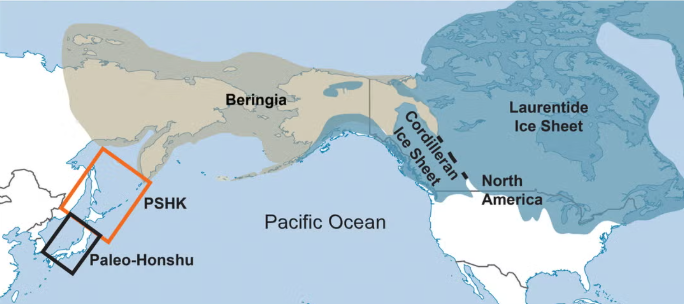
In this region, early humans had already mastered stone tool production and the ability to navigate dangerous waters. When Madsen’s team compared thousands of stone tools from Japan, Russia, and North America, they found striking similarities—in shape, production techniques, and even in their intended use.
“They were using identical techniques,” Madsen noted. “It points to a cultural connection across the Pacific Rim, not just a migration.”
Stone Tools that Carry Memories
At ancient sites such as Cooper’s Ferry in Idaho and Cactus Hill in Virginia, archaeologists have uncovered stone tools dating between 16,000 and 20,000 years old—far older than the Clovis culture, long believed to represent the earliest technology in the Americas.
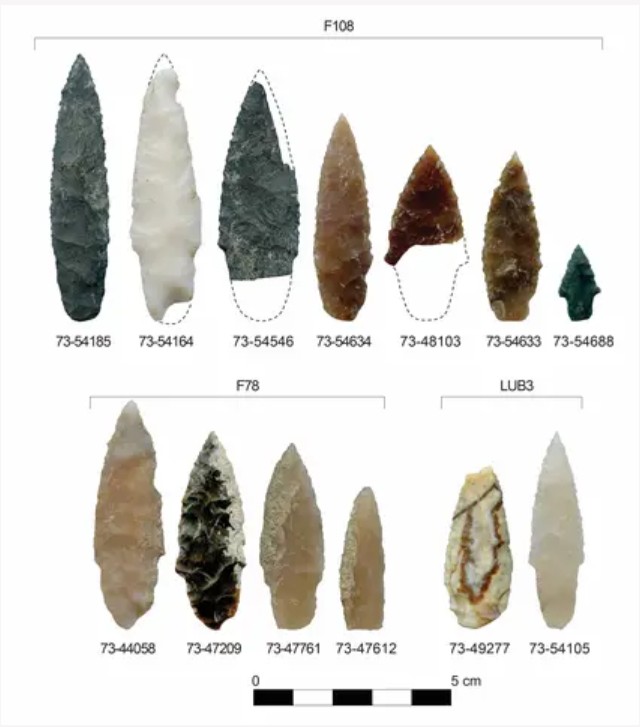
These tools are slender and sharp, crafted using the core-and-blade technique (striking large stones to produce thin blades) and bifacial flaking (chipping both sides of a stone to form a symmetrical point). This technology is identical to toolmaking methods found in Hokkaido and Northeast Asia.
“These advanced tools represent a technological fingerprint,” Davis explained. “They connect the American Upper Paleolithic directly to its roots in Northeast Asia.”
In other words, every stone fragment uncovered carries the collective memory of humankind—of skills, inherited knowledge, and cultural connections that once crossed oceans.
Traces Sunk Beneath the Sea
If the old theory that humans arrived by land were correct, there would be evidence of hearths, bones or tools in Alaska and Canada, which were once buried under ice. However, no ancient sites from that period have yet been discovered there.
Instead, the oldest sites are located farther south, in areas that remained ice-free at the time. This strongly supports Davis and Madsen’s theory that the first route into the Americas was by sea.
When the ice melted and sea levels rose again, the ancient coastlines where these people once lived were likely swallowed by the Pacific Ocean. “Additional evidence is probably submerged along the Pacific Rim,” Davis said. “But even without it, the tools we have tell a clear story.”
Rewriting Maps, Rewriting History
This discovery isn’t only about human migration, but also about who these people were. They were not merely wanderers chasing mammoths across frozen plains, they were skilled seafarers and innovators who understood ocean currents, the stars, and advanced stone technology.
“We can now explain not only that the First Americans came from Northeast Asia, but also how they traveled, what they carried, and what ideas they brought with them,” Davis noted.
The study affirms that the first Americans were part of a global Paleolithic tradition, a vast network linking Eurasia, East Asia, and eventually the Americas. Genetic evidence now supports this as well: Indigenous peoples of the Americas share DNA connections with populations from Northeast Asia and Northern Eurasia.