


Jakarta — The Embassy of the Republic of Colombia in Indonesia hosted an intimate and inspiring literary morning with acclaimed Colombian author Ingrid Rojas Contreras, whose memoir The Man Who Could Move Clouds has become one of the most celebrated literary works of recent years.
Held on Tuesday, November 4, at the Embassy’s auditorium on Jl. Jend. Sudirman, the event gathered writers, readers, diplomats, and literary enthusiasts to celebrate the intersections of memory, identity, and the unseen forces that shape both Colombia and Indonesia — from history to mysticism, from rain to remembrance.
Rojas Contreras, whose memoir was a finalist for the 2023 Pulitzer Prize for Memoir or Autobiography and the National Book Award, captivated the audience with her reflections on storytelling, cultural inheritance, and her own deeply personal experience of amnesia — an event that became the catalyst for her book.
“I lost my memory for eight weeks,” she shared, “and in forgetting, I learned the many ways in which remembering is not just an individual act, but a communal one. Our families, our countries, even our ancestors, remember through us.”
The discussion, moderated by representatives from the Colombian Embassy, unfolded in a warm and thoughtful atmosphere. Guests sipped Colombian coffee as Rojas Contreras drew connections between myth and history, between the visible and the mystical — themes that resonate not just in Colombia but across Indonesia as well.
From Bogotá to Bali: A Shared Spiritual Sky
Ingrid Rojas Contreras’s visit to Jakarta came shortly after her appearance at the Ubud Writers and Readers Festival 2025, where she joined other international authors in discussions on “The War Women Must Wage” and the “Power of Memory in Latin American Literature.”
Her participation in Ubud established her as one of the festival’s most engaging speakers, particularly for Southeast Asian audiences who saw parallels between Latin American magical realism and the spiritual traditions of the Indonesian archipelago.
At the Jakarta event, these parallels surfaced again when a participant asked about Colombia’s long-standing myths of cloud movers and rain shapers — central figures in The Man Who Could Move Clouds.
Smiling, Rojas Contreras responded, “In Colombia, the idea of someone who can move clouds is not fantasy. It is part of the landscape — of how we understand our connection to the sky. I’ve now learned that in Indonesia, there is also a belief in the pawang hujan, the rain shaman. That feels like a bridge between our worlds.”
Indeed, both Indonesia and Colombia — tropical, agricultural, and deeply spiritual societies — share traditions that blend climate, culture, and the unseen forces of nature. The Indonesian pawang hujan and Colombia’s nube movers both symbolize a deep relationship with the weather and an enduring respect for nature’s mysteries.
Rain, Ritual, and the Realities of Climate Change
One of the morning’s most thought-provoking moments came when a participant asked how rain-moving ritualsintersect with the modern realities of climate change.
Rojas Contreras paused thoughtfully before replying, “That’s the question of our time. We once believed we could control nature — make it rain or make it stop. But now, nature reminds us that it has a memory too. The rain doesn’t forget. The earth doesn’t forget.”
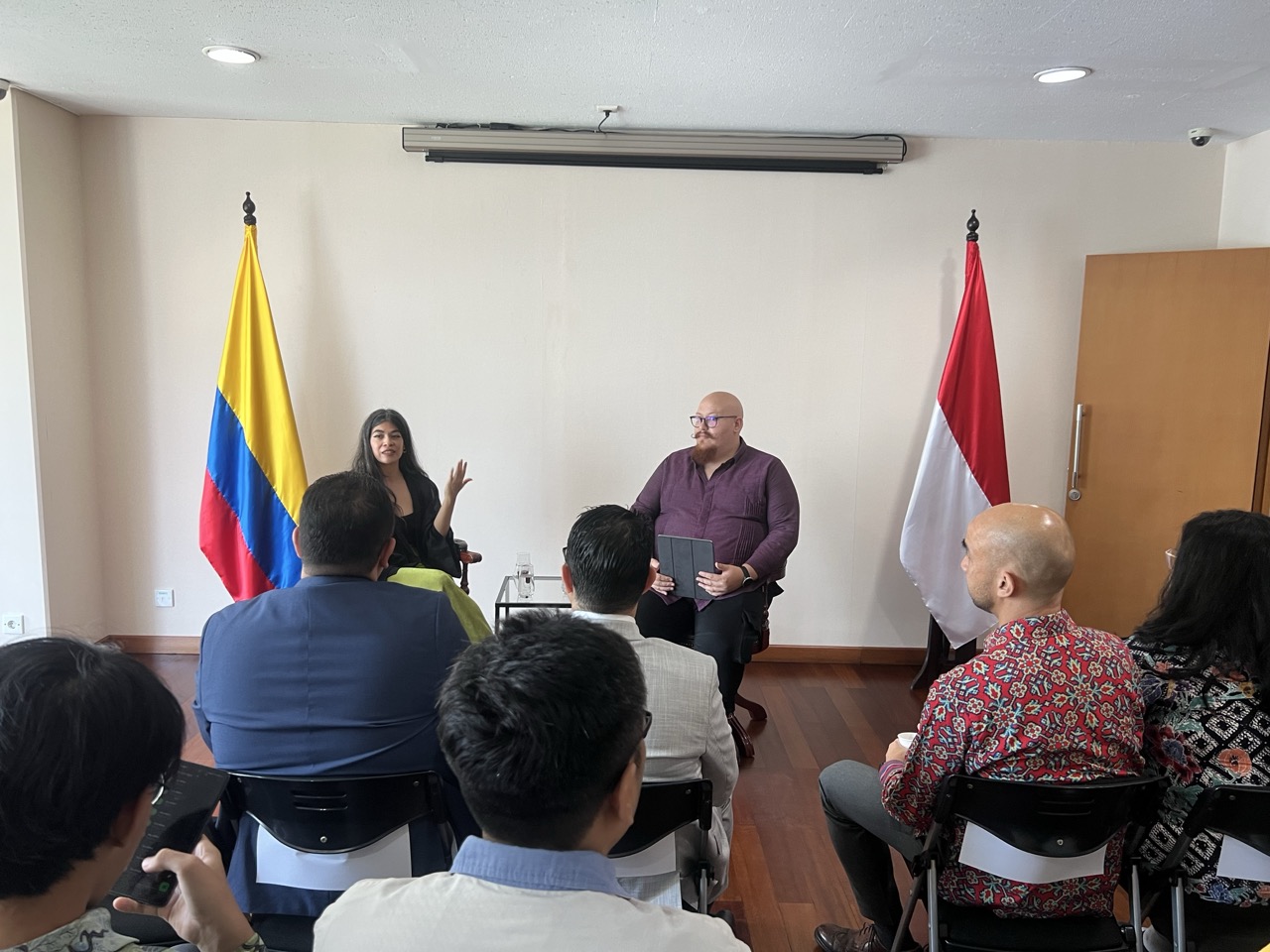
Her words resonated with attendees, many of whom nodded in recognition of Indonesia’s ongoing struggles with extreme weather, flooding, and shifting agricultural patterns — issues strikingly similar to those faced in Colombia. Both nations, despite being oceans apart, share tropical ecosystems heavily affected by climate change, where farmers must adapt to unpredictable seasons and environmental disruption.
“The connection between our two countries,” she continued, “is not just literary or cultural — it’s ecological. We are writing new stories about survival, resilience, and how to live with a changing earth.”
A Moment of Memory and Magic
The session ended with a lighthearted, human touch. As part of a small giveaway organized by the Embassy, Rojas Contreras offered a signed copy of The Man Who Could Move Clouds to a lucky participant — the one who could guess her birth month.
Laughter filled the room as guesses flew around: “June!” “October!” “April!” Finally, a participant called out “September,” prompting cheers when Rojas Contreras confirmed, “Yes — September, the month of clouds!”
It was a fitting conclusion to a morning that moved effortlessly between intellect and intimacy, between serious reflection and simple joy.
Literature as Cultural Diplomacy
The Embassy of Colombia in Indonesia has long used cultural and literary events as a means to strengthen ties between the two nations. Tuesday’s gathering was another testament to the role of storytelling in diplomacy — a reminder that books and conversations can bridge continents just as effectively as trade or politics.
“Ingrid’s presence here is not only an honor but a symbol of shared imagination,” said a representative of the Embassy. “Both our nations believe that stories — whether told under tropical rains or clear skies — have the power to connect and heal.”
As guests lingered to chat and sip their last cups of Colombian coffee, one could sense that the morning had done more than promote a book — it had created a dialogue between two cultures that understand the poetry of weather, the mystery of memory, and the enduring human desire to find meaning in the clouds.


