


Tigers and kangaroos are both iconic animals. One symbolizes the power of Asia’s forests, while the other is inseparable from Australia’s arid landscapes. Geographically, they live relatively close to each other on the world map, separated only by the Indonesian archipelago.
Yet strangely, these two animals might as well come from different planets. There is no place in the wild where tigers and kangaroos live side by side.
And yes, this phenomenon is no coincidence—it is the result of a long and dramatic history of the Earth, centered on an invisible boundary known as the Wallace Line.
The Invisible Line That Divides the Animal World
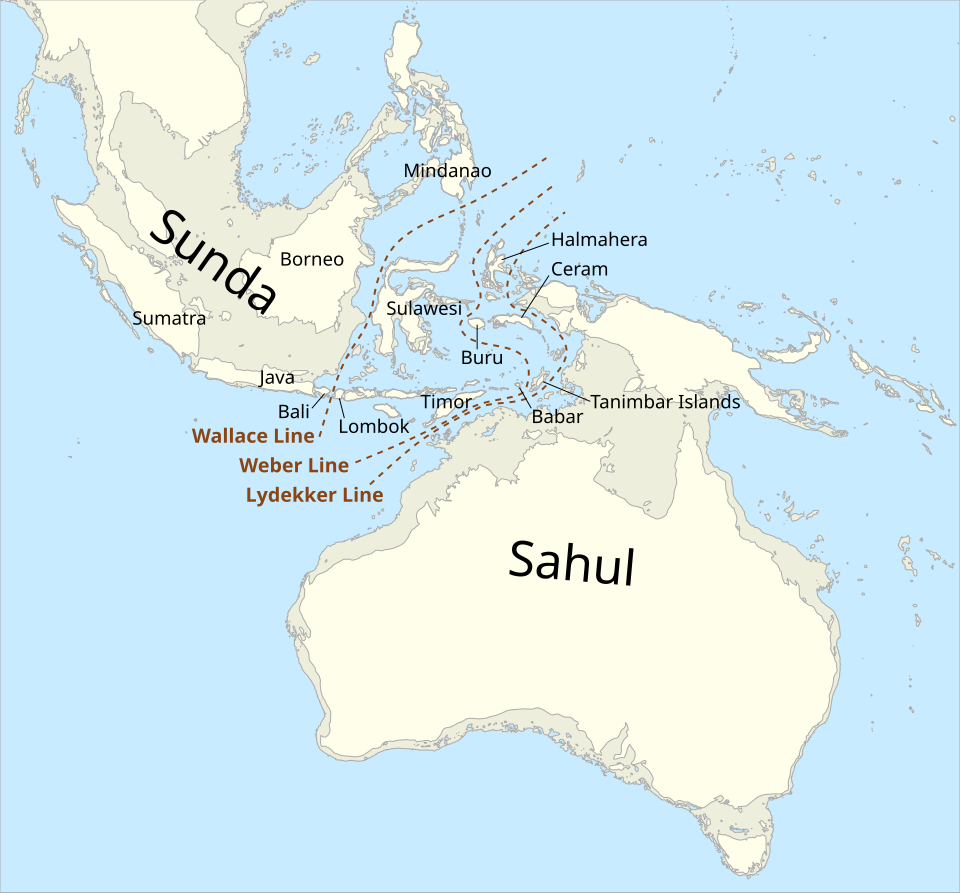
The Wallace Line is not a fence, wall, or massive chasm visible from above. It is an imaginary line stretching from the Indian Ocean, separating Bali and Lombok, winding between Borneo and Sulawesi, and ending east of the Philippines. Yet its impact on animal life is unmistakably real.
To the west of this line, Asian fauna dominate: elephants, tigers, rhinoceroses, orangutans, and other primates. Step eastward, and the biological landscape changes dramatically. Marsupials such as kangaroos, cuscuses, and koalas, along with cockatoos and other Australasian species, take over.
There is almost no gray zone between the two. Even islands separated by only a few dozen kilometers can host entirely different animal communities.
This striking pattern was what first astonished Alfred Russel Wallace in the 19th century, long before biogeography became an established scientific discipline.
When Continents Moved and the World Changed
To understand why this boundary is so “sacred,” we must go back tens of millions of years, to a time when the world map looked completely unfamiliar. Australia was once attached to Antarctica and lay far to the south.
When it broke away and slowly drifted northward, it eventually collided with the Asian tectonic plate. This massive collision gave rise to the Indonesian archipelago.
In theory, these islands should have served as a natural bridge for animals moving in both directions. In reality, migration was highly uneven.
A major study by researchers from the Australian National University (ANU) and ETH Zurich, published in the journal Science, shows that far more Asian animals successfully crossed into and survived in Australia than Australian animals attempting to enter Asia.
One key reason lies beneath the sea. Along the Wallace Line, the waters are extremely deep and have never formed land bridges,even during ice ages, when sea levels dropped dramatically.
Strong currents, extreme depth, and long-term geological stability have made this region a natural barrier that is nearly impossible to cross.
Climate: A Decisive but Often Overlooked Factor
Geography, however, is not the whole story. As Australia drifted away from Antarctica, profound changes occurred in the global climate. The Earth became cooler and drier.
Species that survived in Australia evolved to withstand extreme conditions: prolonged droughts, high temperatures, and harsh, unpredictable environments.
In contrast, Asian animals evolved in warm, humid tropical climates. When they “hopped” from island to island across Indonesia—where climatic conditions were relatively stable—they were already moving within a familiar comfort zone.
It is therefore unsurprising that many Asian species were more successful at establishing themselves in northern Australia than Australian marsupials were at surviving on the tropical islands of Southeast Asia.
An analysis of around 20,000 species reveals a consistent pattern: species with broader climate tolerance have a much higher chance of crossing the Wallace Line.
Why This Story Still Matters Today
The Wallace Line is not merely a relic of the past. It helps us understand why tropical biodiversity is so extraordinarily rich, why certain species become invasive more easily than others, and how climate change may reshape the map of life in the future.
In a world increasingly interconnected by human activity, natural boundaries like the Wallace Line remind us that geological history and climate leave long-lasting imprints that cannot simply be erased.
Tigers and kangaroos may live in regions that appear close on a map, but millions of years of Earth’s history have ensured that they remain inhabitants of two very different worlds.


