


In 1956, at the height of the Cold War, Indonesia's founding president Ir. Sukarno delivered an extraordinary diplomatic ultimatum to Soviet Premier Nikita Khrushchev: find the abandoned tomb of Imam al-Bukhari in Central Asia, or there would be no state visit to the USSR.
This wasn't about weapons, trade, or political alliances—it was about rescuing the forgotten grave of a ninth-century Islamic scholar whose work remains sacred to over a billion Muslims worldwide.
Al-Bukhari: The Scholar the Soviet Era Tried to Erase
Imam Muhammad ibn Ismail al-Bukhari, born in Bukhara on July 21, 810 CE, compiled Sahih al-Bukhari—containing 7,275 authenticated sayings of Prophet Muhammad. This masterwork is considered Islam's most authoritative text after the Quran itself.
Yet by the 1950s, his tomb near Samarkand, Uzbekistan, had vanished from memory. When Soviet communists consolidated power over Central Asia, they systematically suppressed religion. According to journalist Iftikhar Gilani's research, the communist regime "severed cultural connections that had existed for centuries." Mosques were locked, religious schools closed, and Islamic sites deliberately abandoned.
The tomb in Khartang Village, 30 kilometers from Samarkand, was overgrown with weeds—forgotten even by locals who walked past it daily.
Why Sukarno Refused to Bend to Moscow
Following Indonesia's successful 1955 Asian-African Conference in Bandung, which gathered 29 nations and elevated Indonesia to global prominence, Soviet Premier Khrushchev courted Sukarno's friendship. But Sukarno, who combined revolutionary nationalism with genuine Islamic scholarship, had other priorities.
According to the Madain Project archives, Khrushchev initially refused Sukarno's condition about the tomb and even sent emissaries to Jakarta attempting to change his mind. But Indonesia's president stood firm—no tomb, no visit.
For the Soviet Union, desperately wanting to showcase Indonesia as proof that non-aligned nations could work with communism, this created an impossible dilemma. Finding a forgotten grave in vast Soviet territory, during an era when religion was suppressed, seemed nearly impossible.
Inside the Soviet Search for a Forgotten Sacred Grave
Faced with Sukarno's unwavering demand, Khrushchev mobilized Soviet intelligence agencies and historians. Teams scoured archives, secretly interviewed elderly Muslims, and searched the countryside around Samarkand.
Muhammad Maksud, current guardian of Imam al-Bukhari's tomb, explained that Soviet officials gathered information from "Muslim elders around Samarkand" who had preserved oral histories despite decades of persecution.
Israil, today's muezzin at the Imam al-Bukhari Mosque, recounted that when finally located, "its condition was neglected, and its location was overgrown with bushes and weeds." Soviet workers cleared the site and conducted restoration work so that when Sukarno arrived in September 1956, he could pray at the rediscovered tomb.
How Sukarno Triggered the Reopening of the Saint Petersburg Mosque
Sukarno's impact extended beyond Imam Bukhari's tomb. During his visit to Leningrad (now Saint Petersburg), he spotted a distinctive blue-domed building from his motorcade. Despite security protocols preventing a stop, Sukarno recognized it as a mosque.
The Saint Petersburg Mosque (also known as Blue Mosque), built in 1910 by Tsar Nicholas II for the Muslim community, had been converted into a warehouse after the 1917 Bolshevik Revolution. According to M. Aji Surya's book "Geliat Islam di Rusia," when Sukarno expressed disappointment during Kremlin talks, the Soviet government announced within a week that the Saint Petersburg Mosque would reopen for worship—the first such reversal of religious suppression.
Muslims in 1950s Leningrad began calling it "Sukarno's Mosque," and this reopening became "a collective memory for Muslims in St. Petersburg," marking the beginning of gradual religious tolerance in Soviet Russia.
From Neglect to Pilgrimage: A Tomb Reborn
Indonesian Vice President Ma'ruf Amin, during his June 15, 2023 visit to the tomb, emphasized this connection: "Previously this was unknown, no one had discovered the tomb of Imam al-Bukhari. But Bung Karno made the government here [Uzbekistan] aware that there was a major figure here."
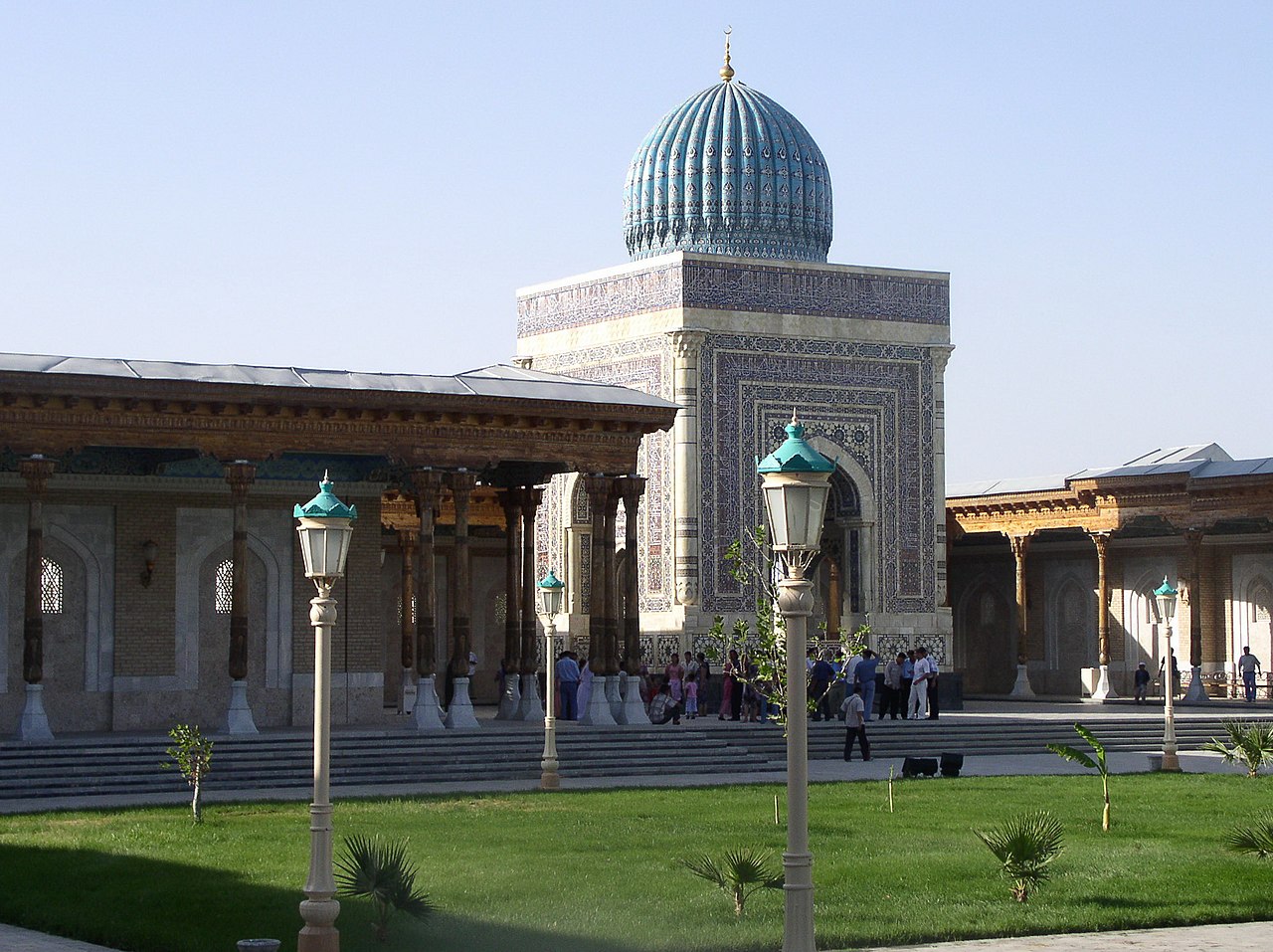
Following Sukarno's visit, other Muslim leaders requested access. By 1998, independent Uzbekistan under President Islam Karimov transformed the site into a magnificent memorial complex covering 10 hectares, declaring Imam al-Bukhari an intellectual patron of the nation.
Today's complex includes a restored mausoleum with blue-tiled dome, a mosque accommodating 10,000 worshippers, a university, museum, and madrasah. The central tomb features light-green onyx inscribed with Quranic verses. Over 1.5 million pilgrims visit annually.
Honoring Sukarno at the Resting Place of al-Bukhari
Recognizing Sukarno's pivotal role, Indonesia and Uzbekistan are collaborating on the "Sukarno Garden" project—a memorial library and park within the tomb complex. The Faculty of Ushuluddin at UIN Jakarta has committed to curating collections on Islamic thought and Indonesian history for this library.
Dr. Muhammad Rifqi Fatkhi from UIN Jakarta explained during a November 25, 2024 forum that Sukarno's connection to Imam al-Bukhari predated his presidency. In his book "Islam Sontoloyo," Sukarno wrote requesting a copy of Sahih al-Bukhari, demonstrating early scholarly interests.
According to KH Abdul Mun'im DZ, Chairman of the Panata Dipantara Foundation, Sukarno studied with Islamic scholars including Mohammad Hasyim Asy'ari, founder of Nahdlatul Ulama (NU), which deeply influenced his understanding of Islamic texts and determination to honor Imam al-Bukhari's legacy.
What Sukarno’s Gamble Teaches Modern Diplomacy
Sukarno's unconventional approach offers important lessons for international relations. By leveraging Indonesia's geopolitical importance during the Cold War to achieve cultural and religious objectives, he demonstrated that diplomacy extends beyond traditional political concerns.
His success in pressuring a communist government to restore Islamic heritage—without military force or sanctions—showcased the power of principled negotiation backed by strategic positioning. The Asian-African Conference's success had made Indonesia valuable enough that even ideological opponents would accommodate seemingly impossible demands.
The story ultimately represents enduring connections between Indonesia and Central Asia—links forged through Islamic scholarship that transcend political systems. Just as Imam al-Bukhari's collections traveled from ninth-century Bukhara to modern Indonesian pesantren, Sukarno's diplomacy reconnected these distant regions, reminding the world that Islamic heritage belongs to a global community united by shared intellectual traditions rather than divided by Cold War politics.
Sources:
Madain Project, Indonesian Vice President's Office, UIN Jakarta, National Geographic Indonesia, works by Iftikhar Gilani, M. Aji Surya, and Sigit Aris Prasetyo.


