Across the globe, Chinese New Year is marked by red lanterns, dragon dances, and family reunions. But in Southeast Asia, this ancient festival has evolved into something deeply local.
For centuries, the Chinese diaspora in countries like Indonesia, Malaysia, Singapore, and Vietnam has blended their ancestral traditions with local customs, creating a vibrant cultural tapestry that is unique to the region.
As we gallop into the Year of the Fire Horse in 2026, let’s look at how Southeast Asia puts its own soul into the Lunar New Year.
The "Prosperity Toss": Malaysia and Singapore’s Yee Sang
One of the most iconic sights during Lunar New Year in Malaysia and Singapore is a group of people standing around a table, tossing shredded vegetables and raw fish high into the air with chopsticks. This is Yee Sang (or Yusheng).
While its roots are in southern China, the modern, colorful version we see today was popularized by chefs in Southeast Asia in the 1960s.
The tradition is simple: the higher you toss the ingredients, the more luck and prosperity you will have in the coming year. It is a loud, messy, and joyful affair that perfectly captures the communal spirit of the region.
You won’t find this specific "tossing" frenzy in mainland China; it is a homegrown Southeast Asian masterpiece of celebration.
The Sweet Symbolism of Indonesia’s Lontong Cap Go Meh
In Indonesia, particularly on the island of Java, the Lunar New Year celebrations reach their peak fifteen days after the new moon with Cap Go Meh. Here, the celebration is incomplete without a plate of Lontong Cap Go Meh. This dish is a beautiful example of culinary acculturation.
It takes the traditional Chinese rice cake and pairs it with Javanese staples like opor ayam (chicken in coconut milk), sambal goreng ati, and sayur lodeh.
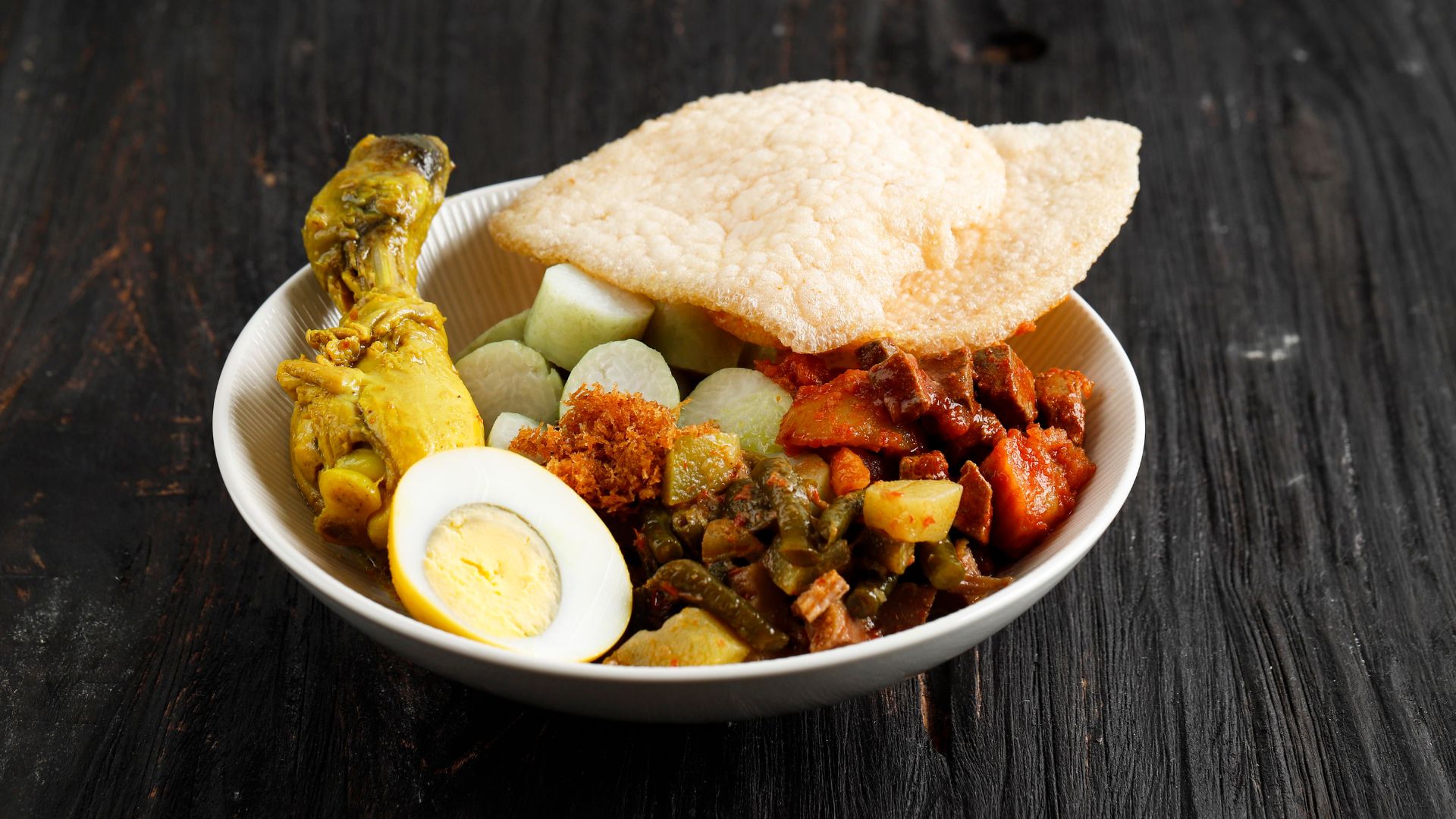
This dish was created because early Chinese immigrants in Java wanted to celebrate the holiday with their local neighbors.
The round shape of the lontong symbolizes the full moon, while the rich yellow turmeric broth represents gold and prosperity. It is a dish that tastes like history, a blend of Peranakan heritage and Javanese hospitality.
Vietnam’s Tet: A Celebration of Peace and Earth
In Vietnam, the Lunar New Year is known as Tet Nguyen Dan, or simply Tet. While it shares the same lunar calendar, the customs are distinctly Vietnamese. The centerpiece of every Tet celebration is Banh Chung, a square-shaped sticky rice cake filled with mung beans and pork, wrapped in banana leaves.
Legend has it that the square shape represents the Earth. Making Banh Chung is a slow, laborious process that brings families together for hours, sitting around a fire to boil the cakes.
Unlike other parts of Asia where red is the only dominant color, Tet in Vietnam is also famous for the yellow apricot blossoms (Hoa Mai) and pink peach blossoms, symbolizing the arrival of spring and a fresh start.
The Colorful Bazaars of Bangkok and Manila
In the Philippines, particularly in Manila’s Binondo, the oldest Chinatown in the world, Chinese New Year is a massive street party. You will see the Tikoy (sticky rice cake) being sold on every corner, which Filipinos believe helps "stick" the family together.
Meanwhile, in Bangkok’s Yaowarat district, the celebrations are a neon-lit extravaganza of street food and traditional opera, where Thai-Chinese families offer prayers for a "fast and fiery" year, fitting for the 2026 Fire Horse.
A Shared Heritage of Resilience
What makes Chinese New Year in Southeast Asia so special is not just the food or the lanterns; it is the resilience of the culture. These traditions survived through generations of migration and adaptation.
In 2026, as the region moves forward with the dynamic energy of the Fire Horse, these celebrations serve as a reminder of our shared identity.
In Southeast Asia, Chinese New Year is no longer just for the Chinese community; it is a regional holiday where everyone, regardless of their background, joins in the hope for a prosperous year ahead. It is a time when the streets of ASEAN turn red, but the heart of the celebration is 100 percent local.