


Hidden beneath the forests northwest of Ho Chi Minh City lies one of the most extraordinary remnants of twentieth-century warfare.
The Cu Chi Tunnels in Viet Nam reveal a vast underground network once used by Vietnamese fighters during decades of conflict. Today, they stand as a powerful symbol of endurance, ingenuity, and national determination.
Geographic Setting and Historical Context

The Cu Chi Tunnels are located in Cu Chi District, about seventy kilometers from central Ho Chi Minh City.
During the years of conflict in Viet Nam, this region was strategically important because of its proximity to the former South Vietnamese capital of Saigon. The dense jungle terrain provided natural cover, making it an ideal location for guerrilla warfare.
The tunnel system began taking shape in the late 1940s during the resistance against French colonial forces. Over time, especially during the Viet Nam War, it expanded dramatically under the direction of the Viet Cong.
By the 1960s, the network stretched for more than two hundred kilometers, linking villages, supply routes, and military strongholds in a hidden web beneath the earth.
Construction and Engineering Ingenuity

The tunnels were entirely hand-dug, mostly using simple tools and baskets to remove soil. The clay-rich earth of the region proved particularly suitable because it hardened when exposed to air, helping the tunnel walls remain stable.
Construction often took place at night to avoid detection from enemy aircraft and patrols. The system was built on multiple levels, sometimes reaching depths of ten meters.
These layers included living quarters, storage rooms, kitchens, medical stations, and even small meeting rooms.
Narrow passageways connected everything, and many entrances were cleverly disguised with trapdoors covered by leaves and soil.
Ventilation shafts were hidden within termite mounds or dense vegetation, allowing smoke from underground kitchens to dissipate without revealing their location.
The engineering demonstrated remarkable adaptability. Bomb craters caused by heavy air raids were often repurposed as concealed tunnel entrances. When sections were destroyed, fighters quickly rebuilt them, maintaining the network’s functionality despite relentless attacks.
Life Underground During Wartime
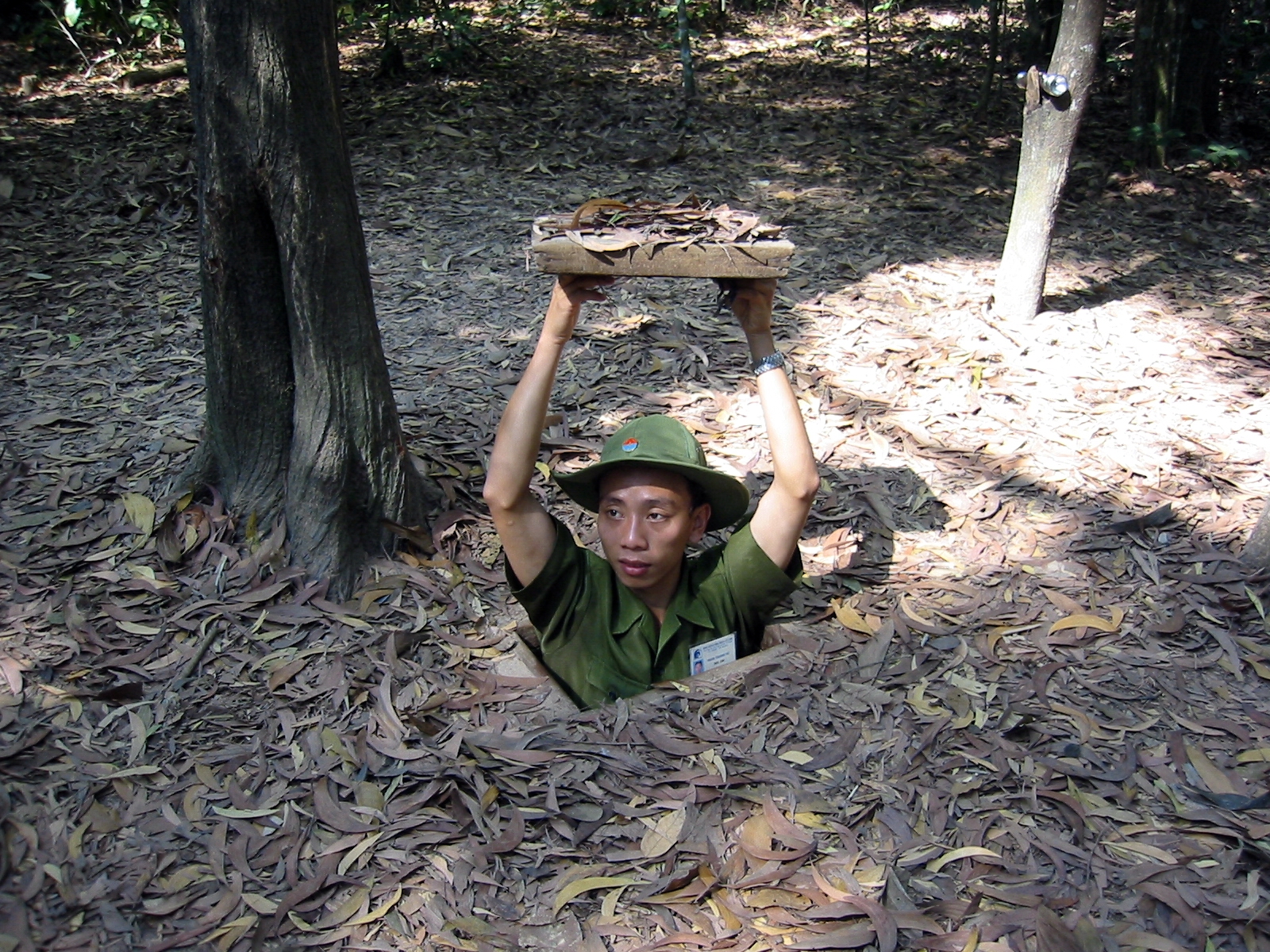
Life inside the Cu Chi Tunnels was harsh and dangerous. The narrow passageways were often less than a meter wide and required crawling. Air circulation was limited, and temperatures underground could be stifling. Insects, snakes, and disease were constant threats.
Despite these challenges, thousands of people lived and worked within the tunnels for extended periods. Entire communities moved underground during intense bombing campaigns.
Kitchens were designed with long, angled chimneys to cool and disperse smoke. Wells provided water, and makeshift hospitals treated wounded fighters under extremely difficult conditions.
The tunnels also served as a base for planning and launching military operations. Fighters could emerge unexpectedly to carry out attacks and then disappear back into the network.
This ability to strike and vanish frustrated opposing forces and contributed significantly to the effectiveness of guerrilla tactics in the region.
Military Significance During the Viet Nam War

During the Viet Nam War, the Cu Chi Tunnels became a focal point of strategic conflict. American and South Vietnamese forces launched repeated campaigns to locate and destroy the network.
Massive bombing operations and ground assaults targeted the area, yet much of the tunnel system survived.
Specially trained soldiers known as “tunnel rats” were sent underground to search for intelligence and sabotage operations. These missions were extremely dangerous due to booby traps, narrow confines, and limited visibility.
The resilience of the tunnel system symbolized the broader determination of Vietnamese fighters during the conflict.
The region earned the nickname “Iron Triangle” among American troops because of its reputation as a stronghold of resistance. Despite intense military pressure, the tunnels remained operational for much of the war, underscoring their strategic value.
Transformation into a Historical Site

After the war ended in 1975, the Cu Chi Tunnels were preserved as a historical and cultural site. Today, they attract visitors from around the world who seek to understand the realities of wartime life.
Guided tours allow guests to walk through widened sections of the tunnels and see reconstructed living spaces, command centers, and trapdoor entrances.
Exhibits display photographs, artifacts, and wartime equipment, offering context about the broader conflict in Viet Nam.
Visitors can observe demonstrations of traditional trap mechanisms and learn how everyday objects were adapted for survival and defense. The experience provides a vivid sense of how resourcefulness shaped the underground community.
While some sections have been enlarged for safety and tourism, the preserved areas still convey the claustrophobic conditions endured by those who once relied on them. The site encourages reflection on both the human cost of war and the resilience required to survive it.
A Symbol of Endurance and Ingenuity

The Cu Chi Tunnels represent more than a military strategy; they embody the perseverance of a people determined to defend their homeland. Built with limited resources yet remarkable creativity, the network stands as a testament to human adaptability under extreme pressure.
Today, the tunnels remain an important educational landmark in Viet Nam. They remind visitors that history is not only written in open battlefields but also carved quietly beneath the surface.
Through narrow passageways and hidden chambers, the story of endurance continues to resonate with each new generation.


