



Indonesia's journey toward becoming a major player in the global electric vehicle (EV) industry represents one of the most ambitious economic transformations in its modern history. Long recognized as a leading exporter of natural resources, the country is now leveraging its vast mineral wealth, industrial capacity, and domestic market to position itself at the center of the global energy transition.
Rather than viewing EVs solely as an environmental solution, Indonesia has embraced electrification as a national development strategy. The goal extends beyond cleaner transportation—it is about creating jobs, strengthening domestic industries, attracting investment, and moving higher up the global value chain.
From Resource Giant to Industrial Powerhouse
At the heart of Indonesia's EV ambitions lies its vast nickel wealth. The country possesses the world's largest nickel reserves, a critical ingredient in many lithium-ion batteries used in electric vehicles.
Recognizing the strategic value of this resource, Indonesia adopted a bold downstream industrialization policy known locally as hilirisasi. Instead of exporting raw nickel ore, the government encouraged investors to establish smelters, battery processing facilities, and manufacturing plants within the country.
This policy has transformed industrial centers such as the Morowali Industrial Park in Central Sulawesi into globally significant hubs for battery materials and EV supply chains. What was once a resource-exporting economy is increasingly evolving into a manufacturing and industrial powerhouse.
President Prabowo Subianto has repeatedly emphasized that the EV sector is central to Indonesia's broader vision of achieving energy independence and industrial self-sufficiency. In his view, the country must move beyond being merely a supplier of raw materials and become a global producer of high-value clean-energy products.
A Domestic Market Shifting into High Gear
Indonesia's EV market has expanded at a remarkable pace. Battery electric vehicle sales have climbed from roughly 10,000 units only a few years ago to more than 104,000 units in wholesale deliveries. EVs now account for approximately 15 to 18 percent of passenger vehicle sales, making Indonesia one of Southeast Asia's fastest-growing electric mobility markets.
The country's scale provides a significant advantage. With more than 280 million people and one of the largest automotive markets in Asia, even modest increases in EV adoption translate into substantial demand.
Indonesia's mobility patterns also create unique opportunities. Motorcycles remain the primary mode of transportation for millions of Indonesians, making electric two-wheelers a critical component of the country's electrification strategy. The transition of this enormous motorcycle ecosystem could ultimately become one of the world's largest EV success stories.
Policies Designed to Accelerate Change
Government support has played a major role in driving the sector forward. Authorities have set ambitious targets of 600,000 electric cars and 3.8 million electric motorcycles operating nationwide by 2030.
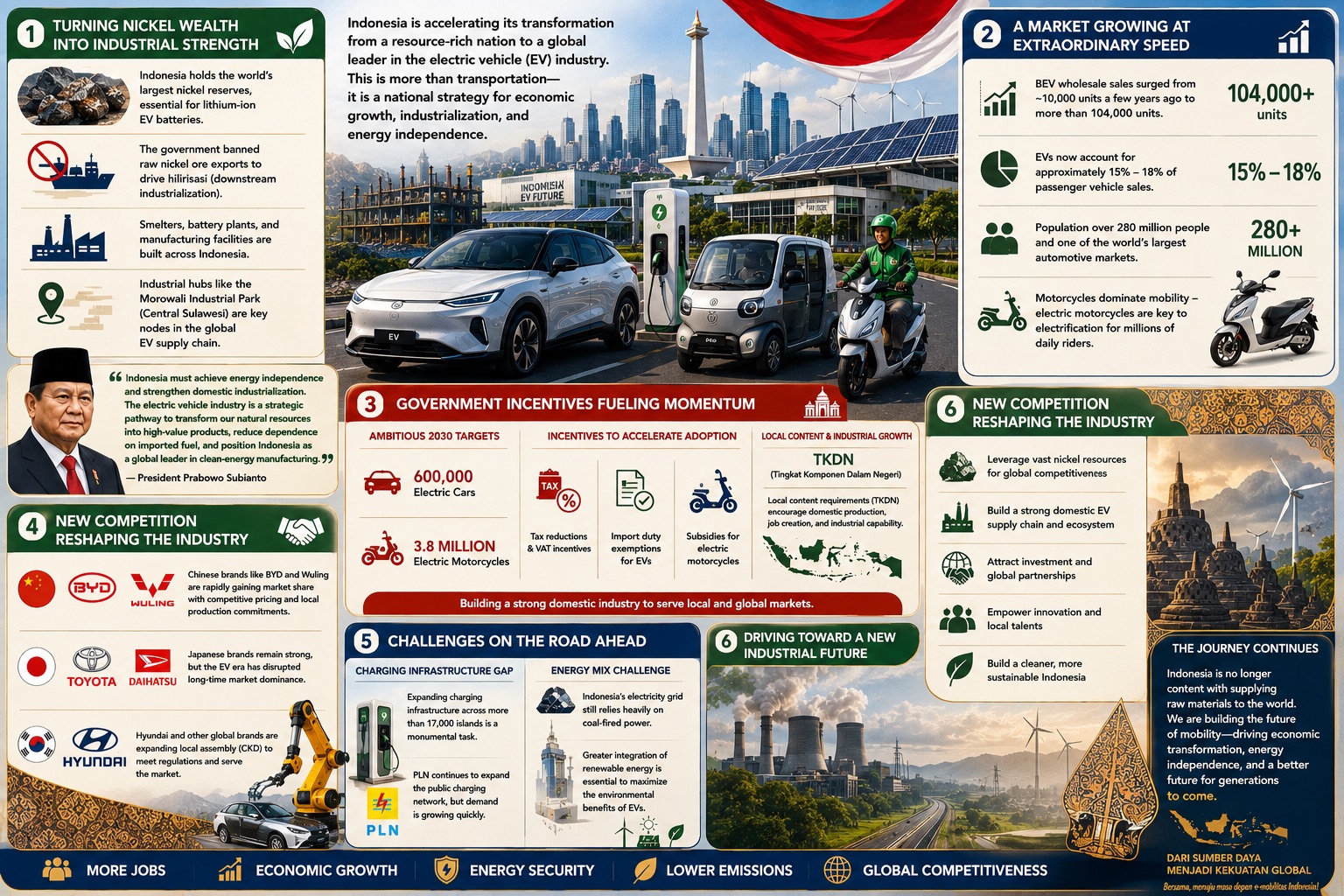
To encourage both investment and consumer adoption, the government has introduced a range of incentives, including tax reductions, VAT exemptions, and subsidies for electric motorcycles.
Another key pillar is the implementation of Tingkat Komponen Dalam Negeri (TKDN), Indonesia's local content requirement framework. Through TKDN, manufacturers are encouraged to source components and conduct production activities domestically in exchange for various incentives and market advantages.
This approach ensures that EV growth contributes not only to vehicle sales but also to broader industrial development and job creation.
A New Competitive Landscape Emerges
The rise of EVs has reshaped Indonesia's automotive market. For decades, Japanese automakers dominated the sector, controlling the overwhelming majority of vehicle sales.
Today, the landscape is becoming increasingly competitive. Chinese brands such as BYD and Wuling have rapidly expanded their presence through attractive pricing, innovative technology, and commitments to local manufacturing. BYD's emergence among Indonesia's leading automotive brands highlights the speed of this transformation.
Meanwhile, Hyundai has strengthened its position through domestic assembly operations, while several global manufacturers are transitioning from imports to local production in order to comply with regulatory requirements and remain competitive.
Navigating the Roadblocks Ahead
Despite impressive progress, Indonesia still faces significant challenges. Building charging infrastructure across an archipelago of more than 17,000 islands remains a complex undertaking. State-owned utility PLN continues to expand the public charging network, but demand is growing alongside adoption rates.
Questions also remain regarding the environmental footprint of the electricity used to power EVs. Indonesia's grid still relies heavily on coal-fired generation, creating a paradox in which cleaner vehicles depend on a relatively carbon-intensive energy system. Expanding renewable energy capacity will therefore be essential to maximizing the environmental benefits of electrification.
Building the Future of Mobility
Indonesia's EV transition is ultimately about much more than transportation. It represents a broader effort to transform the country's economic structure, strengthen industrial competitiveness, and secure a more resilient energy future.
By combining abundant nickel resources, supportive government policies, growing domestic demand, and increasing manufacturing capabilities, Indonesia is laying the foundations for a globally significant EV ecosystem.
The road ahead will not be without challenges, but the direction is clear. Indonesia is no longer content with exporting raw materials to the world. Instead, it is working to become a nation that designs, manufactures, and powers the next generation of mobility.


