


Malaysia's relationship with the automobile runs deep. For decades, national brands such as Proton and Perodua have symbolized the country's industrial aspirations, while highways stretching from Johor to Kedah have connected a growing middle class to economic opportunity. Today, a new chapter is unfolding as electric vehicles begin reshaping the nation's automotive landscape.
Unlike some countries that view electrification primarily through an environmental lens, Malaysia is pursuing a carefully calibrated strategy. The objective is not only to encourage cleaner mobility but also to preserve its position as a regional automotive hub while strengthening domestic manufacturing capabilities.
From Niche Market to Mainstream Momentum
Not long ago, electric vehicles were largely associated with luxury showrooms and affluent early adopters. That perception is rapidly changing.
The Malaysian EV market has experienced remarkable growth, with registrations reaching nearly 5,900 units in a single month and recording year-on-year growth exceeding 100 percent. EVs now account for approximately 7.6 to 9.1 percent of the country's Total Industry Volume, meaning that roughly one in every dozen new vehicles sold is fully electric.
A major factor behind this shift has been the emergence of more affordable models aimed at everyday consumers. Perhaps the clearest sign of mainstream acceptance is the success of Proton's dedicated electric vehicle initiative. The Proton e.MAS series has quickly become one of the country's most visible EV success stories, demonstrating that electrification is no longer limited to premium imports.
Protecting Industry While Encouraging Investment
Malaysia's EV strategy reflects a careful balancing act between openness and protection.
A significant turning point came with the expiration of the tax exemption for fully imported electric vehicles at the end of 2025. Imported EVs now face normal duties, while policies continue to favor vehicles assembled domestically.
The Ministry of Investment, Trade and Industry has also maintained regulations requiring imported EVs to meet minimum pricing and performance thresholds. These measures are designed to prevent foreign brands from overwhelming the domestic market while encouraging global manufacturers to establish local production facilities.
Meanwhile, tax incentives for Completely Knocked-Down assembly operations have been extended until the end of 2027. The message is clear: Malaysia welcomes EV investment, but it prefers factories over imports.
Making Electric Mobility More Affordable
Recognizing that affordability remains a major concern, the government introduced a new road tax framework tailored specifically for electric vehicles beginning in 2026.
Transport Minister Anthony Loke described the revised structure as an effort to create a fairer and more practical system for EV owners. Under the new kilowatt-based formula, many mass-market electric vehicles now pay road taxes comparable to conventional petrol-powered cars.
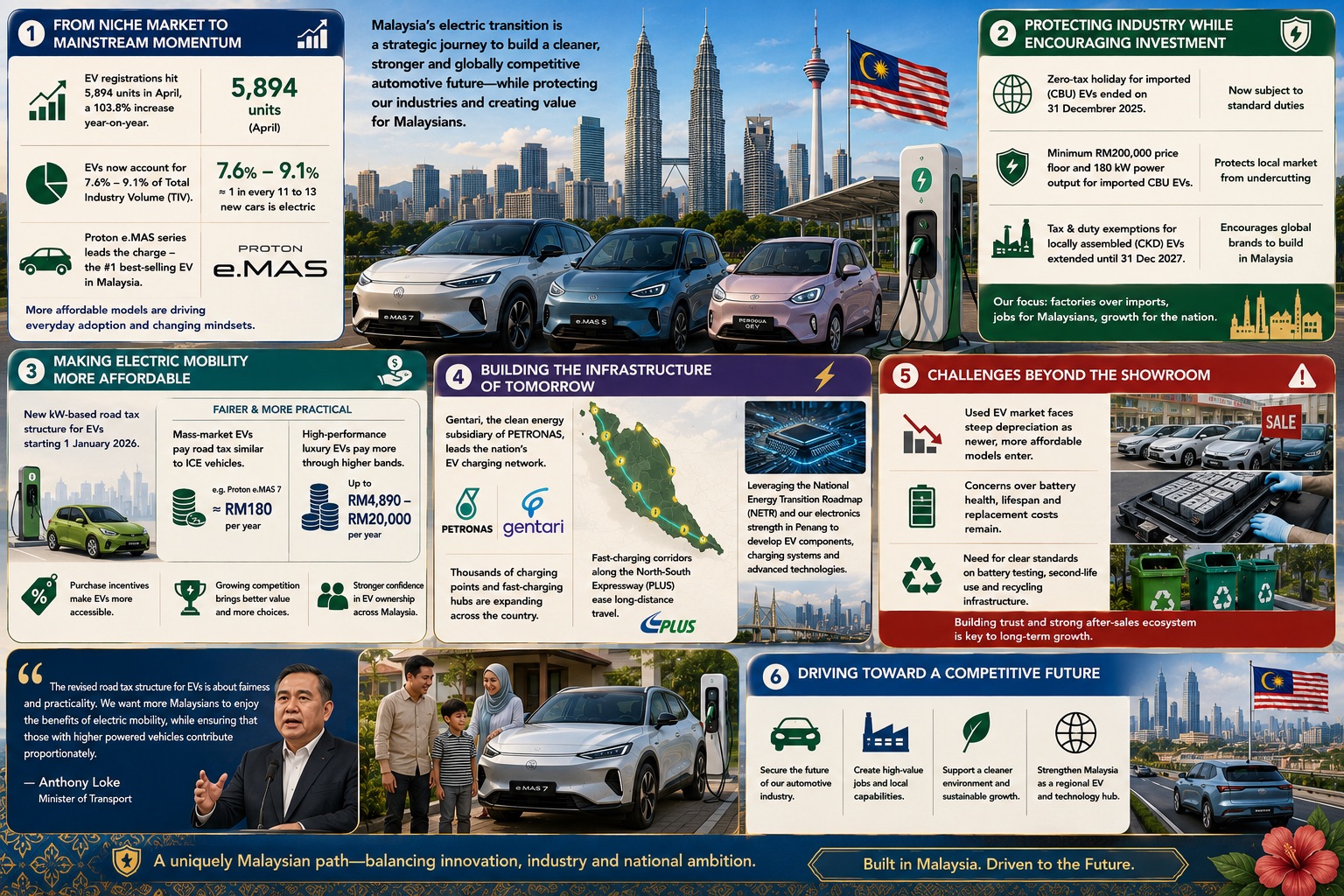
This approach lowers barriers for consumers while ensuring that ultra-high-performance luxury EVs contribute proportionately through higher tax brackets.
Combined with purchase incentives and growing competition among manufacturers, the reforms have helped strengthen consumer confidence in electric mobility.
Building the Infrastructure of Tomorrow
No EV transition can succeed without charging infrastructure, and Malaysia has moved aggressively to expand its network.
One of the most interesting aspects of this transformation is the role of Gentari, the clean energy subsidiary of Petronas. In a striking example of industrial evolution, Malaysia's national oil company is now helping lead the development of the country's EV charging ecosystem.
Fast-charging stations have become increasingly common along the North-South Expressway, reducing concerns about long-distance travel between major cities. At the same time, Malaysia's National Energy Transition Roadmap is leveraging the country's strong electronics sector, particularly in Penang, to develop expertise in EV components, charging systems, and related technologies.
Challenges Beyond the Showroom
Despite encouraging growth, several challenges remain.
One of the most significant concerns involves the used EV market. Early adopters who purchased premium electric models at high prices have experienced rapid depreciation as newer and more affordable vehicles enter the market.
Questions surrounding battery health, long-term maintenance costs, and recycling infrastructure also continue to influence consumer perceptions. Establishing reliable standards for battery assessment and disposal will be essential as the market matures.
Driving Toward a Competitive Future
Malaysia's EV journey is about more than replacing petrol engines with batteries. It is a broader effort to secure the future of one of the country's most important industries while adapting to a rapidly changing global economy.
By combining industrial protection, strategic incentives, infrastructure investment, and domestic innovation, Malaysia is charting a uniquely Malaysian path toward electrification. The road ahead may present challenges, but the foundations are already being laid for a future in which electric mobility supports not only environmental goals, but also national competitiveness and economic resilience.
As the transition accelerates, Malaysia is demonstrating that success in the EV era is not simply about adopting new technology—it is about ensuring that the benefits of that transformation are built and shared at home.


