


In a nation where long-term planning shapes everything from housing and transport to energy and urban development, Singapore's electric vehicle revolution feels less like a sudden disruption and more like the next logical step in a carefully designed future.
What was once considered a premium lifestyle choice has now become the dominant preference among new car buyers. Electric vehicles account for more than 57 percent of new car registrations, surpassing petrol and hybrid vehicles combined. For Singapore, the transition is not simply about cleaner transportation—it is a demonstration of how policy, infrastructure, and market forces can work together to accelerate change.
Building the Future Through Policy
The foundation of Singapore's EV success lies in decisive government action.
Under the Singapore Green Plan 2030, the government has committed to phasing out internal combustion engine vehicles over the coming decades. New diesel car and taxi registrations have already been discontinued, while all new vehicle registrations are expected to move toward cleaner-energy models by 2030. By 2040, conventional petrol and diesel vehicles will no longer be part of Singapore's automotive future.
To support the transition, policymakers introduced incentives such as the EV Early Adoption Incentive and the Enhanced Vehicular Emissions Scheme. These measures significantly narrowed the price gap between electric and conventional vehicles during the market's early growth phase.
Transport Minister Chee Hong Tat has emphasized that electrification forms a key pillar of Singapore's broader sustainability agenda, helping the nation reduce emissions while modernizing its transport system.
Chinese Brands Redefine the Marketplace
One of the most striking developments in Singapore's EV story has been the dramatic reshaping of the automotive market.
Chinese manufacturers have emerged as dominant players, led by BYD, which now accounts for nearly one-quarter of all new vehicle sales in the country. Other brands such as Chery, GAC Aion, and MG have also risen rapidly through the rankings, challenging the long-standing dominance of Japanese and Korean manufacturers.
Tesla remains one of the most recognizable premium brands in the market, while luxury electric offerings continue to attract affluent consumers seeking advanced technology and performance.
The transformation reflects a broader regional trend, but nowhere is it more visible than in Singapore, where consumers are often among the first in Southeast Asia to embrace emerging automotive technologies.
Charging Infrastructure Within Reach
Singapore's compact geography provides a natural advantage for electric mobility.
The average daily driving distance is approximately 55 kilometers, making range anxiety largely irrelevant for most motorists. Unlike larger countries that require extensive highway charging networks, Singapore focuses on residential accessibility.
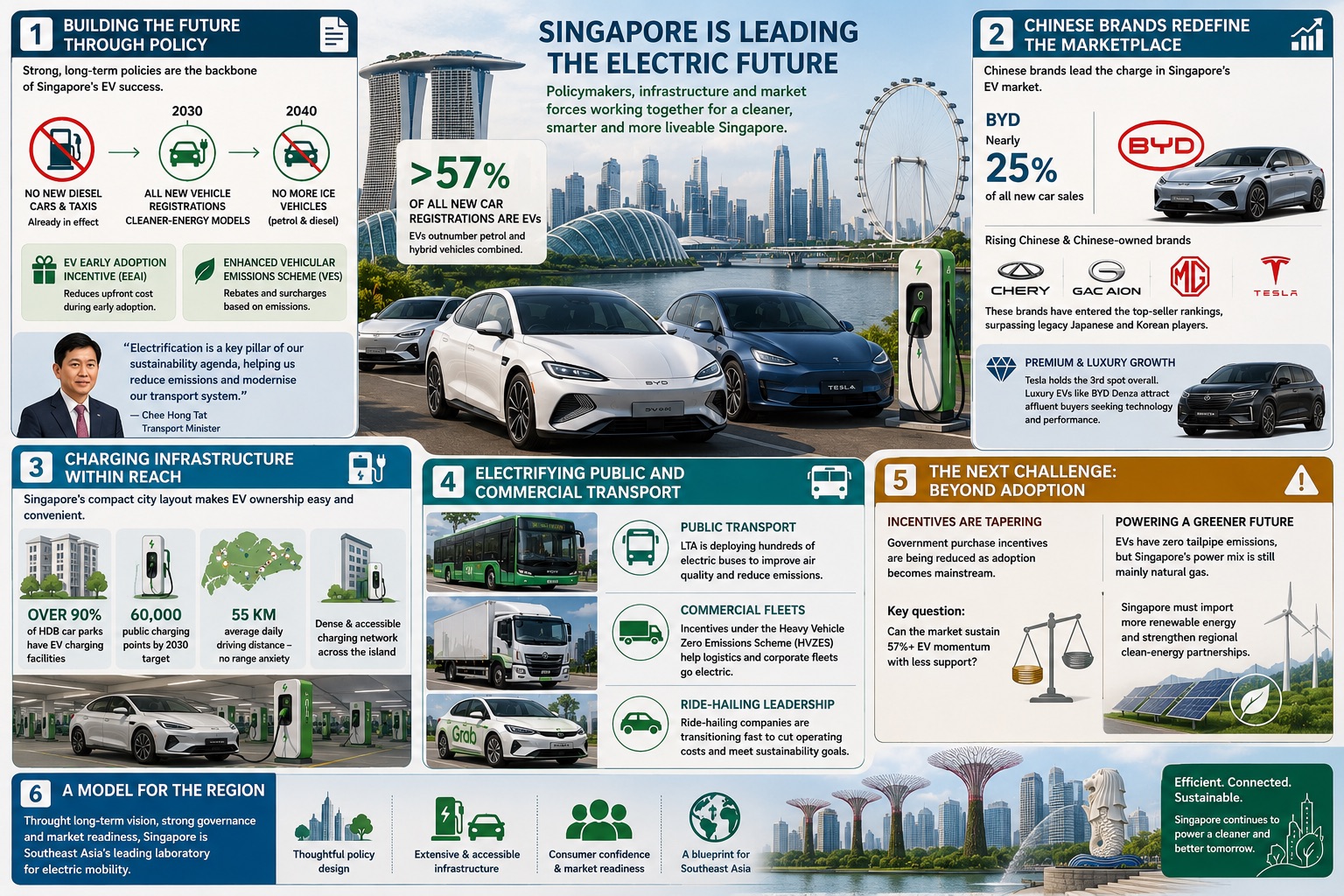
Today, more than 90 percent of Housing and Development Board car parks have access to EV charging facilities, bringing charging infrastructure directly into the neighborhoods where most Singaporeans live.
The government is also progressing toward its goal of deploying 60,000 charging points nationwide by 2030. This dense and accessible network is helping make EV ownership increasingly convenient for both private and commercial users.
Electrifying Public and Commercial Transport
The transition extends well beyond private vehicles.
The Land Transport Authority has accelerated the deployment of electric buses across the public transport network, supporting national emissions reduction targets while improving urban air quality.
Commercial operators are also embracing electrification. Through programs such as the Heavy Vehicle Zero Emissions Scheme, logistics companies and fleet operators are receiving incentives to transition toward cleaner vehicles.
Ride-hailing companies have become particularly active participants in this shift, attracted by lower operating costs and growing consumer demand for sustainable transport options.
The Next Challenge: Beyond Adoption
Despite remarkable success, Singapore's EV journey is entering a new phase.
As adoption becomes mainstream, government purchase incentives are gradually being reduced. A key question for policymakers and industry observers is whether consumer demand will remain strong once financial support becomes less generous.
Another important consideration involves the source of electricity itself. Although EVs eliminate tailpipe emissions, Singapore's power generation remains heavily dependent on natural gas. Achieving deeper decarbonization will require expanding access to imported renewable energy and strengthening regional clean-energy partnerships.
A Model for the Region
Singapore's EV transformation demonstrates what can happen when long-term vision, strong governance, and market readiness align.
The city-state may lack the vast manufacturing ecosystems of Indonesia or Thailand, but it has established itself as Southeast Asia's leading laboratory for electric mobility. Through thoughtful policy design, extensive infrastructure deployment, and consumer confidence, Singapore has shown that large-scale electrification is achievable even in one of the world's most densely populated urban environments.
As the rest of the region accelerates toward an electric future, Singapore continues to offer a glimpse of what that future may look like—efficient, connected, and increasingly powered by clean energy.


