


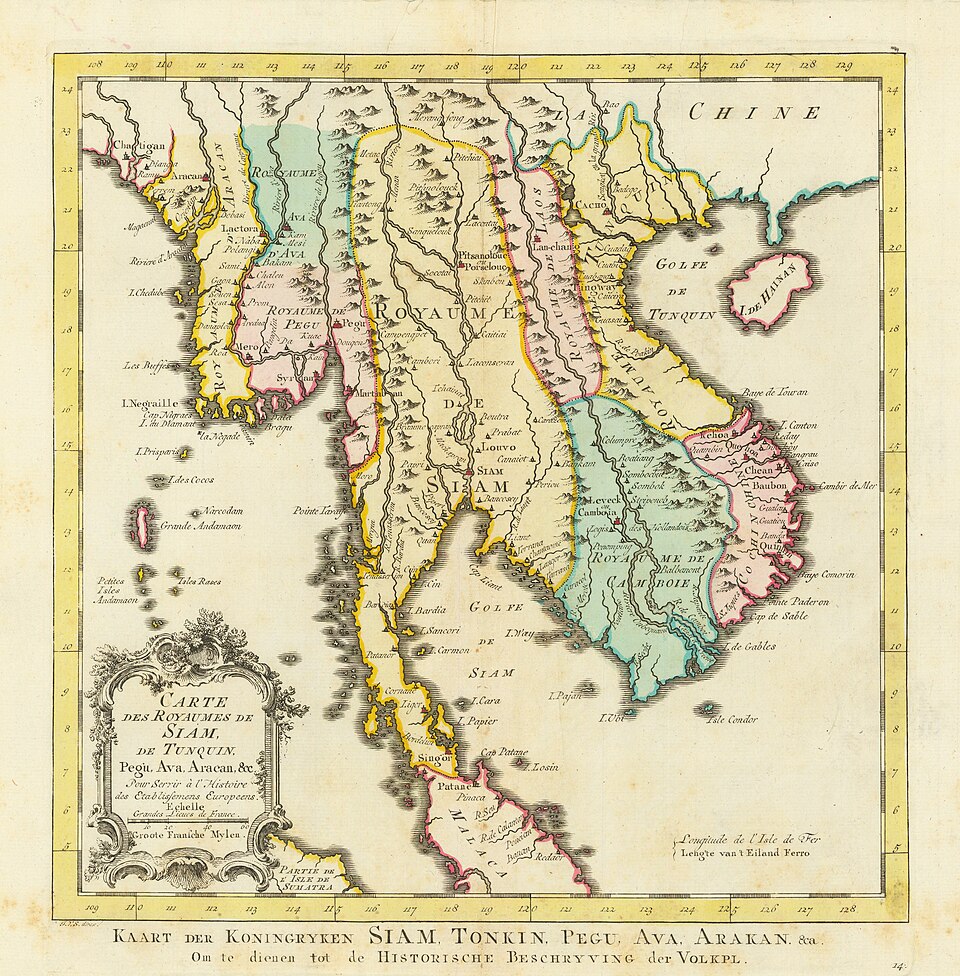
In 1909, the Kingdom of Siam stood between three European colonial territories at once: British Burma to the west and northwest, French Indochina to the east, and British Malaya to the south. Of its four directions, only the north bordered China rather than a European colonial power.
Siam was the only kingdom in Southeast Asia that was never formally colonized, even as all of its neighboring states had fallen under European rule. To preserve that position, Siam ceded territory to Britain and France in several stages. The lands it gave up were its peripheral regions, while the kingdom's core in the Chao Phraya basin remained intact.
The First Western Border
Britain, not France, was the first European power to share a direct land border with Siam. Following the First Anglo-Burmese War (1824–1826), Britain seized Tenasserim, a province in southern Burma that bordered Siam to the west. This marked the first time Siam shared a land frontier with a European colonial power.
Three decades later, King Mongkut (Rama IV) took a highly unusual approach for his time. Rather than waiting for external pressure to build, he proactively signed the Bowring Treaty in 1855 with the British envoy Sir John Bowring.
The treaty opened Siam's markets to free trade, fixed import duties at three percent, and granted British subjects extraterritorial rights within Siam. Mongkut later signed similar agreements with France and several other Western powers.
The logic behind this strategy was straightforward. By voluntarily granting the rights that European powers often fought to secure elsewhere, Siam removed one of the most common justifications for colonial intervention.
In 1886, following the Third Anglo-Burmese War, Britain annexed the whole of Burma. Siam's western frontier had now become a full border with British India.
Warships Off Bangkok
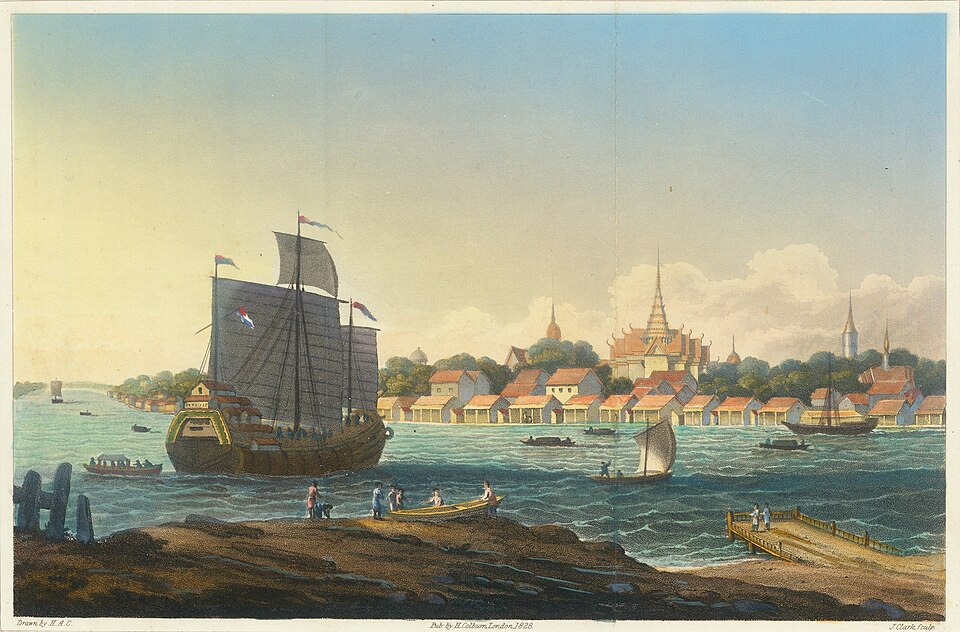
Pressure from the east proved even more intense. On July 13, 1893, two French warships, Inconstant and Comète, forced their way into Bangkok despite being denied permission by Siam. Fort Chulachomklao fired warning shots, but the French vessels did not stop.
A firefight followed, leaving three French sailors dead and around 20 Siamese soldiers killed. A French steamship named Say also sank during the incident.
France then issued an ultimatum. Siam was forced to cede all territory east of the Mekong River, which would later become modern-day Laos, and pay an indemnity of three million francs.
A 25-kilometer demilitarized zone was established along the western bank of the Mekong. According to GlobalSecurity, the 1893 territorial cession amounted to roughly one-third of Siam's territory at the time.
The loss of territory did not end there. In 1904, Siam ceded additional land on the right bank of the Mekong in exchange for the return of the port of Chanthaburi, which remained under French occupation. In 1907, King Chulalongkorn (Rama V) was compelled to transfer Battambang and Siem Reap to French Cambodia.
In the south, the final boundary was settled with Britain. On March 10, 1909, the Anglo-Siamese Treaty was signed.
Siam transferred sovereignty over Kedah, Kelantan, Perlis, and Terengganu, the four northern Malay states on the Malay Peninsula, to British Malaya. The southern land boundary was fixed at 566 kilometers.
In return, Britain provided Siam with a substantial loan to finance the construction of its railway network.
Surviving Between Two Empires
Chulalongkorn responded to pressure from both Britain and France with a deliberate diplomatic strategy. In 1892, he appointed Gustave Rolin-Jaequemyns, a Belgian legal scholar, as General Adviser to Siam, a position he held until 1902.
The appointment was more than a technical one. As a respected European official whose professional interests were tied to Siam's independence, Rolin-Jaequemyns was able to advocate for the kingdom within European political circles.
Chulalongkorn also made two state visits to Europe, in 1897 and 1907. These journeys were carefully designed as both diplomatic missions and public relations campaigns, presenting Siam to European leaders as a modern and sovereign kingdom.
In 1896, British and French interests converged in a way that ultimately benefited Siam. Through the Anglo-French Declaration, the two colonial powers formally recognized Siam's independence, particularly the Chao Phraya basin, as a neutral buffer zone. Both preferred an independent Siam to sharing a direct border with one another.
From Siam to Thailand
European pressure largely subsided after 1909, but major changes soon came from within the kingdom itself.
On June 24, 1932, a group of military officers and technocrats, many of whom had been educated in Europe, carried out a bloodless coup that ended absolute monarchy. Siam subsequently became a constitutional monarchy.
Seven years later, on June 24, 1939, Prime Minister Phibun Songkhram announced that the country's name would be changed from Siam to Thailand, deliberately marking the seventh anniversary of the 1932 Revolution.
The decision had been approved during a cabinet meeting on May 8, 1939, in just ten minutes, despite opposition from three of the six ministers present. The name "Thailand" emphasized the identity of the ethnic Thai majority and symbolized modernization.
During the Second World War, Thailand aligned itself with Japan and temporarily regained parts of the territories it had previously ceded to France and Britain. Following Japan's defeat, those territories were returned.
In 1946, the country's name was changed back to Siam, but after Phibun returned to power, the name Thailand was permanently reinstated on May 11, 1949.
The country's present-day borders are, in essence, the product of the treaties signed between 1893 and 1909 and were ultimately reaffirmed after the end of the Second World War.


