


In the late sixteenth century, a port on Manila Bay became a marketplace where three continents converged. Silver mined in the mountains of Mexico and Peru was unloaded at the same docks where Chinese silk and porcelain were loaded, while spices and goods from the Southeast Asian archipelago changed hands in between.
Such an exchange had never before taken place in such a direct and continuous manner.
Several economic historians regard this moment as the birth of truly global trade. In a 1995 article published in the Journal of World History, Dennis O. Flynn and Arturo Giráldez of the University of the Pacific argued that global trade emerged with the founding of Manila in 1571, when all of the world's major populated continents began exchanging goods with one another on a continuous basis.
Their argument has been recognized as highly influential while also being described as controversial by later reviewers, placing Manila at the center of a historical debate that continues today.
The Birth of the Manila Galleon Trade
The path toward that role had actually begun several years earlier. In 1565, the Augustinian friar and navigator Andrés de Urdaneta pioneered the tornaviaje, the return sea route from the Philippines to Mexico that European sailors had failed to discover for decades following Ferdinand Magellan's voyage in 1521.
A review of Andrés Reséndez's Conquering the Pacific, published in the Journal of Arizona History (2022), notes that the arrival of Urdaneta's ship, San Pedro, in Acapulco marked the beginning of a new era of navigation between Spain's colonies in the Philippines and the Americas. The vessels operating along this route later became known as the Manila Galleons.
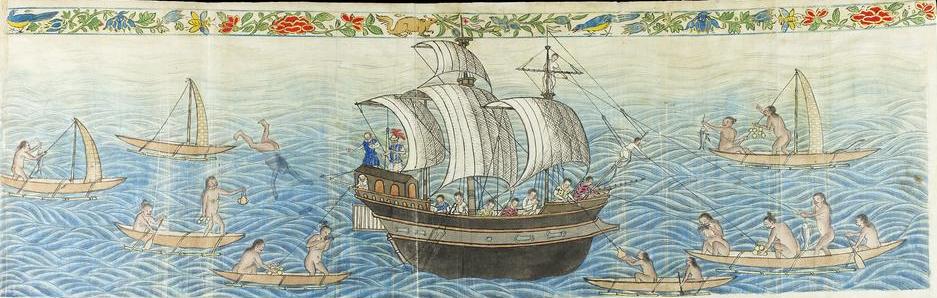
Manila itself did not become the center of global commerce until Miguel López de Legazpi transferred the colonial capital from Cebu to Manila in 1571. According to Flynn and Giráldez, it was from this point onward that all of the world's major populated continents began exchanging goods with one another on a continuous basis.
The distinction between these two dates is important. The year 1565 marked the opening of the maritime route, while 1571 was the year Manila officially began functioning as the entrepôt linking Asia and the Americas through the Manila Galleon trade.
Why China Became the Center of Gravity
What kept this marketplace in motion was silver. In their 1995 Journal of World History article, Flynn and Giráldez explain that China's fiscal and monetary system had shifted to a silver standard, causing the metal to be worth as much as twice its value elsewhere in the world.
This price differential drew American silver across the Pacific to Manila, where Chinese merchants exchanged it for silk, porcelain, and textiles.
In the same analysis, Flynn and Giráldez argue that the Spanish conquest of Manila in 1571 and the development of direct trade between Asia and Spanish America—driven by the large-scale shipment of silver in exchange for Asian commodities, particularly textiles—marked the dawn of a truly global trading system.
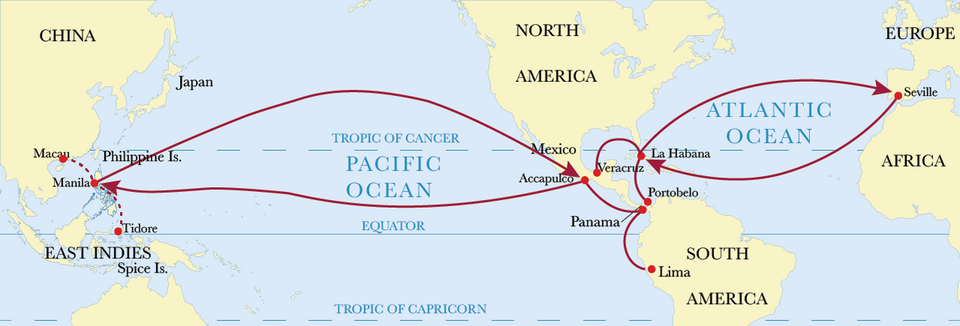
Within this framework, Europe functioned more as an intermediary than as the center of global commerce. Flynn and Giráldez even conclude that, during this period, China's economic influence on the Western world was far greater than Europe's influence on Asia.
A Thesis That Remains Debated
The claim that globalization was born in Manila is far from universally accepted among historians.
The 1571 date proposed by Flynn and Giráldez has been described as controversial because some historians place the beginning of genuine global integration in the Philippines much later, around the eighteenth century, when both the volume and the nature of trade changed dramatically.
The debate centers not on whether Manila played a pivotal role, but on when a trading network can legitimately be described as truly global.
Despite the disagreement over the timeline, there is broad consensus on one point. At the time, Manila was the meeting place where American silver, Chinese goods, and Southeast Asian commodities converged within a single commercial circuit.
Whether the city deserves to be called the world's first global city ultimately depends on the definition being used. Its role as the hub linking three continents through a unified trading network, however, is difficult to dispute.


