Cambodia has experienced several shifts in its official national identity over the years. The territory has officially altered its country name six times over the span of approximately seven decades.
The sequence of the shifts commenced following the era of full independence from France in 1953.
Each successive administrative leadership brought a new formal identity agreed upon by the ruling authorities. The changes in official identity were consistently accompanied by significant visual transformations of the national flag.
The Early Era of Post-French Independence

The first name implemented was the Kingdom of Cambodia, which remained in effect from 1953 until 1970. The identity was designated immediately after breaking free from French colonialism. The governance system at that time operated as a constitutional monarchy.
The title aligned with the initial leadership structure headed by the royal family. During this period, the national flag featured three horizontal stripes of blue-red-blue. A white silhouette of the three-towered Angkor Wat temple was positioned directly in the center of the wide red stripe.
The Transition to a Republican Form

The first identity shift occurred when the official name changed to the Khmer Republic in 1970. This new title persisted for five years until 1975.
The government at the time deliberately omitted royal terminology from the nation's name. The move marked a new era for Cambodia as it began adopting a republican system.
The national symbols were also completely overhauled to align with the new secular identity. The flag background changed entirely to a deep blue color. A small red square containing a white silhouette of Angkor Wat was placed in the upper left corner, adjacent to three white stars.
The Democratic Name Period

The state identity was completely altered again to Democratic Kampuchea in 1975. The duration of this name was relatively brief, lasting only until 1979.
The spelling of the country's name was intentionally changed from the international version to the local pronunciation. The authorities in power used the title to assert a new sovereignty.
The visual representation of the official identity during this era was made highly minimalist. The national flag was changed to a predominantly plain red background. In the center, there was only a silhouette of three Angkor Wat towers drawn in a bright yellow color.
The People's Republic Phase

The official name of the state subsequently shifted to the People's Republic of Kampuchea in 1979. This identity was utilized in diplomatic documents for a decade until 1989. The declaration of the new name took place following a change of leadership control in the capital city of Phnom Penh.
The name was adopted to align with the direction of the new administration. Modifications to the state emblem were conducted again to reflect the current governing phase.
The national flag maintained the dominant plain red background. The distinction lay in the central Angkor Wat silhouette, which was drawn in yellow but featured five towers instead of three.
The Transition Period of the State of Cambodia

Entering the year 1989, the official name of the country was simplified to the State of Cambodia. The utilization of this name lasted until 1993. The term republic was officially dropped from the formal identity of the state.
The visual identity design was also modified to represent the spirit of reunification. The flag background was divided horizontally into two equal color sections, with red on top and blue on the bottom. The yellow five-towered Angkor Wat silhouette was retained in the center.
The Return to the Original Form
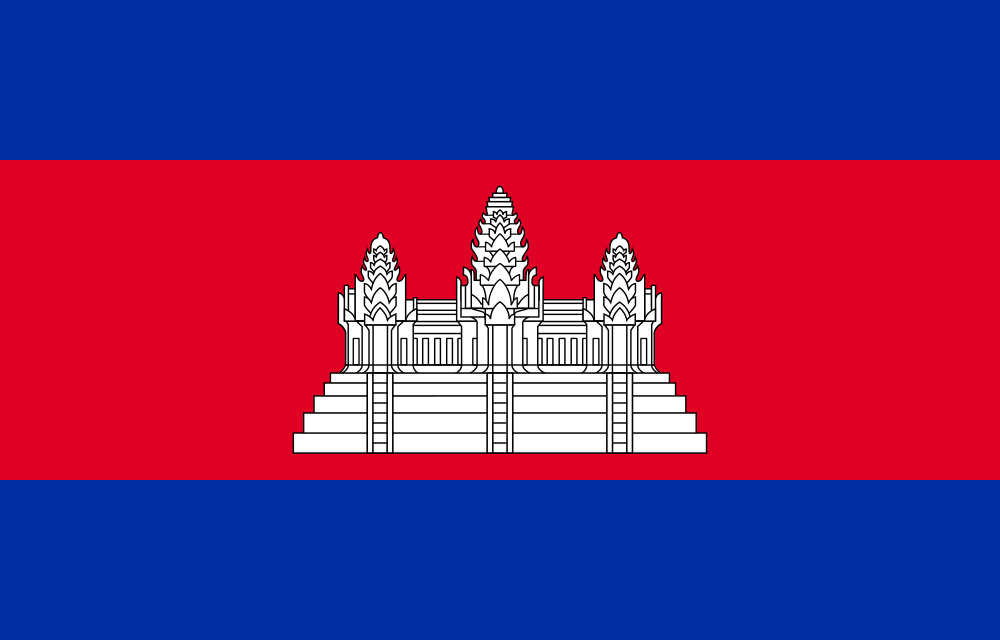
Cambodia eventually returned to using the official name Kingdom of Cambodia in 1993. This identity has continued to endure until the present day. The return to the original name marked the full restoration of Cambodia's constitutional monarchy system.
The local authorities readopted the 1953 name as a symbol of returning to the nation's historical roots. The government also restored the use of the original 1953 flag design. The three horizontal blue-red-blue stripes with the white three-towered Angkor Wat silhouette flew officially once again.