


Before stepping onto the stage at the Jakarta Institute of the Arts, the artists behind Les Filles de la Mer met audiences at Institut français d’Indonésie Jakarta on September 1, 2026. The gathering was not a shortened performance, but an invitation to enter the work through conversation: how it was created, whose experiences it carries and why its themes of women, islands, migration and violence cross national borders.
The discussion prepared Jakarta audiences for the production’s performances at Teater Luwes on September 3 and 4. Combining drama, contemporary dance, spoken narrative and immersive visual elements, the production represents more than a French company touring Indonesia. It is a shared artistic journey shaped by French and Indonesian bodies, traditions and perspectives.
Context: A Paris Production Finds Its Indonesian Shore
Created by Paris-based Artistique Théâtre, Les Filles de la Mer, or Daughters of the Sea, was written, directed and choreographed by Lucile Cocito and Shaula Cambazzu. The production was first presented in Paris in 2023 before travelling to Greece in 2025 and undertaking its Indonesian tour from August to September 2026.
Indonesia was never intended to serve merely as another destination on its international calendar. The production was developed through a long-term collaboration with Indonesian dancer and choreographer Kadek Puspasari, who has lived and worked in France since 2010. Her background in classical Javanese and Balinese dance, combined with her contemporary practice, gives the work a direct connection to Indonesia’s artistic traditions.
The country’s archipelagic character also adds another dimension to the production. In Indonesia, the sea is simultaneously a passage, a source of livelihood, a border and a connection between communities. The idea of women separated and united by water therefore finds an immediate resonance among Indonesian audiences.
Content: The Sea as Witness and Bridge
The performance follows women from Asia, Africa and Europe whose journeys eventually intersect in France. Their stories explore physical migration as well as an internal form of migration: the struggle to preserve one’s identity after leaving familiar languages, landscapes and communities.
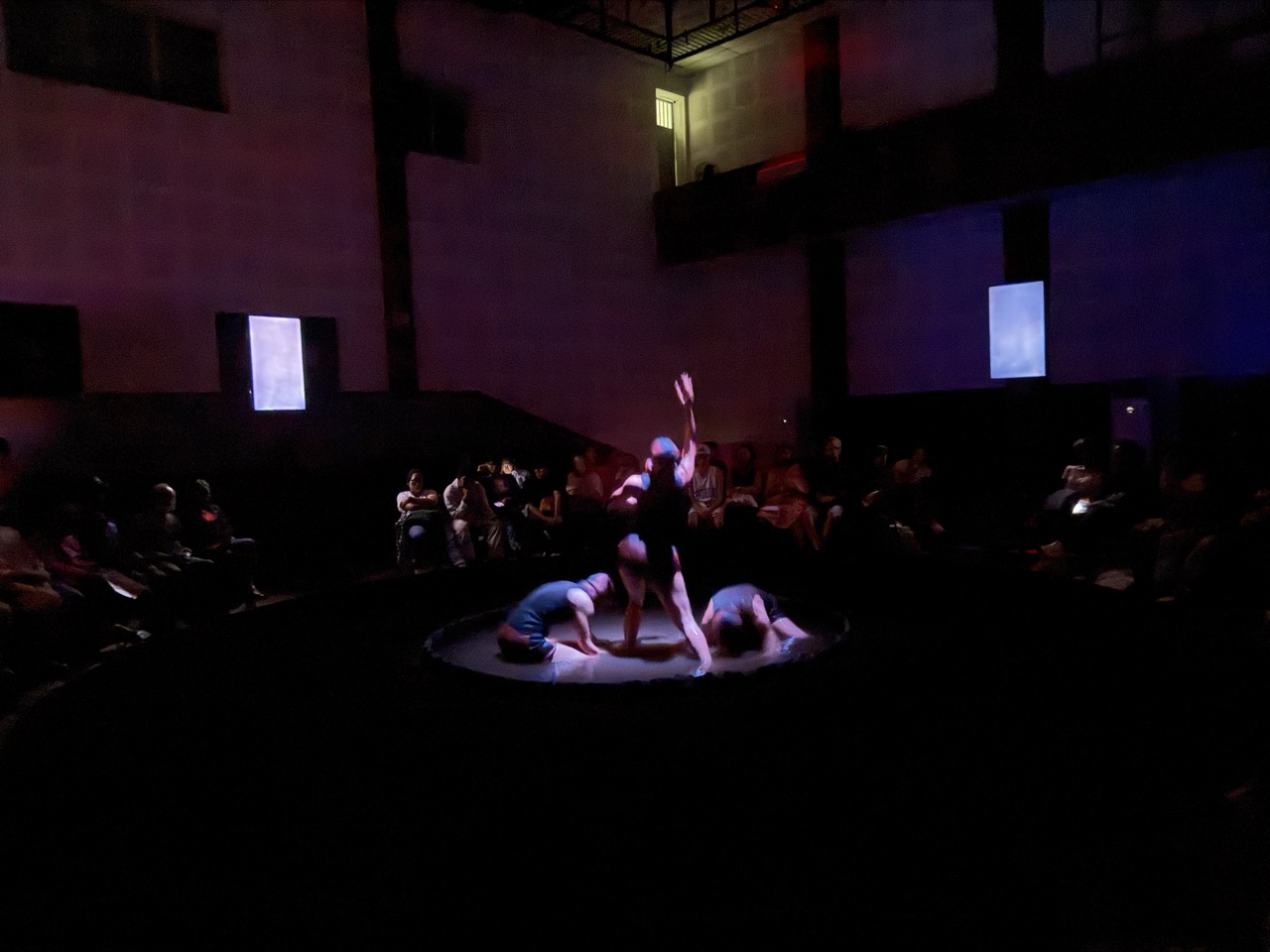
Water and soil become active parts of the performance rather than decorative scenery. The audience sits around the performers, reducing the conventional distance between the stage and the seats. Bodies move through earth, water, sound and projected imagery, creating what the artists describe as an inverted island. The sea appears not only as a geographical boundary but also as a pathway into memory, uncertainty and new possibilities.
The production addresses the particular vulnerability experienced by women during migration. French artist Lucile Cocito summarized the urgency behind the work by saying, “Wherever they are, many women around the world become victims of violence.”
The performance also remembers women whose stories might otherwise disappear from public attention. Among them is Italian performance artist Pippa Bacca, who was killed in Türkiye in 2008 while undertaking an artistic journey intended to promote peace and human connection. Rather than recreating violence as spectacle, the production uses movement and poetry to restore dignity, memory and solidarity.
Collaboration: Tradition Enters Contemporary Motion
The Indonesia–France partnership is most visible in the interaction between different artistic vocabularies. Shaula Cambazzu brings experience in contemporary European dance and theatre, while Kadek Puspasari contributes an embodied knowledge shaped by Bali, Java and her international career.
During the Indonesian tour, the creative process extended beyond performances. The artists encountered classical Javanese and Balinese dance, participated in workshops in Indramayu and explored mask traditions and Reog in Ponorogo. These encounters were not intended to copy traditional forms directly. They offered new ways of understanding rhythm, posture, community and the relationship between performers and their surroundings.
Kadek has previously described cultural education as a two-way process rather than a one-directional presentation. “Learning my culture can become a bridge through which people understand themselves,” she explained when discussing her work introducing Indonesian traditions in France.
That principle is visible in Les Filles de la Mer. Kadek does not simply perform a traditional Indonesian dance inside a French production. Her movement emerges from tradition but is translated into a contemporary language suited to the work’s themes and setting. French and Indonesian influences remain identifiable without being separated into competing cultural categories.
Community: Five Cities Become Cultural Laboratories
The scale of the Indonesian journey gives the collaboration greater significance. From August 3 to September 6, the tour travelled through five cities: Surabaya, Surakarta, Yogyakarta, Bandung and Jakarta. Ten performances were scheduled, beginning at Universitas Negeri Surabaya before continuing to Solo, ARTJOG in Yogyakarta, IFI Bandung and Teater Luwes IKJ in Jakarta.
Each stop was designed as a cultural laboratory rather than a single evening of entertainment. The programme included two- or three-day workshops, meetings with local communities, public discussions and conversations with audiences following performances. Universities, festivals, French cultural institutions and Indonesian arts organisations became part of a network supporting the tour.
The project’s planning document set targets of training more than 50 local artists and involving over 500 students and community members in discussions concerning gender equality, migration and cultural identity. Those figures illustrate a model of cultural diplomacy based on participation. Its success is measured not only by the number of seats filled, but also by the artists trained, conversations continued and relationships established.
Local partnerships were essential. Universitas Negeri Surabaya hosted the opening performances, ARTJOG connected the production with Indonesia’s contemporary arts community, and the Jakarta Institute of the Arts provided a setting where performers, students and audiences could meet. The public discussion at IFI Jakarta further allowed people to question the artists directly before encountering the complete production.
Continuity: Building Exchange Beyond the Final Applause
The lasting value of Les Filles de la Mer will depend on what happens after the tour. Workshops can lead to future artistic research, university partnerships or invitations for Indonesian performers to develop work in France. Conversations about migration and violence against women can also continue through community organisations, educational programmes and new creative projects.
This approach reflects a contemporary direction in Indonesia–France cultural relations. Cultural diplomacy is no longer limited to presenting a finished national product to a foreign audience. It increasingly involves co-creation, translation, local participation and the willingness of visiting artists to learn from the places they enter.
For Indonesia, the tour creates international space for local artistic knowledge without requiring tradition to remain static. For France, it provides a deeper encounter with an archipelago whose performance cultures are inseparable from community, spirituality and collective memory. For the artists, the collaboration demonstrates that cultural exchange is strongest when every participant is allowed to influence the work.
As Les Filles de la Mer completes its Indonesian journey in Jakarta, the sea at the centre of its story takes on another meaning. It no longer represents only distance or separation. Through movement, dialogue and shared creation, it becomes a route connecting Paris with Indonesia’s artistic cities—and women’s experiences across continents with audiences willing to listen.


