


In Southeast Asia, a standing forest supports life far beyond its boundaries. It feeds streams that irrigate farms, supplies materials for village businesses and shelters wildlife found nowhere else. Protecting that canopy increasingly depends on whether the people living closest to it can earn a secure livelihood while keeping it intact.
Building on progress
Recent forest-loss figures reveal both progress and continuing pressure. According to the World Resources Institute’s analysis of University of Maryland satellite data, Indonesia’s tropical primary forest loss rose 14 per cent in 2025 compared with 2024, although it remained well below the peaks of the mid-2010s. Agricultural expansion and mining continued to threaten forests in parts of Papua and Sulawesi.
Malaysia’s primary forest loss remained comparatively low in 2025. Nevertheless, the country has lost nearly one-fifth of its primary rainforest since 2001, largely through agricultural expansion and logging. These satellite measurements track primary forest loss and should not be confused with national statistics that use different definitions of deforestation.
The figures underline a practical challenge: maintaining recent gains while addressing the pressures that continue to push roads, plantations and extraction into remaining natural forests.
Keeping peatlands wet and communities involved
In Indonesia’s peatlands, forest protection also means managing water. Draining peat exposes carbon-rich soil to drying and fire, creating risks that extend from nearby villages to neighbouring countries affected by haze.
Research in Dompas village in Riau demonstrated how restoration can combine canal blocking, planting and land preparation without burning. Community fire-prevention groups and village authorities participated directly, connecting environmental work with local livelihoods.
“Participatory Action Research builds knowledge and drives changes at the local level,” said Indonesian forestry scientist Herry Purnomo in a CIFOR account of the project published in 2020. His observation captures an enduring lesson: restoration becomes more workable when communities help shape it.
Turning forest rights into local opportunity
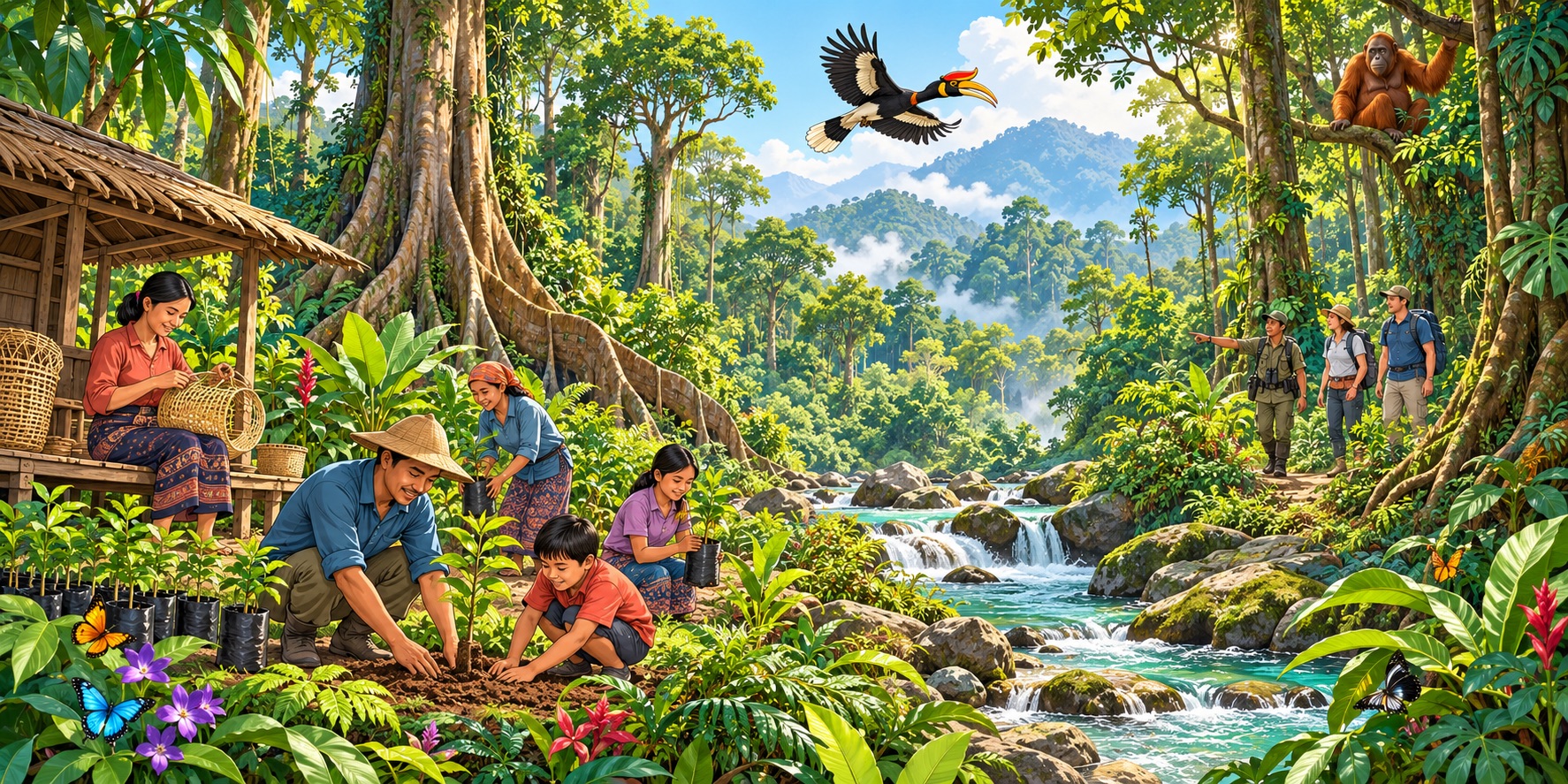
Secure access can give communities a stronger foundation for protecting forests and developing businesses. By the end of 2023, Indonesia had issued nearly 10,000 social forestry permits covering approximately 6.4 million hectares, according to the World Bank.
The opportunities extend beyond timber. In Todowongi, North Maluku, a community forestry initiative supported ginger products and rattan furniture. In Taram Nagari, West Sumatra, a roughly 800-hectare management licence helped residents develop forest tourism, including walking routes and food stalls around local natural attractions.
These examples show how conservation can support household income through processing, guiding and hospitality. They also suggest a more useful measure of ecotourism success than visitor numbers alone: how much value remains with the people managing the landscape.
Growing a shared regional response
Cooperation is increasingly connecting forest recovery with food security. Launched in Bangkok in June 2026, the four-year REVIVE–Asia project brings together landscapes in Indonesia’s Margowitan Model Forest, the Philippines’ Carood Watershed Model Forest and Thailand’s Ngao Model Forest.
Its emphasis is community-led restoration after fire, supported by research and approaches that strengthen food systems.
“We need to address forest health and secure food systems simultaneously,” said David Ganz, executive director of Bangkok-based RECOFTC. The connection is particularly relevant where farming communities depend on forest water supplies and where repeated fires undermine both ecosystems and livelihoods.
Regional networks also offer space for park managers to exchange experience and strengthen conservation skills. The ASEAN Heritage Parks programme supports that cooperation, while individual countries retain responsibility for managing their protected areas. Regional recognition is a platform for practical collaboration; effective protection still requires capable institutions and sustained work locally.
Southeast Asia’s forest future will be shaped by choices made in villages, businesses and government offices alike. Keeping forests standing means making conservation dependable work—with secure rights, healthier landscapes and lasting opportunities for the communities who call them home.


