


For Southeast Asia, climate action begins close to home: in classrooms disrupted by floods, coastal communities protecting their livelihoods and neighbourhoods seeking affordable, reliable electricity. As October 24 approaches, the International Day of Climate Action offers an opportunity to connect these everyday concerns with decisions shaping the region’s future.
The date’s climate significance grew from a global mobilisation organised by 350.org on October 24, 2009, involving more than 5,000 events in 181 countries. Its origins are in civil society campaigning; the date also marks United Nations Day, a separate official observance celebrating international cooperation.
Bringing Climate Action Closer to Home
The urgency is evident across the region. The World Meteorological Organization’s State of the Climate in Asia 2025 documented exceptional rainfall and flooding in Vietnam, while Cyclone Senyar brought severe flooding to parts of Indonesia, Malaysia and Thailand. Across Asia, ocean heat reached a record high, adding pressure on marine ecosystems and coastal livelihoods.
These findings reinforce the need to connect emissions reductions with practical preparedness. Climate action includes cleaner electricity, but also understandable warnings, accessible evacuation routes and public services that remain operational during extreme weather.
For schools, this means planning how learning can continue when buildings become inaccessible. For local governments, it means ensuring that warnings reach people with disabilities, older residents and communities with limited internet access. Such measures turn climate policy into something residents can recognise in their daily lives.
Young People Turn Concern into Participation
Youth movements are helping make those connections visible. Filipino climate activist Mitzi Jonelle Tan has linked campaigning with direct support for communities affected by storms, combining relief work with listening to residents’ experiences.
“This isn’t just about the weather and the environment. It’s about justice,” Tan said in an account published by UNICEF. Her message places people’s unequal exposure to climate impacts at the centre of the discussion.
That perspective has also entered policy advocacy. In November 2025, Filipino youth presented a 12-point climate statement calling for stronger local adaptation, safer schools, protection for environmental defenders and transparent financing accessible to grassroots initiatives. Government representatives committed to bringing the recommendations into discussions at COP30.
The next test is sustained participation. Young people need opportunities to help shape budgets, monitor implementation and evaluate results, alongside the space to organise campaigns and communicate climate science.
Learning from Forests and Local Communities
In Indonesia, university networks illustrate how climate education can connect national ambitions with local knowledge. UNDP reported in March 2025 that its MOVERS Climate Leaders Initiative had involved approximately 1,242 participants and partnered with five universities in Padang, Majene, Palembang, Badung and Medan.
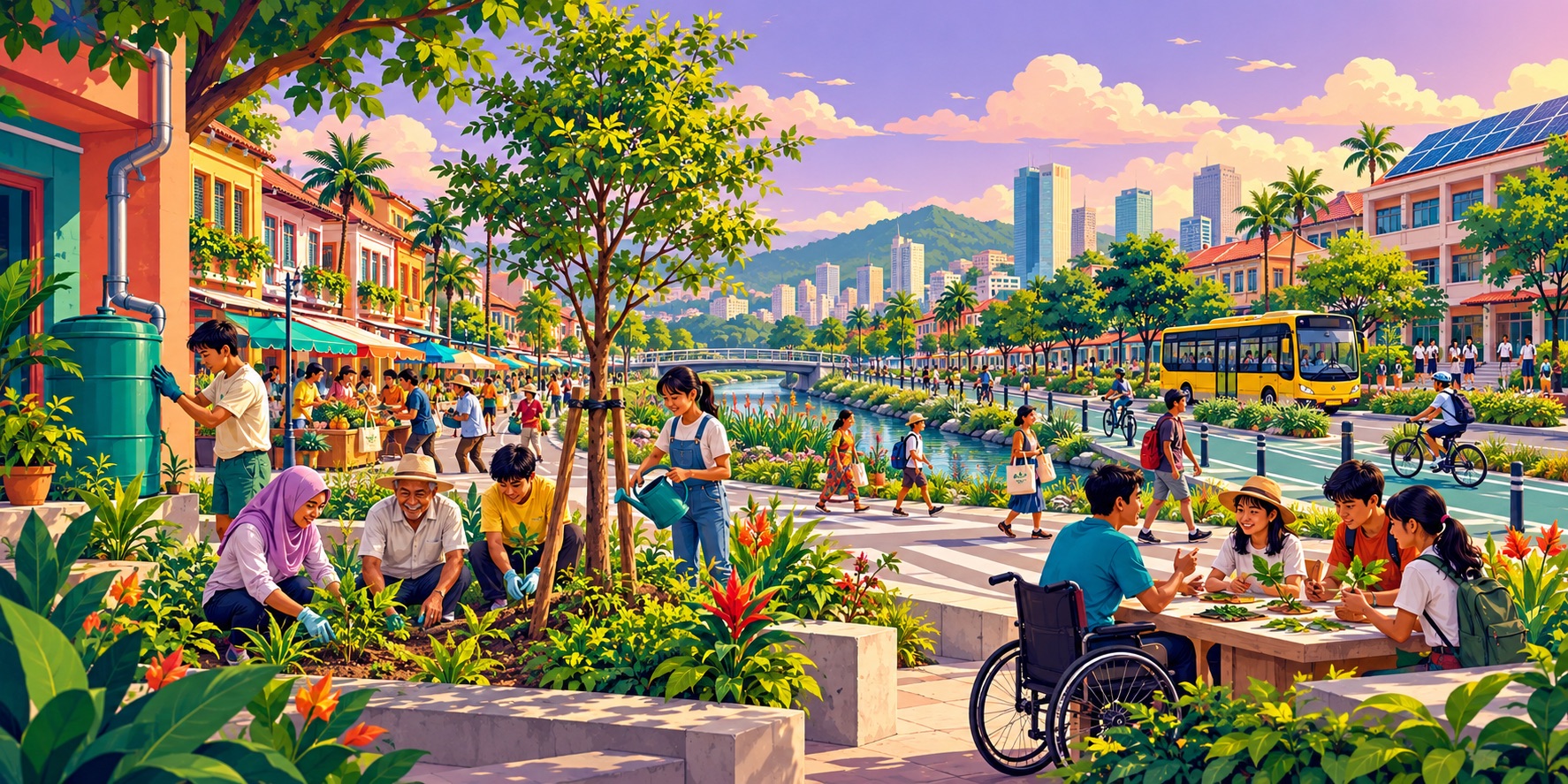
Activities connected Indonesia’s forestry and land-use climate goals with students’ surroundings. In Majene, West Sulawesi, students participated in mangrove planting. In Padang, discussions explored customary forest management and its relationship with community life.
“This traditional knowledge has proven effective in preserving nature while sustaining the livelihoods of local communities,” said Muhyiatul Fadilah, a lecturer at Universitas Negeri Padang, during the programme.
Her observation highlights an essential principle: environmental programmes should involve the people who know and manage the landscape. For organisers planning October activities, meaningful follow-through could include community monitoring, continued student research and reporting on what happens after a planting event.
Building a Cleaner, Fairer Energy Future
Community initiatives operate alongside a much larger energy challenge. The International Energy Agency’s Southeast Asia Energy Outlook 2026 reports that regional electricity generation has grown by around 60% since 2015. Coal supplied much of that expansion, increasing its share of generation from 37% to 47%.
There are also signs of progress. Almost 19 gigawatts of renewable energy capacity were awarded through auctions in 2025, according to the IEA. However, integrating more renewable electricity requires stronger grids, storage and investment, alongside new generating capacity.
For climate advocates, these figures support a focused question: how quickly are commitments becoming dependable, affordable clean power?
A fair transition must also account for workers and communities whose incomes depend on existing industries. Training, employment opportunities and meaningful consultation should accompany changes in energy production. Public accountability requires looking at both emissions performance and the distribution of costs and benefits.
Making October 24 a Starting Point
Regional cooperation can help connect national efforts. The planned ASEAN Power Grid, for example, offers a framework for cross-border electricity connections. The IEA estimates that realising planned interconnections would require about US$27 billion by 2040, illustrating the scale of investment behind regional ambitions.
At community level, October 24 can serve as a practical checkpoint: what has improved, who remains excluded and which commitments still need funding? Schools, museums, businesses and youth organisations can use the occasion to publish progress and establish their next steps.
Southeast Asia’s climate action story is already being written through education, advocacy and investment. Its strength will depend on whether that momentum delivers lasting protection, cleaner development and a meaningful voice for the people facing the greatest risks.


