The history of South Korea's democracy is inseparable from the Gwangju Tragedy of May 1980. The bloody event in Gwangju became a crucial turning point that ultimately brought down General Chun Doo-hwan's authoritarian regime.
The military dictatorship began when Chun Doo-hwan seized power through a coup d'état in December 1979. Chun Doo-hwan immediately imposed nationwide martial law to suppress citizen protests.
University campuses were forcibly closed and political activities were completely banned. Armed military patrols on the streets fueled political tensions that eventually erupted in Gwangju.
Student Protests Met with Military Violence
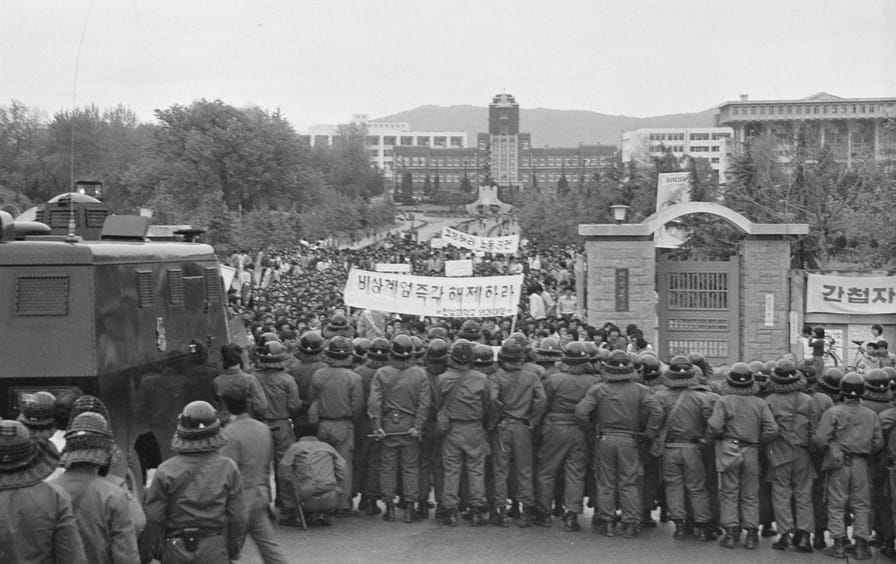
The wave of protests began when students from Chonnam National University gathered in front of the campus gates on May 18, 1980.
They demanded the lifting of the curfew and the reopening of academic activities. The military command responded to this demonstration by deploying special airborne troops.
Forces brutally beat the students with clubs. The death of a local youth named Kim Gyeong-cheol due to torture on the first day became a major turning point. News of his death spread rapidly by word of mouth and ignited the anger of the entire city.
Ordinary citizens from various professions joined the streets to protect the students. Taxi and city bus drivers formed vehicular convoys to break through military barricades to evacuate the wounded. They called their movement the Drivers for Democracy.
Taking Up Arms Against State Violence
Faced with escalating citizen resistance, the military government chose to tighten censorship on national media.
Local television station MBC was burned down by crowds after broadcasting false reports that smeared the protesters. The military then responded by opening fire with live ammunition into the crowds.
Open shootings by military forces at key city locations triggered a wave of armed self-defense among Gwangju residents.
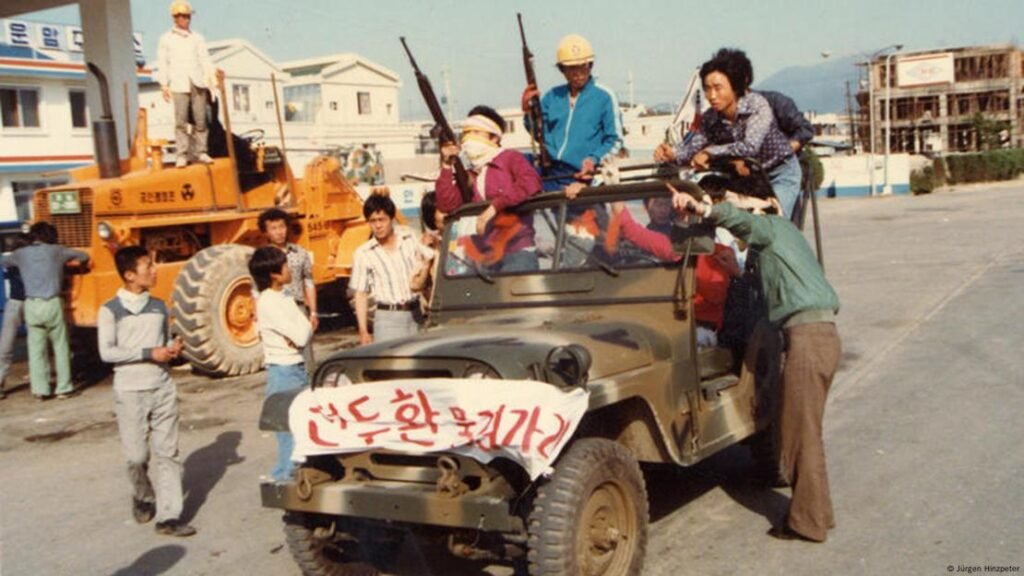
To protect themselves against fierce state repression, citizens raided local police stations and coal mining facilities to grab weapons. They organized a civilian militia to fight back against the troops.
The military forces temporarily pulled back and encircled the city perimeter. For five days starting May 22, 1980, residents took full control of Gwangju and set up local committees to distribute food, supply medicine, and keep the streets safe.
The Bloody Dawn of May 27
Military forces did not stay idle and surrounded Gwangju from the outside. All telephone lines were severed and power supplies to residential areas were completely cut off. This move left citizens isolated without outside help.
The military government launched a large-scale assault around three in the morning on May 27, 1980.
Tanks and armed helicopters were deployed to penetrate downtown barricades. The uneven battle at the provincial office ended within ninety minutes.

Hundreds of citizens were killed and more than two hundred others were reported missing following the crackdown.
Official records also documented dozens of women falling victim to sexual violence by soldiers. The military regime attempted to cover up the tragedy by labeling Gwangju citizens as rioters.
The Long Road to Ending the Military Regime
Chun Doo-hwan's attempt to hide the truth about the massacre in Gwangju ultimately failed. Information about the actual events was continuously smuggled through networks of students, churches, and journalists.
The scars of the Gwangju Tragedy transformed into the primary engine driving the pro-democracy movement throughout the 1980s.

The collective movements of the South Korean public erupted in June 1987 through massive demonstrations known as the June Democracy Movement. Major protests broke out in key cities such as Seoul, Busan, and Daegu.
Millions of citizens took to the streets demanding freedom of speech and direct presidential elections. This unstoppable wave of mass protests finally crushed the military dictatorship.
Chun Doo-hwan was forced to step down from office and South Korea held its first democratic election in December 1987.
References:
- Katsiaficas, G. (2001). Remembering the Kwangju Uprising. Socialism and Democracy, 15(1), 85–106. https://doi.org/10.1080/08854300108426270
- Kim, H. (2011). The commemoration of the Gwangju Uprising: Of the remnants in the nation states' historical memory. Inter-Asia Cultural Studies, 12(4), 611–621. https://doi.org/10.1080/14649373.2011.603923