


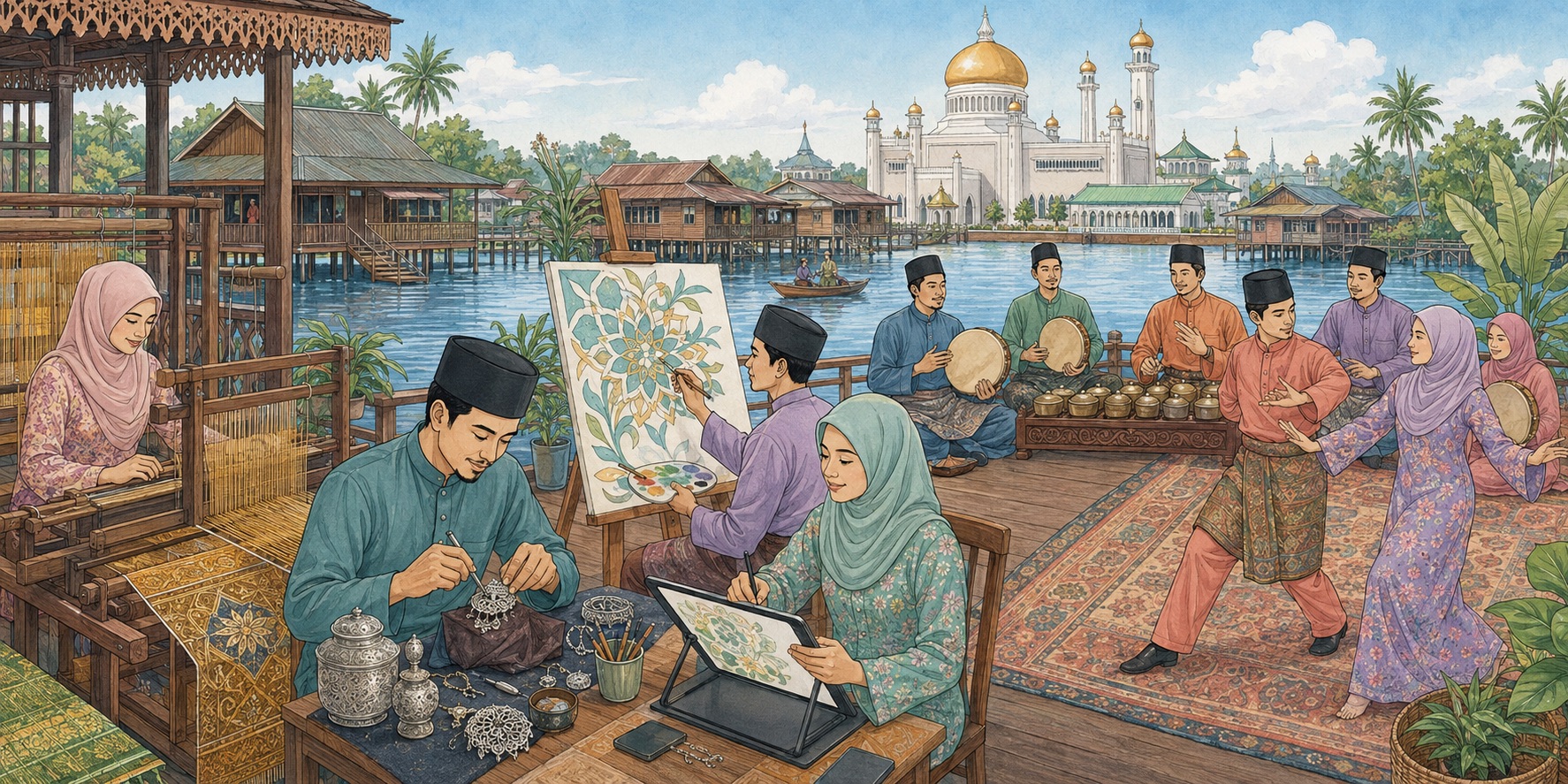
At sunrise, Kampong Ayer glows across the Brunei River; by evening, a young illustrator may be turning the same stilt houses into a cyberpunk city on a tablet. That movement between memory and reinvention captures Brunei Darussalam’s arts scene today. It is smaller and less commercial than those of neighbouring capitals, but its intimacy is a strength: artists, craftspeople, institutions and audiences often meet within the same close-knit creative circle.
Heritage Woven in Gold
Bruneian creativity begins with craftsmanship. At the Brunei Arts and Handicrafts Training Centre, established in 1975, skills are passed from master artisans to new generations. The celebrated kain jong sarat, woven with shimmering gold or silver thread, remains central to weddings, royal ceremonies and formal dress. Its intricate geometry is more than decoration; it expresses patience, status and collective memory.
Metalwork carries a similar story. Kampong Ayer was once home to skilled brass and silver artisans who supplied households and the royal court. Today, the keris, ceremonial objects and floral silverwork preserve that lineage while finding new life as gifts, collectibles and contemporary design references. As BenchLab founder Wan Nurul Naszeerah said of her creative workshops, “We wanted to also revive traditions that we have in Brunei.”
Faith Becomes a Visual Language
Islamic art gives Brunei’s visual culture its distinctive rhythm. Khat calligraphy, especially flowing Thuluth and Diwani-inspired forms, appears on canvases, public displays and contemporary mixed-media works. Artists also draw from the gold domes, mosaic patterns and serene symmetry of Bandar Seri Begawan’s mosques, translating sacred architecture into paintings that feel both familiar and fresh.
Exhibition spaces are widening this conversation. Gallery 4 at the Brunei Energy Hub at Dermaga Diraja has hosted projects such as Art for All, whose third edition displayed more than 100 works by artists with disabilities between December 2024 and January 2025. Paintings, handicrafts and space-themed models showed how Brunei’s arts scene can honour faith and tradition while becoming more inclusive.
Young Creators Change the Tempo
The liveliest shift is unfolding online and in independent spaces. Digital illustrators combine Malay folklore, traditional clothing and rainforest imagery with anime, minimalism and futuristic aesthetics. Platforms and organisations such as Creative Space Art Gallery, The Collective Artevents, Kitani Film Club and Progresif-supported initiatives have helped turn exhibitions, film screenings, workshops and pop-up markets into meeting points for younger audiences.
This digital energy is not yet fully reflected in international benchmarks. The 2025 Global Innovation Index ranked Brunei 131st for creative outputs, even as mobile-app downloads attributed to Bruneian developers rose by 58.37 per cent in 2024 to approximately 117,000. The contrast points not to a lack of talent, but to the need for stronger routes into publishing, intellectual property, exports and sustainable creative careers.
A Stage with a Bruneian Beat
Performing arts retain their own unmistakable sound. Hadrah frame drums accompany devotional chanting, while the bright notes of the gulintangan gong ensemble animate cultural celebrations. Contemporary theatre and spoken-word performances bring another layer, exploring family, folklore, language and the negotiation between modern ambitions and long-held values.
Many artists still balance creative practice with full-time employment. Visual artist Yan Chiew captured the movement’s immediate task simply: “We want to create awareness on the value of art.” That awareness grows when people encounter art in ordinary life, from Sunday’s Bandarku Ceria streets to riverside galleries and community workshops.
A Creative Future Taking Shape
Brunei is now giving that ambition more infrastructure. The BND4-billion Twelfth National Development Plan encompasses 305 projects and includes a planned Cultural and Creative Industries Hub and Community Library. A wider BND61.8-million allocation for research and innovation also covers social sciences, arts and culture.
Brunei’s creative future is unlikely to imitate the scale or speed of Singapore, Kuala Lumpur or Jakarta. Its appeal lies elsewhere: in work made carefully, shared personally and rooted confidently in place. Here, a gold thread, a drumbeat and a digital stylus are not competing symbols. Together, they tell the evolving story of a nation creating forward without letting go of home.


