


In Dili, paint spreads across waterfront walls as women weave ancestry into tais and musicians turn Tetum memories into new songs. In Timor-Leste, whose independence was restored in 2002, art is neither ornament nor nostalgia. It is a language of survival, carrying clan identity, ancestral spirituality and the ambitions of one of Asia’s youngest nations.
Tais Threads Memory Into Everyday Life
The country’s defining visual art begins on a backstrap loom. Traditionally woven by women, tais accompanies weddings, funerals, harvests and official welcomes. Its colours and motifs identify communities: Oecusse textiles often favour restrained, intricate geometry, while work from Lautem may use brighter bands and crocodile imagery drawn from the island’s creation story.
UNESCO placed tais on its list of Intangible Cultural Heritage in need of urgent safeguarding in 2021, recognising its cultural importance and the need to protect the transmission of weaving and natural-dye knowledge. Safeguarding is now tied to livelihoods. A 2024 government report recorded annual business and marketing training for 50 selected weavers, alongside National Tais Day and public campaigns bringing the cloth into contemporary design.
Living Art Gives Memory a New Form
Dili’s modern movement took shape through Arte Moris, meaning “living art” in Tetum. Established in 2002 and given its first campus in 2003, the free art school became a creative home for young people processing conflict, independence and the difficult work of nation-building. Its painters favour vivid acrylics, textured surfaces and surreal images of coastlines, resistance figures and uma lulik, or sacred houses.
That local energy reached a global stage in 2024, when Maria Madeira represented Timor-Leste at its inaugural Venice Biennale pavilion. Her installation, Kiss and Don’t Tell, combined tais, red earth, betel nut, painting, performance and village songs to honour women whose experiences of occupation had been pushed from public memory. As Madeira explained in an interview about the pavilion, “Everything is about the ground for me, it keeps us embedded into being Timorese.”
Sacred Design Keeps Ancestors Close
Beyond galleries, the uma lulik remains one of the country’s most complete works of art. Built from timber, bamboo, thatch and fibre, these high-roofed sacred houses hold clan objects, host ceremonies and connect living families with their ancestors. Carved birds, buffalo horns and geometric signs turn architecture into a shared spiritual text. Across Timor-Leste, ancestral practices and Catholic symbolism also coexist in festivals, memorials and domestic art.
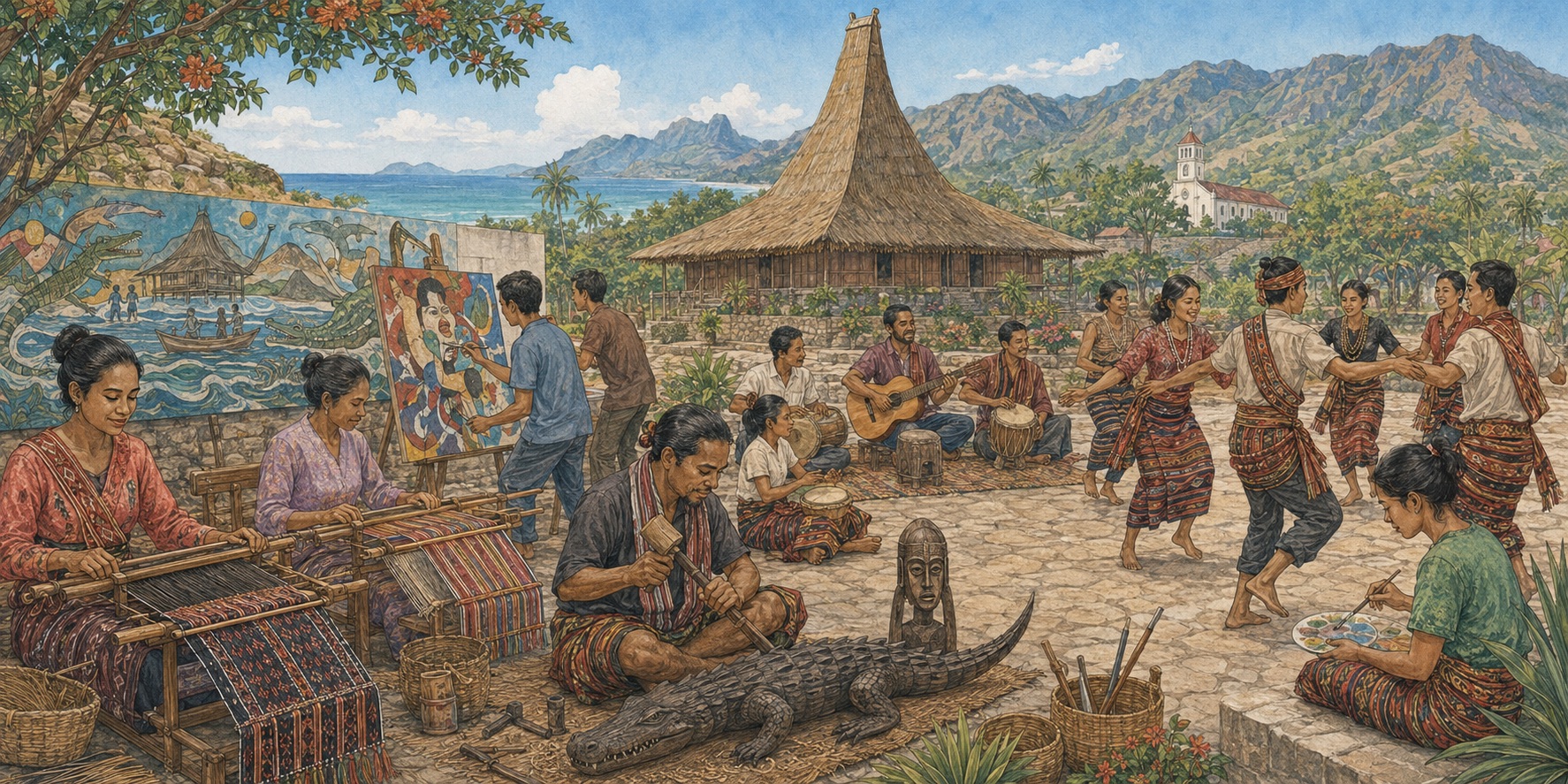
In Lautem, Fataluku carvers extend that language into dark-wood ancestral figures, masks and crocodiles. These are not simply souvenirs; their significance depends on lineage, place and ceremony. The creative challenge is therefore delicate: artisans need income and wider audiences, but cultural objects cannot be separated carelessly from the communities and customary authority that give them meaning.
Songs Carry Resistance Into the Present
Music once helped sustain morale and communicate identity through occupation; today it speaks to land, language, equality and youth opportunity. Singer-songwriter and cultural advocate Ego Lemos captured that history directly: “Cultural resistance plays a very important role to keep the culture of the East Timorese alive,” he said in an interview on music and resistance.
At public celebrations, the stamping circle of tebedai and the measured movement of liralik bring generations together, often framed by tais and hand drums. This youth connection is consequential: a 2025 United Nations report found that 62 percent of Timor-Leste’s population was under 25, giving community schools, bands and mural projects an unusually important role in cultural transmission.
Grassroots Creativity Builds a Wider Future
The sector remains small, but its infrastructure is becoming more visible. Timor-Leste's cultural-policy record reported US$322,320 in support for 128 contemporary and community cultural groups over four years, financing equipment, festivals, fairs and exhibitions.
The same framework connects handicrafts with tourism and local enterprise, from the Alola Foundation’s support for women weavers to Boneca de Ataúro, a cooperative whose embroidered dolls and textiles support approximately 60 island families. For visitors, the most revealing itinerary runs from Dili’s murals and studios to inland weaving communities, then across the water to Ataúro.
Timor-Leste’s creative future will depend on stable spaces, arts education, fair markets and respect for customary ownership. Yet its direction is already clear: this young nation is not merely preserving inherited forms. It is using them to speak, heal and design what comes next.


