Indonesia has spent years building warships and submarines. On 5 August, one of its newest naval systems appeared in a very different form, a boat designed to operate without a crew and carry an explosive payload.
During the 2026 Integrated TNI Exercise in Dabo Singkep, Riau Islands, the Indonesian Navy demonstrated a new unmanned surface vessel (USV) developed by state-owned shipbuilder PT PAL Indonesia.
PT PAL confirmed the platform as a kamikaze USV, adding Indonesia to the growing list of countries developing one-way unmanned vessels for naval operations.
A New Weapon for Indonesia's Navy
According to PT PAL, the USV can reach more than 55 knots, or over 100 kilometers per hour, and carry a 150 kilogram warhead. The company also said the vessel uses an unmanned control system developed as part of its autonomous maritime technology program.
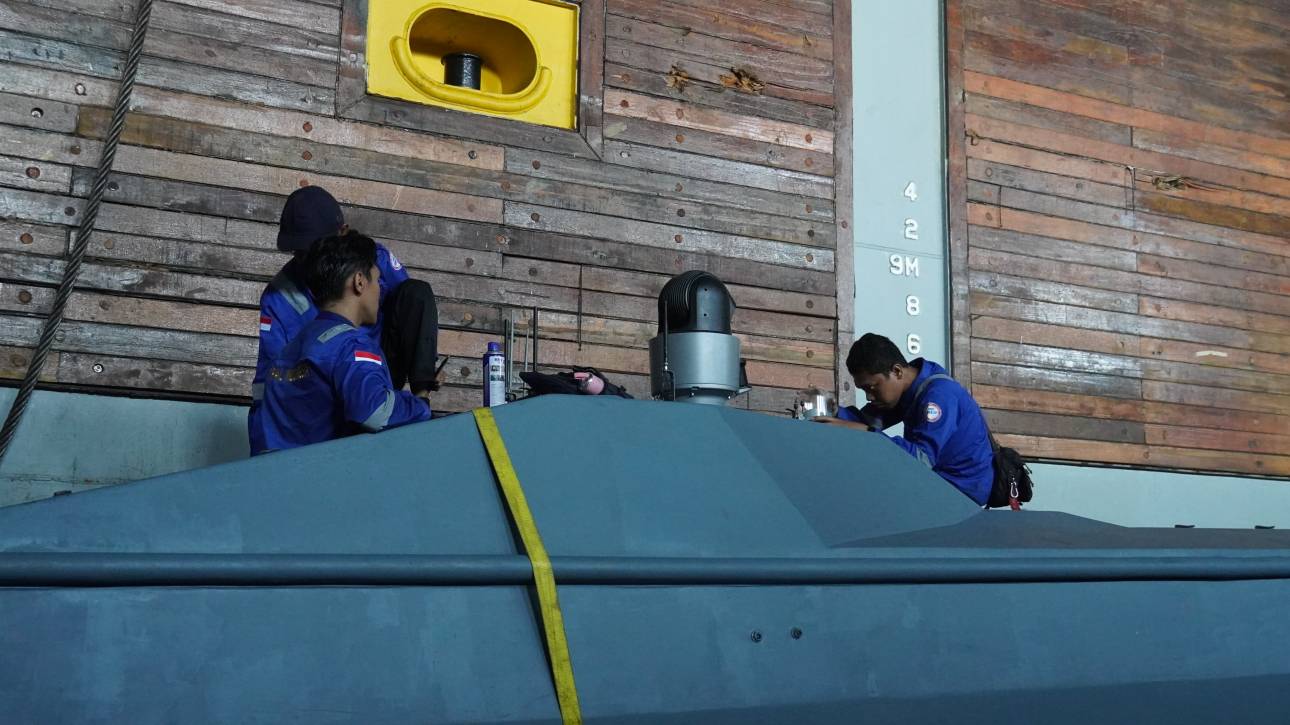
The platform was demonstrated alongside conventional Indonesian naval forces during the Dabo Singkep exercise. The Indonesian Navy also conducted live fire activities involving warships and unmanned systems as part of the exercise.
Unlike conventional USVs designed for surveillance, reconnaissance, or target practice, a kamikaze USV is intended for a one-way mission. It carries its payload toward a target and is not designed to return after an attack.
A First for Southeast Asia
Unmanned surface vessels are not new to Southeast Asia.
Singapore operated USVs during a deployment to the Northern Arabian Gulf as early as 2004, while the Philippine Coast Guard received a USV from the UN Office on Drugs and Crime (UNODC), formally handed over in October 2024.
PT PAL's platform is different because it is specifically presented as a one-way attack USV. Asian Military Review described the system as the first kamikaze USV publicly unveiled in Southeast Asia.
The distinction matters because a USV can perform many different roles. A surveillance vessel may remain at sea and return to base, while a kamikaze USV is built around a single mission, reaching a target and delivering its payload.
The Technology Has Already Seen Combat
Indonesia is entering the field after other countries have already demonstrated what maritime drones can do in combat.
Ukraine has used unmanned surface vessels extensively against Russia's Black Sea Fleet. Its Sea Baby and Magura systems have been used to attack Russian naval vessels and other military targets. According to Reuters, an upgraded Sea Baby reported in 2025 could travel more than 1,500 kilometers and carry up to 2,000 kilograms of payload.
The scale is considerably larger than PT PAL's newly displayed USV, but the underlying concept is similar. An unmanned boat can carry a weapon toward a target without placing a crew aboard.
Iran is also connected to the spread of the technology, although through its regional partners. U.S. Central Command has repeatedly reported Iranian-backed Houthi forces using unmanned surface vessels against ships in the Red Sea, including several incidents in 2024.
The United States has also used kamikaze USVs in combat. On 12 July 2026, three Saronic Corsair unmanned vessels attacked Iran's Bandar Abbas Naval Base, targeting a submarine and ship maintenance facility, according to U.S. Central Command.
Yesterday, using multiple one-way attack surface drones, CENTCOM forces successfully struck a submarine and ship maintenance facility in Iran. Three Corsair unmanned surface vessels hit the port at Bandar Abbas Naval Base, marking the first time American forces have employed sea… pic.twitter.com/bOM2kmgRxz
— U.S. Central Command (@CENTCOM) July 13, 2026
The strike marked the first reported combat use of sea drones by American forces. The Corsair is therefore more than a prototype, it has already been used for the same one-way attack role as PT PAL's new USV.
What PT PAL Has Built
PT PAL has not publicly disclosed several details about its new USV, including its operational range, endurance, autonomous capabilities, or whether the platform has formally entered the TNI inventory.
For now, its appearance at the 2026 Integrated TNI Exercise provides the clearest public demonstration of Indonesia's locally developed kamikaze USV.
The platform also places Indonesia within a wider shift in naval warfare, where unmanned vessels are being developed alongside conventional warships. For a country with one of the world's largest archipelagic territories, the ability to deploy an armed vessel without putting a crew aboard adds another option to its maritime capabilities.