


At the edge of Bandar Seri Begawan, the Brunei River reflects two defining images of the Sultanate: the wooden homes of Kampong Ayer and the golden dome of the Omar Ali Saifuddien Mosque. Together, they reveal a country where water, faith and community continue to shape national identity.
A Capital Born on Water
Kampong Ayer is not simply a preserved attraction. It remains a living settlement of homes, schools, mosques, shops and communal spaces raised above the river. Recent estimates place its population at around 9,000 to 10,000 residents spread across approximately 30 villages connected by wooden and concrete walkways.
Its history reaches back centuries. When Italian explorer Antonio Pigafetta visited Brunei in 1521 during the Magellan expedition, he described a prosperous river-based capital filled with houses, markets and royal buildings. The settlement later became known as the “Venice of the East,” reflecting its importance as a maritime centre linking Borneo with regional trading networks.
Today, water taxis known locally as perahu tambang continue to race between jetties, carrying residents from their riverside homes to the commercial centre of Bandar Seri Begawan. Their engines provide the soundtrack of a community that still treats the river as both a road and a shared public space.
Faith Illuminates the River
Across the water stands the Omar Ali Saifuddien Mosque, completed in 1958 and named after Brunei’s 28th Sultan. Its golden dome, landscaped gardens and ceremonial royal barge create one of Southeast Asia’s most recognisable Islamic landmarks.
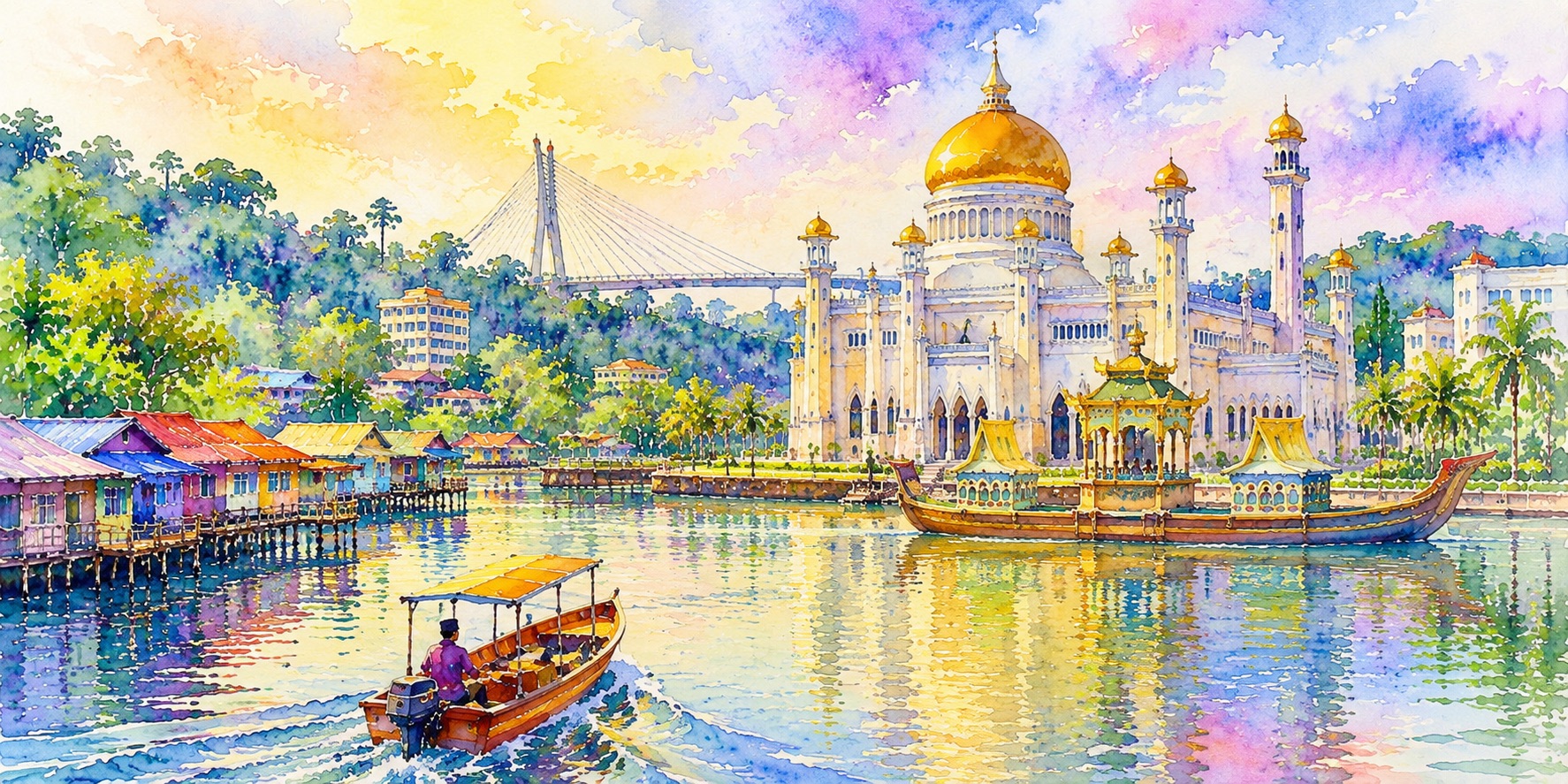
The contrast is central to Brunei’s character. Kampong Ayer represents the country’s maritime origins, while the mosque reflects its Islamic identity and modern nation-building. Seen together at sunset, they form a landscape in which spiritual devotion and riverine heritage reinforce rather than compete with one another.
Modern Comfort on Ancient Stilts
Behind Kampong Ayer’s traditional wooden façades is a community equipped with electricity, piped water, air conditioning, internet access and other modern services. Children attend local schools, residents gather at neighbourhood mosques, and families maintain social networks built over generations.
Licensed Bruneian tour guide Muhammad Nur Syu’aib described the settlement’s walking trail as a window into ordinary life, noting that participating residents “want to showcase their lives.” He added: “The trail shows Brunei’s hospitality at its best.”
Kampong Ayer also belongs to a wider natural landscape. Brunei covers 5,765 square kilometres and has more than 161 kilometres of coastline, while forests account for approximately 72.1 percent of its land. Mangroves lining the Brunei River support fisheries, protect the shoreline and provide habitat for wildlife, including Borneo’s distinctive proboscis monkeys.
Preserving a Living National Story
Modernisation has encouraged many families to move ashore, raising questions about Kampong Ayer’s long-term future. Preservation therefore requires more than maintaining old buildings; it must keep the settlement safe, economically active and meaningful to younger generations.
Pengiran Haji Kamarudzaman Pengiran Haji Ishak, a former permanent secretary at the Ministry of Primary Resources and Tourism, called Kampong Ayer “a very important part of Brunei history, heritage and culture.” Community-based tourism, local handicrafts and the Kampong Ayer Cultural and Tourism Gallery are helping translate that principle into action.
Brunei’s enduring appeal lies in this quiet continuity. Along its river, speedboats, stilt houses, rainforest and golden domes tell one connected story: a small nation moving confidently forward without allowing modern life to erase the landscape from which it grew.


