


Brunei Darussalam is easy to underestimate. On a regional map, it appears as a small country tucked between the Malaysian states of Sarawak and Sabah. Yet beyond Bandar Seri Begawan’s golden-domed mosques and orderly streets lies a destination shaped by river communities, Islamic traditions, coastal towns and some of Borneo’s best-preserved rainforests.
Interest in the country is growing. Brunei recorded 763,375 international tourist arrivals by land, sea and air in 2025, an increase of 12.6 percent from 2024. Nearly 400,000 visitor arrivals were recorded during the first half of 2026, while tourism receipts rose from approximately BND140 million to BND158 million year on year. This momentum is leading into Visit Brunei Year 2027, a national campaign that aims to position the country as more than a short stopover. As Coordinating Minister for Economic Policies and Minister of Economy, Trade and Industry Dato Seri Setia Dr Haji Abdul Manaf bin Haji Metussin explained, “Visit Brunei Year 2027 is not simply about attracting more visitors, but about showcasing Brunei’s unique identity and strengthening partnerships with the travel trade.”
1. Entry Requirements and Immigration Procedures: Prepare for a Smooth Arrival
Brunei welcomes visitors through Brunei International Airport, land checkpoints connecting the country with Sarawak and sea entry points such as the Serasa Ferry Terminal. Passport holders from many countries receive visa-free entry for periods of 14, 30 or 90 days, depending on nationality. Indonesian passport holders are currently eligible for visa-free visits of up to 14 days, although anyone planning to work, conduct professional activities or stay longer must obtain the appropriate permission.
A passport should be valid for at least six months from the date of entry. All foreign nationals arriving or departing through air, land or sea checkpoints must also complete Brunei’s electronic E-Arrival Card. The registration requires passport details, travel information and a local accommodation address, after which the traveller receives a reference number. The card is not a substitute for a visa, so visitors should check both requirements before departure. Those driving from Malaysia should also carry the necessary vehicle documents and allow additional time for border inspections.
2. Best Time to Visit and Seasonal Conditions: Choose the Experience, Not Just the Weather
Brunei has a tropical equatorial climate, which means warm temperatures, high humidity and the possibility of rain throughout the year. The wettest periods generally occur from October to January and again from May to July. February to April and August to September may offer relatively more convenient conditions for river cruises, heritage walks and rainforest excursions, but brief tropical showers remain possible at any time.
The ideal month also depends on what visitors want to experience. Ramadan brings a quieter daytime rhythm and lively evening food markets, although restaurant services and operating hours change during fasting hours. The Brunei December Festival usually adds family activities and cultural events despite the wetter season. Visit Brunei Year 2027 is expected to introduce events around nature, creative arts, cultural heritage, food, sports and Islamic traditions. Visitors should therefore compare the event calendar with seasonal conditions rather than choosing dates based solely on rainfall.
3. Currency, Payments and Typical Travel Costs: Carry Cash for Brunei’s Smaller Experiences
The national currency is the Brunei dollar, or BND, which is maintained at parity with the Singapore dollar. Singapore dollar notes are commonly accepted in Brunei, although coins generally are not interchangeable. Credit and debit cards are widely used at hotels, shopping centres, supermarkets and established restaurants, while international cards can be used at many ATMs. Cash remains useful for night markets, small eateries, water taxis, community enterprises and businesses outside central commercial areas.
Some everyday costs are manageable, but private transportation and organised excursions can increase the total budget. Public buses average around BND1 per ride, while short water-taxi journeys around Kampong Ayer generally cost between BND2 and BND5. Metered taxis begin at BND3.50, with additional airport, inter-district and nighttime charges. Rental cars usually cost approximately BND60 to BND100 per day, depending on the vehicle.
Brunei’s Acting Director of Tourism Development, Salinah Haji Mohd Salleh, offered a useful reminder about contemporary visitor behaviour: “Travellers remained price conscious; flight and accommodation as well as overall value continue to influence travel decisions.” Brunei can be affordable for food and simple urban activities, but visitors should reserve additional funds for guided rainforest trips, river safaris and journeys beyond the capital.
4. Transportation and Geographical Challenges: Look Beyond the Capital
Brunei may be geographically small, but its attractions are spread across four districts. Brunei-Muara contains Bandar Seri Begawan, Kampong Ayer, major mosques and most national museums. Tutong offers rural landscapes, beaches and Tasek Merimbun. Belait combines coastal communities with the country’s oil-industry history, while Temburong provides access to forests, rivers and Ulu Temburong National Park.
The nearly 30-kilometre Sultan Haji Omar ‘Ali Saifuddien Bridge has made road travel between Brunei-Muara and Temburong considerably easier. Nevertheless, Brunei remains a car-oriented country. Public buses are inexpensive and generally operate between 6 a.m. and 8 p.m., but routes and frequencies may not suit tightly scheduled itineraries. Grab and Uber do not operate in Brunei; the local ride-hailing alternative is Dart. Renting a car or arranging a driver is often the most practical choice for visitors exploring multiple districts. In Bandar Seri Begawan, water taxis are not simply tourist attractions but an important part of daily mobility along the Brunei River.
5. Internet Access, SIM Cards and Essential Apps: Stay Connected from the Airport
Mobile connectivity is generally reliable in Bandar Seri Begawan and other populated areas, although reception may weaken inside remote rainforest locations. Brunei’s principal telecommunications providers are DST, Imagine and Progresif. Their booths at Brunei International Airport make it convenient for arriving travellers to obtain a local SIM card or data package. A passport may be required for registration.
Dart should be installed before travelling because it is the country’s main ride-booking application. Moovit can assist with public-bus information, while Google Maps is useful for driving, locating restaurants and checking distances. Downloaded offline maps are advisable for Temburong and other rural areas. WhatsApp is widely used by accommodation providers, tour operators, guides and drivers, so keeping an active number makes last-minute coordination easier. Visitors should also save their E-Arrival Card confirmation, hotel address and tour reservations offline in case they cannot immediately connect after crossing a land border.
6. Languages and Useful Local Expressions: A Few Malay Words Open Doors
Malay is Brunei’s official language, while Brunei Malay is commonly used in everyday conversation. English is widely understood, particularly in hotels, government institutions, tourism businesses, restaurants and urban shopping areas. This makes Brunei relatively easy to navigate for international visitors, although conversations may become more limited in smaller villages or with older residents.
Simple Malay expressions can make encounters warmer. Terima kasih means thank you, selamat pagi means good morning, apa khabar? means how are you, and tolong can mean please or help, depending on the context. Assalamu’alaikum is also a common and respectful greeting, especially when entering a Muslim home or meeting local community members. Visitors do not need to master the language, but showing an interest in local vocabulary communicates respect and often creates more meaningful exchanges than immediately relying on English.
7. Religion, Customs, Dress Codes and Etiquette: Travel with Cultural Awareness
Islam plays a central role in Brunei’s national identity, alongside the philosophy of Melayu Islam Beraja, or Malay Islamic Monarchy. Visitors are not expected to follow Muslim religious practices, but they should respect the public customs shaped by them. Modest clothing is appropriate in government buildings, villages and religious spaces. Mosque visitors must remove their shoes, maintain silence and follow photography instructions. Women are generally expected to cover their hair, shoulders and knees inside mosques, with robes and head coverings often available at major sites.
Brunei’s weekly rhythm also differs from that of many neighbouring destinations. Banks, offices, shops, restaurants and attractions generally close between noon and 2 p.m. on Fridays for congregational prayers. During Ramadan, daytime dining arrangements may be limited, with some establishments offering takeaway or delivery before sunset.
Alcohol is not openly sold. Eligible non-Muslim adult travellers may bring a limited quantity into the country, but it must be declared and consumed only in private. Visitors should also wait for a person of the opposite sex to offer a handshake rather than initiating one. These customs do not make travel difficult; they simply reward visitors who observe before acting.
8. Local Food, Drinking Water and Dietary Considerations: Discover Brunei Through the Table
Brunei’s culinary identity blends Malay, Bornean, Chinese and neighbouring regional influences. The country’s best-known dish is ambuyat, a sticky sago preparation eaten with a bamboo utensil called candas and dipped into sour or spicy sauces. Nasi katok, consisting of rice, fried chicken and sambal, is an inexpensive everyday favourite. Visitors should also try grilled seafood, satay, kuih-muih, beef dishes and local drinks at Gadong Night Market.
Halal food is readily available, while pork and other non-halal dishes are found at a smaller number of designated restaurants. Vegetarian travellers should explain whether they avoid seafood-based sauces, shrimp paste or meat stock, as these may appear in dishes that otherwise look vegetable-based.
Brunei’s Public Works Department reports that its water services provide 99.9 percent of the country’s potable-water supply. Travellers with sensitive stomachs may still prefer filtered or bottled water, particularly during rural excursions. Carrying a refillable bottle, where safe refill points are available, reduces plastic waste and is especially useful during humid walks, river journeys and rainforest activities.
9. Safety, Health, Laws and Common Tourist Mistakes: Enjoy the Calm Without Becoming Careless
Brunei has a reputation for low crime and a calm public environment. Visitors should nevertheless use ordinary precautions, including watching personal belongings, locking rental vehicles and avoiding isolated areas alone late at night. Travel insurance remains advisable because specialist treatment, emergency evacuation or changes to regional flights can be expensive.
Mosquito repellent, lightweight rain protection and suitable footwear are essential for mangrove cruises and rainforest excursions. Visitors taking prescription medicine should retain the original packaging and supporting documents. Brunei has strict laws concerning prohibited drugs, public alcohol consumption and socially inappropriate behaviour, and foreign visitors are subject to local legislation.
One of the most common travel errors is treating Brunei as a one-day stopover. Another is assuming that every attraction remains open on Fridays or that public transportation will connect distant sites efficiently. Visitors should confirm operating hours, reserve Temburong activities ahead of time and plan evening transport before leaving their accommodation. Brunei is generally easy to explore, but it works best with advance planning rather than spontaneous rushing.
10. Responsible Travel and Ways to Support Local Communities: Let Your Visit Reach Further
Responsible travel in Brunei begins by spending time and money beyond the most visible landmarks. Official data recorded 287,372 visits to monitored tourist attractions in 2025, but 273,967 of them were concentrated in Brunei-Muara. Temburong’s monitored attraction received only 9,037 visits, illustrating how strongly visitor activity remains centred on the capital. Travelling to Tutong, Belait and Temburong can distribute tourism income more widely while revealing a more complete picture of the country.
Visitors can book licensed local guides, use community-based accommodation, buy directly from artisans, eat at locally owned establishments and choose operators that follow environmental standards. In Kampong Ayer, residents’ homes and neighbourhoods should be treated as living communities rather than open-air exhibits. In forests and mangroves, wildlife should be observed quietly without feeding, touching or pursuing animals for photographs. Staying longer also has a positive economic effect, allowing visitors to combine Bandar Seri Begawan with river heritage, local cuisine, rainforest conservation and district-based experiences.
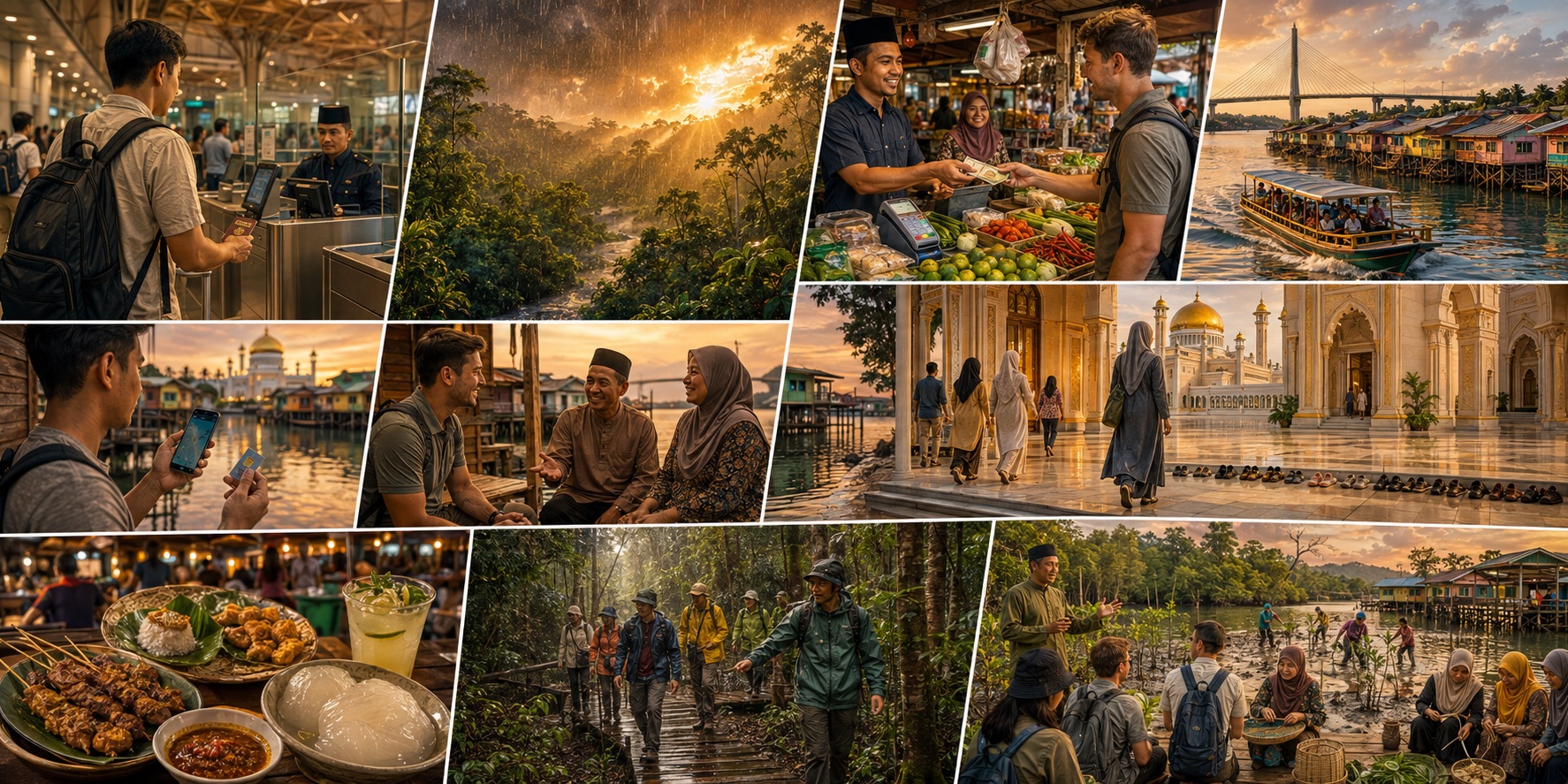
Brunei does not compete with Southeast Asia’s busiest destinations through crowded nightlife, mass tourism or endless commercial attractions. Its strength lies elsewhere: in the stillness of the Brunei River, the call to prayer across Bandar Seri Begawan, the hospitality of Kampong Ayer and the forest canopy of Temburong. Arrive prepared, respect the country’s rhythm and remain long enough to see beyond the golden domes. The Abode of Peace may be quiet, but it has much more to say than a short stopover can reveal.


