


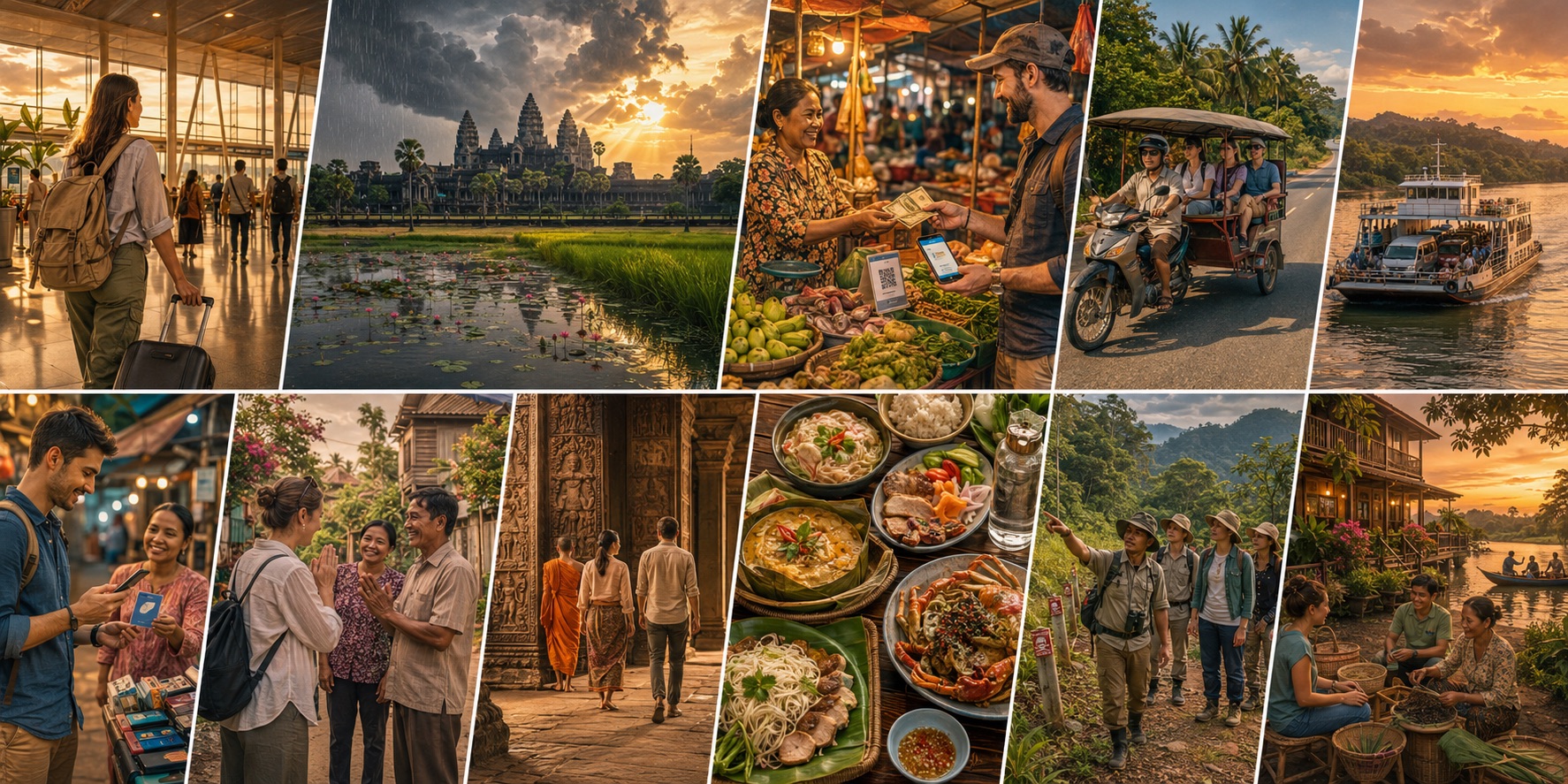
At first light, Angkor Wat appears in a sheet of water: five towers, a pale sky and a line of visitors growing quiet without being asked. That famous silhouette is often a traveller’s introduction to Cambodia, but it is only the first page. The country’s fuller story runs along Phnom Penh’s riverfront, through Battambang’s creative neighbourhoods, over Kampot pepper fields, into the Cardamom forest and beside the Mekong at Kratie.
Cambodia is welcoming more travellers while asking tourism to create more value at home. Ministry of Tourism figures released in May 2026 recorded 5.57 million international visits in 2025 and US$3.878 billion in receipts. Arrivals fell 16.9 percent from 2024, yet receipts rose 6.6 percent and equalled 9.8 percent of GDP. The same official snapshot counted about 420,000 direct tourism jobs and 129 community-based tourism sites. Those numbers give every itinerary a human scale: where a visitor sleeps, eats, hires a guide and buys a souvenir can carry income far beyond the temple gates.
1. Entry Requirements and Immigration Procedures: Start with a Smooth Arrival
Cambodia’s entry rules depend on nationality, so begin with the official e-Visa and Cambodia e-Arrival services rather than a commercial look-alike. A standard tourist visa is generally single-entry, costs US$30, must be used within three months of issue and permits a 30-day stay. Visa on arrival is available to many nationalities, while ASEAN passport holders may qualify for visa-free entry for a limited stay. Exemptions and pilot programmes can change, so confirm the rule for the passport you will actually carry.
Your passport should have at least six months’ validity and a blank page. Air passengers should complete the free Cambodia e-Arrival before immigration. It combines arrival, health and customs information and can also support an electronic visa-on-arrival process. Save the confirmation offline, carry proof of onward travel and keep a printed copy of any e-Visa. An e-Visa is not accepted at every land checkpoint, so verify the approved port before choosing an overland route.
One update catches travellers using older guidebooks: Techo International Airport, code KTI, replaced Phnom Penh International Airport as the capital’s main gateway in September 2025. Check the airport code on every transfer booking. Overland travellers should also recheck border operating conditions close to departure, especially on routes involving Thailand.
2. Best Time to Visit and Seasonal Conditions: Choose Your Shade of Cambodia
November to February usually brings the most comfortable dry-season weather, with lower humidity and easier road travel, but also the highest demand around Angkor and the southern islands. March and April are intensely hot; temple days work best when they begin early, pause at midday and resume in the softer afternoon light. Khmer New Year in mid-April is joyous and deeply local, although transport fills quickly and some businesses close for family celebrations.
From May to October, the monsoon turns rice fields electric green, fills moats and rivers, and sends dramatic clouds over the temples. Rain often arrives in force and then clears rather than continuing all day, though rural tracks can become muddy and coastal crossings may be disrupted. In launching Cambodia’s 2026 green-season campaign, Tourism Minister Huot Hak said, “It aims to turn the rainy season into a vibrant, high-value and sustainable tourism period.”
Travellers who accept a flexible schedule may find fewer crowds, vivid landscapes and better room rates. Season also changes the experience. Tonle Sap expands during the rains, waterfalls strengthen in places such as Phnom Kulen, and the Cardamoms become lush but harder to traverse. Build a weather buffer into island boats, forest stays and long road journeys rather than treating the forecast as a fixed timetable.
3. Currency, Payments, and Typical Travel Costs: Spend with Confidence
The Cambodian riel is the national currency, while US dollars remain common in tourism. In August 2026, the National Bank of Cambodia’s official rate was close to 4,000 riel to US$1, which is also the easy rate used for quick street calculations. Small purchases and change are increasingly handled in riel. Carry clean, low-denomination dollar notes because torn, marked or excessively worn bills may be refused, and check your change before leaving a counter.
Cards work in many urban hotels and restaurants, but cash still helps at markets, villages and family-run businesses. KHQR signs are now widespread. The National Bank reported about 37,000 Bakong Tourist accounts by June 2026, giving visitors another way to scan local QR codes, although a backup card and cash remain sensible when signal or setup fails.
A practical daily plan is about US$30 to US$50 for a budget trip and roughly US$60 to US$120 for comfortable mid-range travel, excluding major long-distance transport and premium tours. A simple Khmer meal may cost US$2 to US$5 and a short app-booked tuk-tuk ride around US$1 to US$3, but tourist centres, islands and private guides cost more.
Angkor’s official passes remain a major fixed expense: US$37 for one day, US$62 for three days and US$72 for seven days. In markets, bargain warmly and lightly. Offer a fair counterprice, and do not turn a small difference into a contest.
4. Transportation and Geographical Challenges: Let the Journey Set the Pace
Tuk-tuks are part of Cambodia’s street rhythm, from dawn runs to Angkor to evening rides beside the Tonle Sap River. Grab and the home-grown PassApp provide a visible fare and destination, reducing language friction. When hiring a driver directly, agree on the price, stops, waiting time and whether sunrise or distant temples are included before setting off.
Distances can look short on a map and feel long on the road. Intercity buses and vans connect Phnom Penh, Siem Reap, Battambang, Kampot and the coast, but traffic, roadworks and wet-season flooding can slow the timetable. Choose reputable operators, avoid night road travel when possible and never assume a motorbike rental is covered by ordinary travel insurance. Helmets and an appropriate licence are essential.
Both principal airports sit outside the centres they serve. Allow generous transfer time from KTI to Phnom Penh, and roughly an hour or more between Siem Reap-Angkor International Airport and Siem Reap town. The Siem Reap airport operates an official shuttle, with an onward tuk-tuk often needed from its city stop. In the south, ferry departures to islands can shift with sea conditions, so keep the final mainland connection flexible.
5. Internet Access, SIM Cards, and Essential Apps: Stay Connected, Then Look Up
Mobile data is inexpensive and generally strong in Phnom Penh, Siem Reap and provincial centres. Smart, Cellcard and Metfone are the main names travellers encounter, with coverage varying outside cities. Buy a SIM from an official desk or shop, register it with your passport and confirm that data works before leaving. An eSIM can simplify arrival, but a local physical SIM may perform better on longer rural journeys.
Download Cambodia e-Arrival before flying, then add Grab or PassApp for urban rides, offline maps for weak-signal areas and an offline Khmer language pack. Bakong Tourist can be useful for KHQR payments if you plan to travel cash-light. Many hotels, guides and small operators communicate through Telegram, WhatsApp or Messenger, so ask which channel they monitor rather than assuming email will receive a quick answer.
Connectivity thins in the Cardamoms, northeastern provinces, some Mekong stretches and offshore islands. Screenshot tickets, hotel addresses and emergency contacts, and ask a host to write a destination in Khmer before a remote transfer. The best phone habit is paradoxical: prepare it thoroughly, then put it away at a pagoda, village meal or Mekong sunset.
6. Languages and Useful Local Expressions: Open Doors with a Few Khmer Words
Khmer is Cambodia’s official language. English is common in established visitor areas, but less dependable in markets, villages and transport stops; older Cambodians may also speak some French. A destination name written in Khmer is often more useful to a driver than a perfect English explanation.
A small vocabulary changes the tone of an encounter. Suostei is a friendly hello, while chom reap suor is the more formal greeting. Aw kohn means thank you, som toh means sorry or excuse me, thlai ponman asks how much, and chnganh means delicious. Roman spellings vary because Khmer sounds do not map neatly into English, so listen to a local speaker and imitate gently.
Pair a greeting with a sampeah, palms together with a slight bow, especially when meeting an elder or entering a formal setting. Cambodia’s courtesy is often quiet rather than effusive. Speak calmly, use respectful titles when offered and let patience do some of the translation.
7. Religion, Customs, Dress Codes, and Etiquette: Enter Sacred Spaces with Care
Theravada Buddhism shapes public life, alongside older spirit traditions and strong respect for family and the monarchy. At pagodas and sacred parts of Angkor, cover your shoulders and knees, remove hats and follow signs about shoes. Do not touch carvings, climb on fragile structures, interrupt worship or pose casually with Buddha images. Ask before photographing monks or ceremonies, and never use a monk or worshipper as uninvited scenery.
Angkor is a living sacred landscape, not an abandoned film set. The APSARA National Authority asks visitors to respect worshippers, dress appropriately and avoid touching temple surfaces. A three-day pass gives more room to alternate famous sites such as Angkor Wat and Bayon with quieter places such as Preah Khan or Banteay Kdei, reducing both personal fatigue and pressure on a few crowded monuments.
Everyday etiquette is equally simple. Avoid touching anyone’s head or pointing your feet toward people or sacred images. Give and receive objects with the right hand or both hands. Public anger causes embarrassment, while a calm conversation protects everyone’s dignity. At Tuol Sleng and Choeung Ek, dress soberly, keep voices low and avoid theatrical selfies; these are places of memory for living families.
8. Local Food, Drinking Water, and Dietary Considerations: Taste the Country One Region at a Time
Cambodian cooking is subtle, seasonal and far broader than a single serving of fish amok. Start a Phnom Penh morning with bai sach chrouk, pork and rice, or follow locals to nom banh chok, rice noodles with fragrant curry and herbs. In Kep, blue crab meets Kampot pepper; in Battambang, farms and family kitchens reveal the rice, fruit and preserved flavours behind the menu. Prahok, fermented fish paste, supplies depth to many dishes even when it is not visible.
Chef Rotanak Ros, known as Chef Nak, captures the capital’s culinary pull: “This is the place where everyone comes for a better life—and when they come from different parts of Cambodia, they bring their food.”
Her observation is a useful itinerary: markets and neighbourhood restaurants can tell a more varied national story than an international hotel buffet.
Do not drink untreated tap water. Use sealed bottled water or a reputable filtered-refill station, and choose busy stalls where food is cooked hot in front of you. Established restaurants generally use commercial ice, but caution is wise with raw salads, unpeeled fruit and food left warm. Vegetarians should explain that they also avoid fish sauce, oyster sauce and prahok. Travellers with serious allergies should carry a professionally translated Khmer card and their own medication.
9. Safety, Health, Laws, and Common Tourist Mistakes: Travel Alert, Not Alarmed
Most visits to Cambodia are trouble-free, yet traffic and opportunistic theft deserve daily attention. Keep phones and bags away from the street side of a tuk-tuk, use an app or trusted driver after dark, and do not resist a snatch attempt. The most common risky choice is often a casual motorbike ride without a helmet, licence or valid insurance. Drug offences carry severe penalties, and unfamiliar recreational products should never be treated casually.
Landmines and unexploded ordnance remain a serious rural hazard, not a feature of maintained temple circuits or city streets. HALO Trust reports more than 65,000 recorded casualties since 1979 and 49 casualties in 2024; most remaining minefields are concentrated along the rural northwestern border.
In remote forests, former conflict areas and dry rice fields, stay on established roads and marked paths, use a knowledgeable local guide, obey warning signs and never touch an unknown metal object. Current travel advisories also warn against areas close to the Thailand border because conditions can change quickly, so check official guidance before any border crossing or remote excursion.
See a travel-health professional before departure, keep routine vaccinations current and discuss hepatitis, typhoid, rabies or malaria prevention according to your route and activities. Dengue prevention is relevant even in cities, so use repellent and cover up around dawn and dusk. Medical facilities are strongest in Phnom Penh and Siem Reap; insurance should include hospital care and evacuation. A reusable health kit, oral rehydration salts and sun protection are far more useful than bravado.
10. Responsible Travel and Ways to Support Local Communities: Make Your Visit Count
Responsible travel in Cambodia begins with refusing experiences that turn vulnerability into entertainment. UNICEF Cambodia urges visitors not to tour or volunteer in orphanages: short-term access can disrupt children, weaken safeguarding and encourage unnecessary institutional care. Support organisations that keep children with families and communities, and leave direct child-facing work to trained, screened professionals.
Choose Cambodian-owned guesthouses, licensed local guides, family restaurants and artisans who can explain where and how an item was made. Buy no antiquities or wildlife products. Refill water where reliable systems exist, decline unnecessary plastic and follow wildlife-viewing distances. In Mondulkiri, research elephant projects carefully and prefer observation without riding, forced bathing or performances.
Then widen the map. Battambang offers contemporary arts and old shophouses; Kampot and Kep connect pepper farms, river life and seafood; Kratie opens the Mekong and carefully managed dolphin watching; Sambor Prei Kuk brings forested pre-Angkor temples; and community stays such as Chi Phat place local guides at the centre of a Cardamom experience. Booking directly, staying an extra night and paying a fair rate turn an itinerary into local income rather than a fast extraction of sights.
Cambodia rewards the traveller who leaves room between landmarks. That space may become a market breakfast, a rainstorm over a lotus pond, a conversation with a tuk-tuk driver or an unhurried afternoon in a town that never appeared on the original plan. Arrive with the right documents, a flexible route and respectful curiosity, and Angkor will remain unforgettable without having to carry the whole country alone.


