


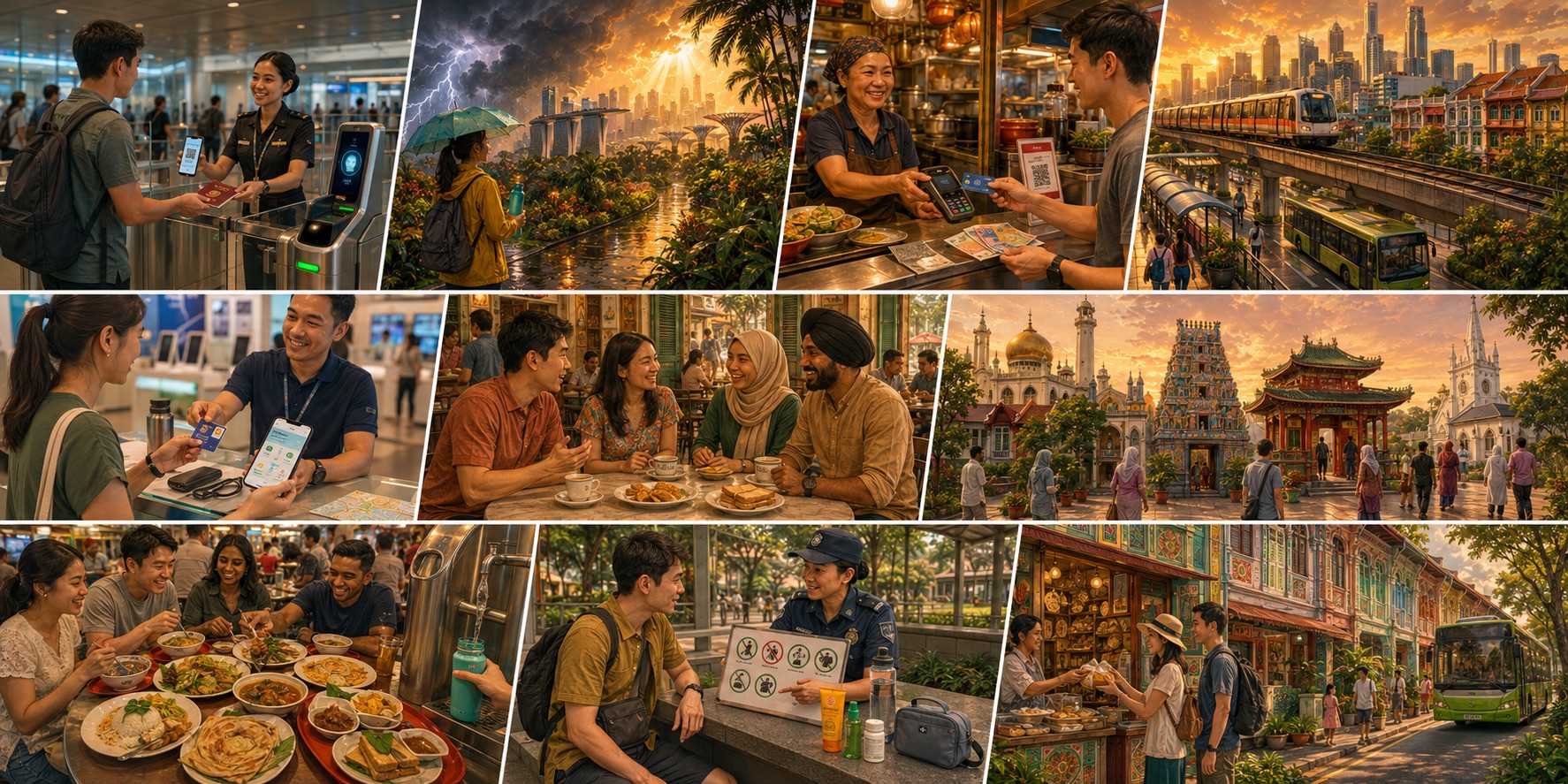
Singapore often introduces itself through motion: an airport train gliding toward the city, commuters tapping through MRT gates and breakfast crowds gathering around a hawker stall for kopi, kaya toast or noodles. The city-state is compact, but its polished skyline contains neighbourhoods shaped by Malay, Chinese, Indian, Peranakan and migrant histories.
Singapore welcomed 16.9 million international visitors in 2025 and recorded a historic S$32.8 billion in tourism receipts. For 2026, the Singapore Tourism Board projects between 17 million and 18 million arrivals and S$31 billion to S$32.5 billion in receipts. Tourism Board Chief Executive Melissa Ow captured the direction of that growth: “We are attracting visitors who value the distinctive experiences that Singapore offers.”
1. Entry requirements and immigration procedures: Start with a seamless arrival
Visitors generally need a passport with at least six months of validity. Whether a visa is required depends on nationality, and obtaining a visa does not guarantee entry. Immigration officers determine the length of each stay through an electronic Visit Pass, which may differ from the visa’s validity period. Keep proof of onward travel, accommodation and sufficient funds available.
Most travelers must submit the free SG Arrival Card within three days before arrival, including the day of arrival. The card is not a visa and should be completed only through the Immigration and Checkpoints Authority or its official mobile application. Paid websites offering to complete it are unnecessary.
Travelers arriving after visiting a country with yellow-fever transmission risk may need a valid vaccination certificate. Singapore also uses biometric immigration clearance, so visitors may be asked to provide facial, iris or fingerprint information. Check the electronic Visit Pass after entry to confirm the permitted departure date.
2. Best time to visit and seasonal conditions: Plan for sunshine and sudden rain
Singapore is warm and humid throughout the year, with daytime temperatures commonly reaching approximately 31 to 33 degrees Celsius. There is no completely dry season. A blue morning can become a heavy afternoon thunderstorm with little warning, particularly during the inter-monsoon periods.
The Northeast Monsoon generally runs from December to early March and can bring prolonged rain, especially from December into January. The Southwest Monsoon usually occurs from June to September and may produce early-morning squalls. Late March to May and October to November are transitional periods with frequent thunderstorms and lightning.
The best time therefore depends more on events, prices and personal tolerance for heat than on a perfect weather window. Carry a compact umbrella, refillable bottle and light rain protection. Schedule outdoor walks through the Singapore Botanic Gardens, Kampong Gelam or Southern Ridges for the morning, leaving museums and shopping areas for the hottest part of the afternoon.
Major occasions such as Chinese New Year, the Formula 1 Singapore Grand Prix and year-end celebrations can increase hotel prices. They also reveal the city at its most energetic, provided accommodation is booked early.
3. Currency, payments, and typical travel costs: Budget for an expensive city with affordable pleasures
Singapore uses the Singapore dollar. Credit cards, contactless payments and mobile wallets are accepted almost everywhere in hotels, malls, attractions and established restaurants. Visitors can also use many contactless bank cards directly on buses and MRT trains, although cards issued overseas may incur an administrative or foreign-transaction fee.
Cash still has a place. Some hawker stalls, traditional shops and market vendors accept only cash or domestic QR-payment systems that international visitors cannot easily use. Keep a modest supply of small notes rather than assuming every stall will accept a foreign mobile wallet.
Accommodation will usually be the largest expense. Singapore’s average hotel room rate was about S$274 in 2025. Hostels and capsule properties may start around S$50 to S$100, while many midrange hotel rooms cost S$160 to S$300 or more. A hawker meal can cost approximately S$4 to S$12, while restaurant meals are considerably higher. Public transportation generally remains affordable, making it possible to balance high accommodation costs with inexpensive meals and journeys.
Restaurant menus may exclude service charges and the prevailing Goods and Services Tax, so the final bill can exceed the listed prices. Tipping is not normally expected, although rounding up for exceptional service is appreciated.
4. Transportation and geographical challenges: Let the MRT expand your map
Singapore’s MRT and bus systems are clean, frequent and comparatively easy to understand. A contactless bank card can be used by tapping in and out with the same card or mobile device. Travelers planning intensive sightseeing can compare ordinary fares with the Singapore Tourist Pass, which provides unlimited travel on basic public buses and trains for a fixed period.
Avoid tapping in with a physical card and tapping out with the same card stored in a phone wallet. The system may treat them as separate payment methods and charge an incomplete journey. On buses, cash is possible, but the exact fare is required and no change is provided.
The network reaches most areas of interest, including Katong-Joo Chiat, Little India, Chinatown, Kampong Gelam and the civic centre. Locations such as the Mandai wildlife parks, Changi Village and parts of Lim Chu Kang may require a bus, taxi or ride-hailing connection. Grab, Gojek and TADA are commonly used private-transport platforms.
Distances are short, but tropical heat can make a 20-minute walk feel much longer. Covered walkways and underground passages help, although construction, rain and expressways sometimes complicate apparently simple routes. Late-night travelers should check the final train and bus times rather than assuming the system operates around the clock.
Travel across the land border to Johor Bahru in Malaysia can involve significant immigration queues, particularly on weekends and public holidays. Leave generous time when connecting to a flight, train or long-distance bus.
5. Internet access, SIM cards, and essential apps: Use technology without depending on it completely
Fast mobile coverage is widely available. Singtel, StarHub, M1 and SIMBA sell tourist SIM cards and data packages, while compatible phones can use eSIM services. Registration normally requires a passport, so purchase from an authorized counter, telecommunications shop or reliable airport outlet.
Free Wi-Fi is available in many hotels, malls, libraries and public areas, but registration methods vary. A local SIM or eSIM is more practical for navigation, ride bookings and last-minute attraction reservations. Avoid entering banking information over unfamiliar public networks.
MyICA Mobile is useful for immigration services, while MyTransport.SG and SimplyGo provide public-transport information. Google Maps works well for most journeys, and Grab, Gojek and TADA assist with private transportation. Singapore’s official weather services provide short-term rain forecasts, which are particularly helpful when planning outdoor activities.
Singapore has experienced sophisticated impersonation, banking and parcel scams. Government officers do not ask people to transfer money or disclose bank-login details by telephone. Ignore unsolicited links and verify unusual requests through an official agency website.
6. Languages and useful local expressions: Listen to the city’s many voices
Singapore has four official languages: English, Malay, Mandarin and Tamil. Malay is the national language, while English is the principal language of government, business and education. Most visitors can navigate transportation, hotels and restaurants entirely in English.
Everyday conversation often includes Singlish, a local form of English shaped by several languages and speech traditions. Can indicates that something is possible, while cannot gives a direct negative answer. Makan refers to eating or food, and tapao means taking food away. Chope describes reserving a hawker-centre seat, sometimes with a tissue packet, umbrella or another small object.
The particle lah can add emphasis or familiarity, but visitors should avoid performing an exaggerated version of Singlish. Listening respectfully is more natural than turning local speech into entertainment. Terima kasih means thank you in Malay, while Mandarin speakers may appreciate xie xie and Tamil speakers nandri.
Singaporeans often communicate efficiently, especially in queues and busy transport spaces. Stand on the left side of escalators, allow passengers to leave trains before entering and avoid blocking station gates while checking directions.
7. Religion, customs, dress codes, and etiquette: Enter every community with respect
Singapore’s multicultural character is visible within a few streets. In the city centre, a mosque, Hindu temple, Buddhist temple and church may stand within walking distance of one another. This proximity reflects a carefully maintained religious diversity rather than a collection of attractions existing only for visitors.
Cover shoulders and knees when entering places of worship, remove shoes where requested and ask before photographing ceremonies or worshippers. At the Sultan Mosque in Kampong Gelam, Sri Mariamman Temple in Chinatown or temples around Waterloo Street, follow the signs and instructions provided by community volunteers.
During Ramadan, avoid treating fasting customs as a spectacle in Muslim neighbourhoods. Around Chinese New Year, Deepavali, Hari Raya and other festivals, expect altered opening hours, large family gatherings and crowded cultural districts.
At hawker centres, it is normal to share a larger table with strangers when seats are scarce. A tissue packet or small personal item may indicate that someone has reserved a place. Queue patiently, avoid holding a table longer than necessary during the lunch rush and return trays and crockery after eating. Tray return is a legal responsibility as well as a gesture of consideration for cleaners and other diners.
8. Local food, drinking water, and dietary considerations: Discover Singapore one hawker centre at a time
Singapore’s hawker culture was added to UNESCO’s Representative List of the Intangible Cultural Heritage of Humanity in 2020. Hawker centres function as community dining rooms where dishes and culinary knowledge pass between generations.
Chicken rice, laksa, nasi lemak, roti prata, fish-head curry, satay, char kway teow and kaya toast provide an introduction, but the experience should extend beyond collecting famous dishes. Geylang Serai Market reflects Malay food traditions, Tekka Centre brings together Indian, Chinese and Malay stalls, and Old Airport Road Food Centre remains a favourite for local classics. Tiong Bahru, Chomp Chomp and neighbourhood centres in Toa Payoh, Bedok and Tampines offer different versions of daily Singapore life.
Look for official halal certification if required. Vegetarian does not always mean vegan, and dishes may contain lard, shrimp paste, fish sauce, egg or oyster sauce. Travelers with severe allergies should communicate clearly because small kitchens may share utensils and cooking surfaces.
Singapore’s tap water is safe to drink directly without additional filtration. Refilling a bottle reduces costs and unnecessary plastic. In the tropical heat, drink regularly even when traveling mainly by air-conditioned train.
9. Safety, health, laws, and common tourist mistakes: Respect the rules behind the order
Singapore has low levels of violent street crime, but theft and fraud can still occur. Protect valuables in crowded entertainment districts and confirm ride-hailing vehicles through the application. Travel insurance remains advisable because private medical treatment can be expensive.
The country enforces strict drug laws, including severe penalties for possession, importation and trafficking. Cannabis products that are legal elsewhere remain prohibited. Never carry a package or medication for another person, and check whether prescription medicines containing controlled substances require prior approval.
Vaporisers are illegal to import, purchase, possess or use. Enforcement and penalties were strengthened in 2026, and repeat offenses by short-term visitors can result in a future entry ban. Travelers should not bring a vaping device into the country, even for personal use.
Smoking is prohibited in many public places, including parks, beaches, transport facilities, building entrances and much of Orchard Road, except in designated areas. Public alcohol consumption and takeaway alcohol sales are generally restricted between 10:30 p.m. and 7 a.m., with additional controls in Little India and Geylang.
Littering and failing to return hawker trays can lead to enforcement action. Chewing gum itself is not broadly criminalized, but its commercial importation and sale are restricted, and discarding it improperly is an offense. The practical lesson is to follow posted signs rather than depend on popular jokes about Singaporean laws.
Heat exhaustion, sunburn and dengue are more likely health concerns than serious crime. Use mosquito repellent, take breaks and seek indoor shelter during lightning storms. Call 999 for police assistance and 995 for an ambulance or fire emergency.
10. Responsible travel and ways to support local communities: See the city neighbourhood by neighbourhood
Marina Bay, Gardens by the Bay and the Merlion form only one layer of Singapore. Katong-Joo Chiat reveals Peranakan architecture and family businesses. Kampong Gelam carries Malay and Muslim heritage, while Little India, Geylang Serai, Tiong Bahru and the public-housing estates of Toa Payoh and Queenstown show different chapters in the country’s urban story.
Terrence Voon of the Singapore Tourism Board summarized the opportunity: “Singapore’s compact size and diversity of experiences mean visitors can make the most of every moment.”
Choose locally operated walking tours, independent shops, traditional bakeries and family-run hawker stalls. Visit community museums and heritage institutions rather than treating historic districts as backgrounds for photographs. In residential estates, remember that Housing and Development Board blocks are people’s homes. Avoid photographing residents through windows, occupying common corridors or flying drones without checking the regulations.
Public transportation is usually the most efficient and environmentally responsible way to explore. Pulau Ubin, Sungei Buloh Wetland Reserve, the Rail Corridor and the Southern Ridges reveal a greener Singapore, but visitors should remain on marked trails and never feed monkeys, otters or other wildlife. Feeding wild animals is illegal and can damage both their health and the surrounding ecosystem.
Singapore becomes more rewarding when efficiency is treated as an invitation to look closer. Leave Marina Bay for a neighbourhood market, share a hawker table, notice the languages around you and allow space for ordinary life. The city’s strongest stories are found not only in its celebrated skyline, but in the communities that cook, worship, work and gather beneath it.


