Located in northeast Bali, the village of Trunyan practices an ancient open-air mortuary custom called Mepasah. Under this unique tradition, the deceased are left above ground inside bamboo cages rather than being buried or cremated.
Unlike mainstream Balinese Hindu communities that perform elaborate Ngaben cremation ceremonies, the indigenous Bali Aga people of Trunyan place human remains directly on top of the soil. This custom is rooted in an ancient worldview that views the physical body as an element of nature that must decompose naturally.
The Bali Aga believe that allowing the physical body to return to nature releases the soul without requiring artificial destruction or burial. According to local tradition, this practice aligns with ancient cosmological beliefs that predate the arrival of Hinduism in Bali. By placing the deceased in open air, the community maintains a direct spiritual and ecological balance between human life, ancestors, and the surrounding environment.
Despite corpses decomposing in open air, the burial ground does not produce foul odors or unpleasant smells. This lack of smell is attributed to the sacred Taru Menyan tree growing directly at the primary cemetery site. The giant tree releases a natural scent that neutralizes the odor of decaying flesh throughout the decomposition process.
The village maintains strict customary rules regarding who may receive this open-air burial and how the cemetery grounds are organized. Located along the secluded shores of Lake Batur, the sacred cemetery is accessible only by taking a boat across the water.
The Mepasah Ritual and It Rules
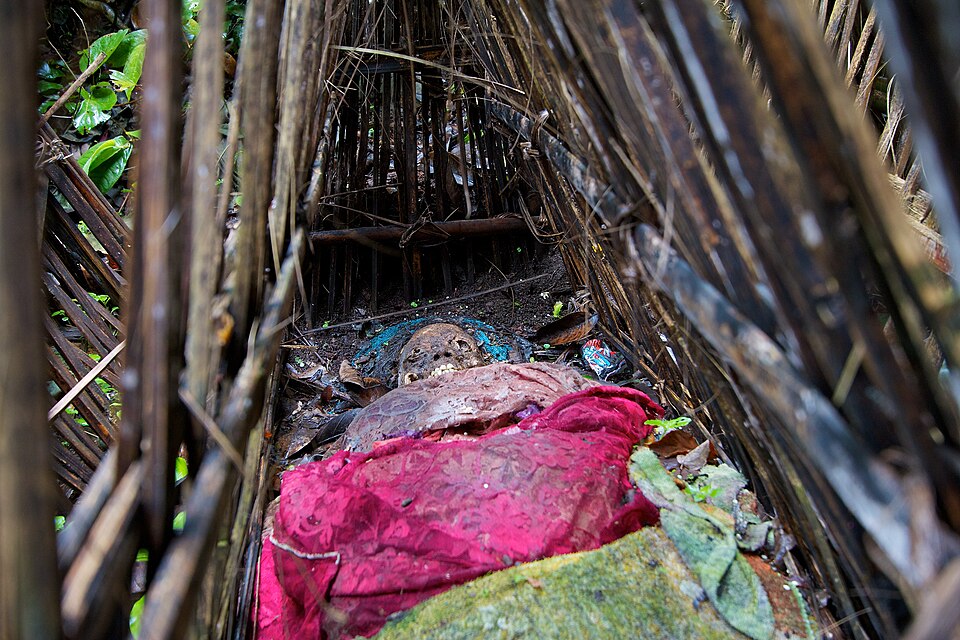
Before placement at the cemetery, the deceased person is cleaned with rainwater and wrapped in a clean white cloth. The body is then transported across Lake Batur by canoe to the sacred cemetery known as Sema Wayah. Once at the site, elders place the body on the open ground inside a triangular bamboo cage called an ancak saji.
The bamboo cages shield resting remains from wild animals while allowing natural air circulation to speed decomposition. Personal items such as plates, footwear, and clothing are placed beside the cage for the deceased person to use in the afterlife. Over several months, natural decay reduces the body until only clean bones and skulls remain on the soil.
The cemetery stays odor-free because it sits directly beneath the massive Taru Menyan tree, whose name means "fragrant tree". Estimated to be around 1,100 years old, this sacred tree emits a natural aroma that absorbs the smell of decay. Local attempts to plant the Taru Menyan species in other locations have continuously failed to reproduce its unique fragrance.
Moreover, open-air burial at Sema Wayah is strictly reserved for adults who were married and died of natural causes. Unmarried individuals and infants are buried or placed in caves at a separate cemetery called Sema Ngude. People who die from accidents, unnatural causes, or diseases are buried underground at a third site named Sema Bantas.
Customary law permits only eleven bamboo cages beneath the Taru Menyan tree at any single time. When a new body arrives, villagers move the oldest remains to an open stone platform to clear space. Skulls from earlier remains are neatly arranged on stepped stone altars to honor the ancestral spirits.
Unique Customs
Longstanding customary law forbids women from entering the Sema Wayah burial grounds during funeral rites. Female villagers accompany the funeral procession only as far as the lake shoreline before men carry the body across the water. This gender restriction reflects ancient rules designed to maintain spiritual purity during mortuary proceedings.
Trunyan is also famous for the rare Barong Brutuk sacred dance performed at Pusering Jagat Temple. Selected unmarried young men isolate themselves for a month before wearing dried banana leaf skirts, masks, and charcoal body paint. During the dance, performers whip spectators with rattan sticks to purify negative energy and bring cosmic balance to the village.