In northeastern Brazil, a single cashew tree covers over 8,500 square meters of ground. To anyone standing beneath, the site feels like an entire grove of separate trees. However, every branch, root, and leaf belongs to one single giant organism.
The footprint of this massive plant measures around 500 meters in circumference. Biologists estimate that its canopy spans an area equal to roughly seventy normal-sized cashew trees. Because of its immense scale, Guinness World Records recognizes it as the largest cashew tree on Earth.
This natural landmark sits in Pirangi do Norte, a coastal area near the city of Natal. Local stories recount that a fisherman planted the original sapling back in 1888. Over more than a century, that single planting expanded across two acres of land.
Despite its great age, the plant remains active and healthy. Each annual harvest produces about 2.5 tons of fresh cashew fruit. This steady output delivers tens of thousands of fruits every single year.
A Genetic Mutation That Creates a Forest
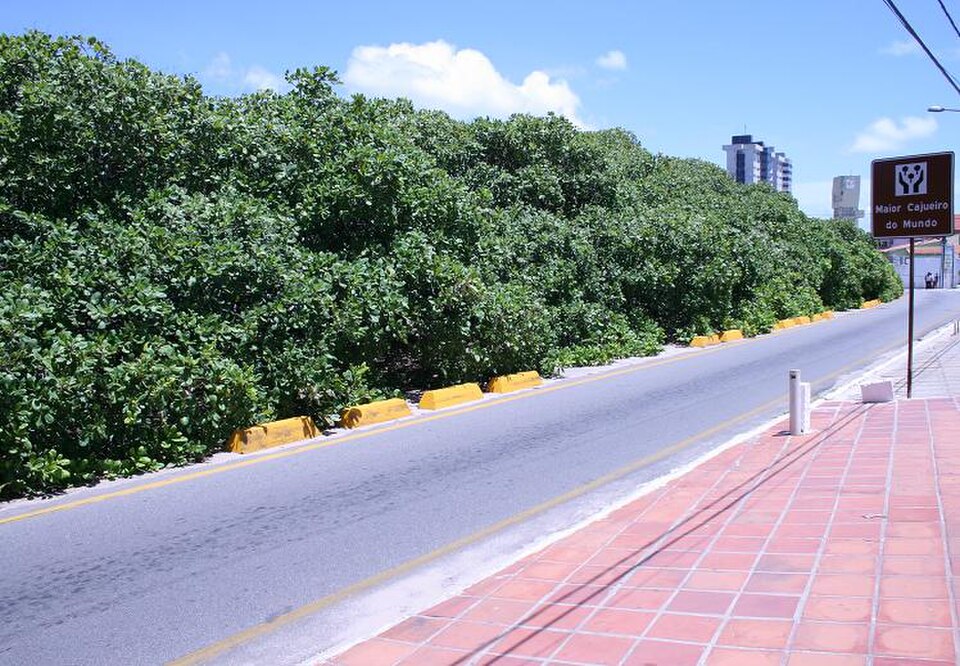
Most trees naturally grow straight up toward the sun. The Pirangi cashew tree carries a rare genetic mutation that forces its branches to spread horizontally. As these heavy limbs extend outward, weight pulls them down toward the soil.
Whenever a branch touches the ground, it takes root and establishes a new anchorage. These root points develop into secondary trunks that look like independent trees. In reality, these new trunks are exact genetic clones of the original plant.
Read also: Why There Are So Many Japanese in Brazil?
Four out of the five main branches on the tree follow this unusual rooting behavior. The fifth branch grew normally, stopped at the ground without taking root, and received the local nickname "minimum wage". Together, the remaining branches created an expanding network of self-replicating wood.
Moreover, the giant cashew tree remains remarkably productive despite its strange growth structure. During the peak harvest season between November and January, it bears between 60,000 and 80,000 fruits. Local workers gather this massive yield directly from the lower branches and ground walkways.
In Brazilian culture, the fleshy cashew apple receives as much appreciation as the nut itself. Because the delicate fruit spoils quickly, workers process most of the harvest locally. The fresh pulp turns into popular juices, sweets, jams, and traditional alcoholic beverages.
The sprawling landmark supports the local economy of the surrounding beach community. Market stalls near the entrance sell roasted nuts, fruit preserves, and regional crafts. Tourism generated by the giant plant creates steady jobs for local residents and vendor shops.
Managing the Sprawling Wonder
Authorities established a protected natural park around the tree to ensure its survival. Raised wooden walkways wind beneath the canopy, letting visitors walk through the interior without trampling fragile roots. A high observation tower provides panoramic views of the green canopy from above.
Managing the landmark brings ongoing challenges because the plant refuses to stop growing. Long branches now push against the boundary walls of the park and reach toward adjacent city streets. Unchecked growth could eventually cover major traffic roads passing through the area.
Park managers restrict heavy pruning so the tree can preserve its unique biological form. Allowing the plant to expand freely honors its natural growth habit without forcing artificial shapes. This careful balance preserves one of the world's most unusual botanical wonders for future generations.
Read also: Assai, a “Japanese Town" in the Heart of Brazil