


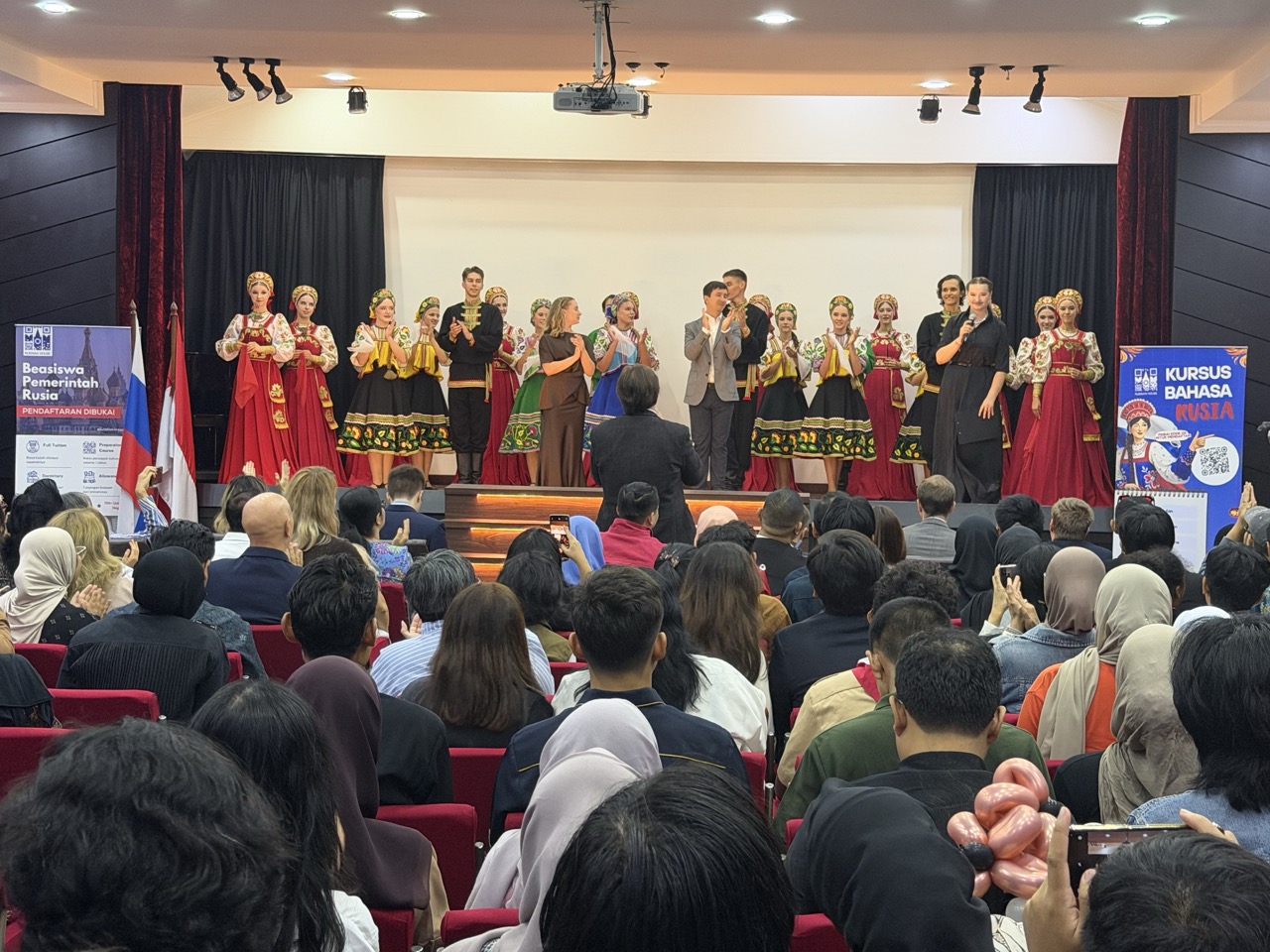
Traditional music, sweeping choreography and brightly colored costumes filled the Russian House in Jakarta on Wednesday, September 16, as the Siberian Patterns Folk Dance Ensemble introduced an Indonesian audience to the cultural diversity of Russia. Around 400 people packed the performance hall for an evening that transformed folk dance into a lively expression of friendship between the two countries.
A Full House Welcomes Russian Culture
The event began with the national anthems of Russia and Indonesia, followed by remarks from Russian Ambassador to Indonesia Sergei Tolchenov and Russian House Jakarta Director Nikita Shilikov.
Tolchenov placed the performance within a broader understanding of diplomacy. Economic and business relations remain important, he explained, but cultural programmes also help countries understand one another. “Cultural events are part of our diplomacy to promote and introduce our culture and to strengthen people-to-people connections,” the ambassador said.
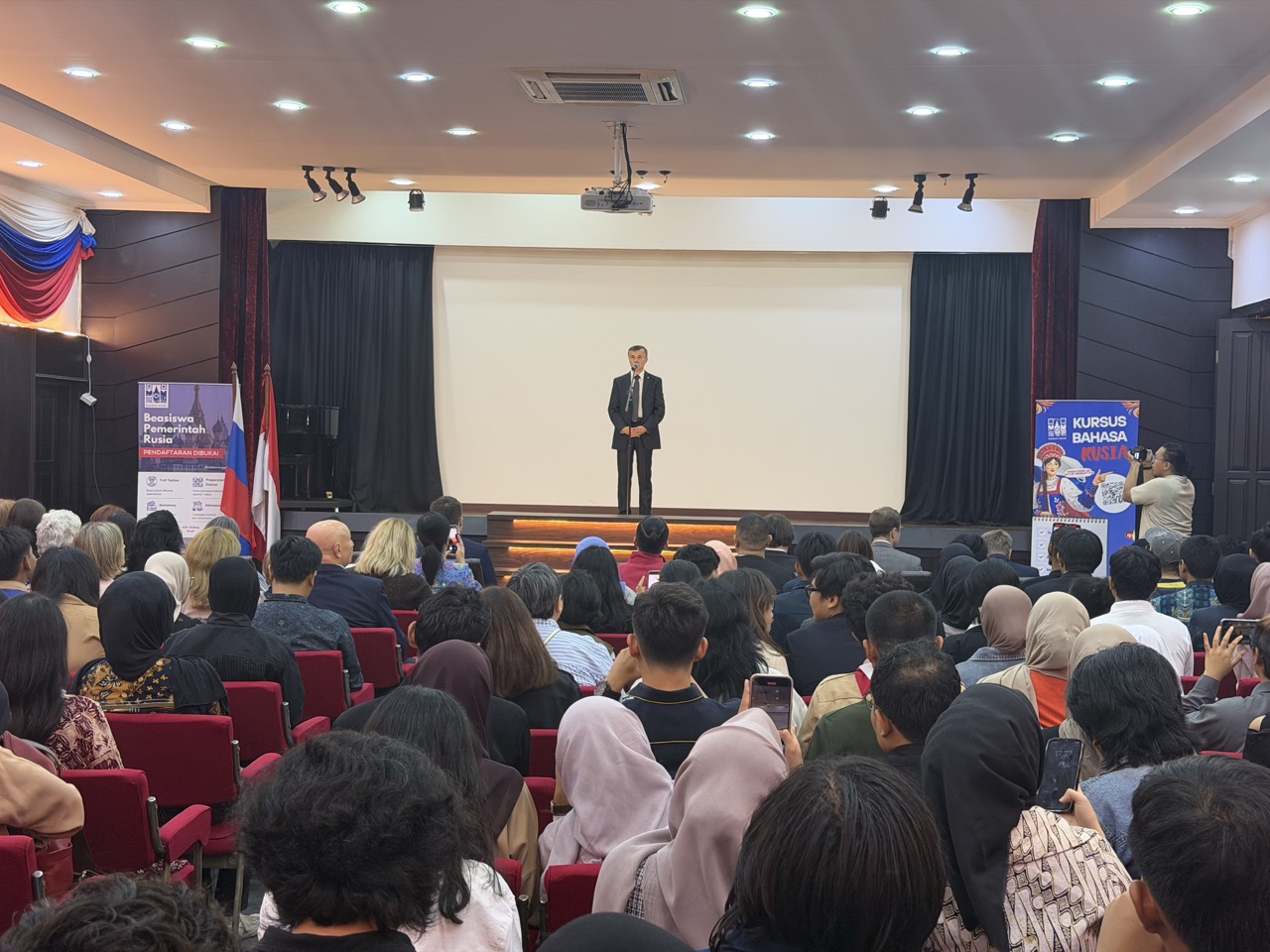
Shilikov thanked the audience for filling the hall and welcomed the opportunity to present another side of Russia to the Indonesian public. As director of the Russian House, he has emphasized the value of cultural, educational and youth engagement in building humanitarian connections alongside formal bilateral relations.
Six Performances, One Enthusiastic Audience
Recognized as an Honored Collective of Folk Art of the Russian Federation, Siberian Patterns presented six dance lineups featuring Russian and Tatar traditions. The programme opened with a Siberian dance, immediately setting an energetic tone through synchronized movement, expressive choreography and richly detailed costumes.
Each performance revealed a different aspect of Russia’s regional heritage. Rhythmic footwork, changing formations and theatrical gestures drew sustained applause, with spectators responding enthusiastically after every appearance.
The concert concluded with Kalinka, one of Russia’s most internationally recognizable folk songs and dances. Its gradually accelerating rhythm provided a spirited finale and brought another long round of applause from the Jakarta audience. After the show, spectators met the dancers and took photographs with the ensemble, extending the interaction beyond the stage.
Cultural Diplomacy Reaches a Younger Generation
Among those attending was Gilang, a Jakarta high school student who had previously participated in activities at the Russian House. For him, the centre offers more than cultural entertainment.
“This is not my first time at the Russian House. I like coming here to learn more about international relations,” he said. Gilang hopes to study the subject at university after graduating from high school.
His experience demonstrated one of the evening’s wider consequences. A dance performance may initially attract visitors through music, costumes and spectacle, but it can also inspire curiosity about another country’s history, society, language and international role.
Building on 76 Years of Partnership
The performance took place as Indonesia and Russia continued developing a relationship established in 1950. The two countries celebrated 75 years of diplomatic relations in 2025 and elevated their ties through a Strategic Partnership Declaration signed that June.
Cultural promotion, tourism, education and scientific cooperation were again identified as areas for collaboration during the 14th Indonesia–Russia Joint Commission in May 2026. The meeting also noted that bilateral trade reached US$5 billion in 2025, illustrating the substantial economic framework surrounding growing cultural engagement.
The cultural relationship is increasingly visible outside official settings. In June 2026, more than 1,500 people attended a Russian House celebration in Jatinangor, West Java, showing the reach of public programmes beyond central Jakarta.
Friendship in Motion
The Siberian Patterns concert showed how cultural diplomacy becomes most effective when audiences can experience it directly. Through six dances, sustained applause and conversations after the performance, Russian culture was not merely displayed but encountered.
For hundreds of spectators—and especially young visitors such as Gilang—the evening offered an engaging entry point into a country that may otherwise feel geographically distant. In Jakarta, dance brought that distance a little closer.


