


Singapore makes a striking first impression. Jewel Changi Airport’s Rain Vortex cascades through a terraced indoor forest, offering arriving travellers a preview of a city where nature and engineering frequently share the same space. Yet the most rewarding Singapore experience begins beyond the airport, in neighbourhoods, gardens and hawker centres that reveal the human character beneath its polished skyline.
From Global Gateway to Destination
Singapore is increasingly attracting travellers who come for the city itself, not simply to change planes. In 2025, it welcomed 16.9 million international visitors and generated a record S$32.8 billion in tourism receipts. For 2026, the Singapore Tourism Board expects between 17 million and 18 million arrivals and S$31 billion to S$32.5 billion in receipts despite an uncertain global environment.
“We are attracting visitors who value the distinctive experiences that Singapore offers,” said Singapore Tourism Board Chief Executive Melissa Ow. The board’s longer-term Tourism 2040 strategy aims to raise annual tourism receipts to between S$47 billion and S$50 billion by developing distinctive attractions, international events and higher-value experiences.
The opportunity is clear, but so is the challenge. Singapore must continue growing as an international hub without allowing its tourism experience to become generic. Its competitive advantage lies not only in efficiency or architecture, but in the close relationship between futuristic design, multicultural heritage and everyday local life.
A City Where Nature Becomes Architecture
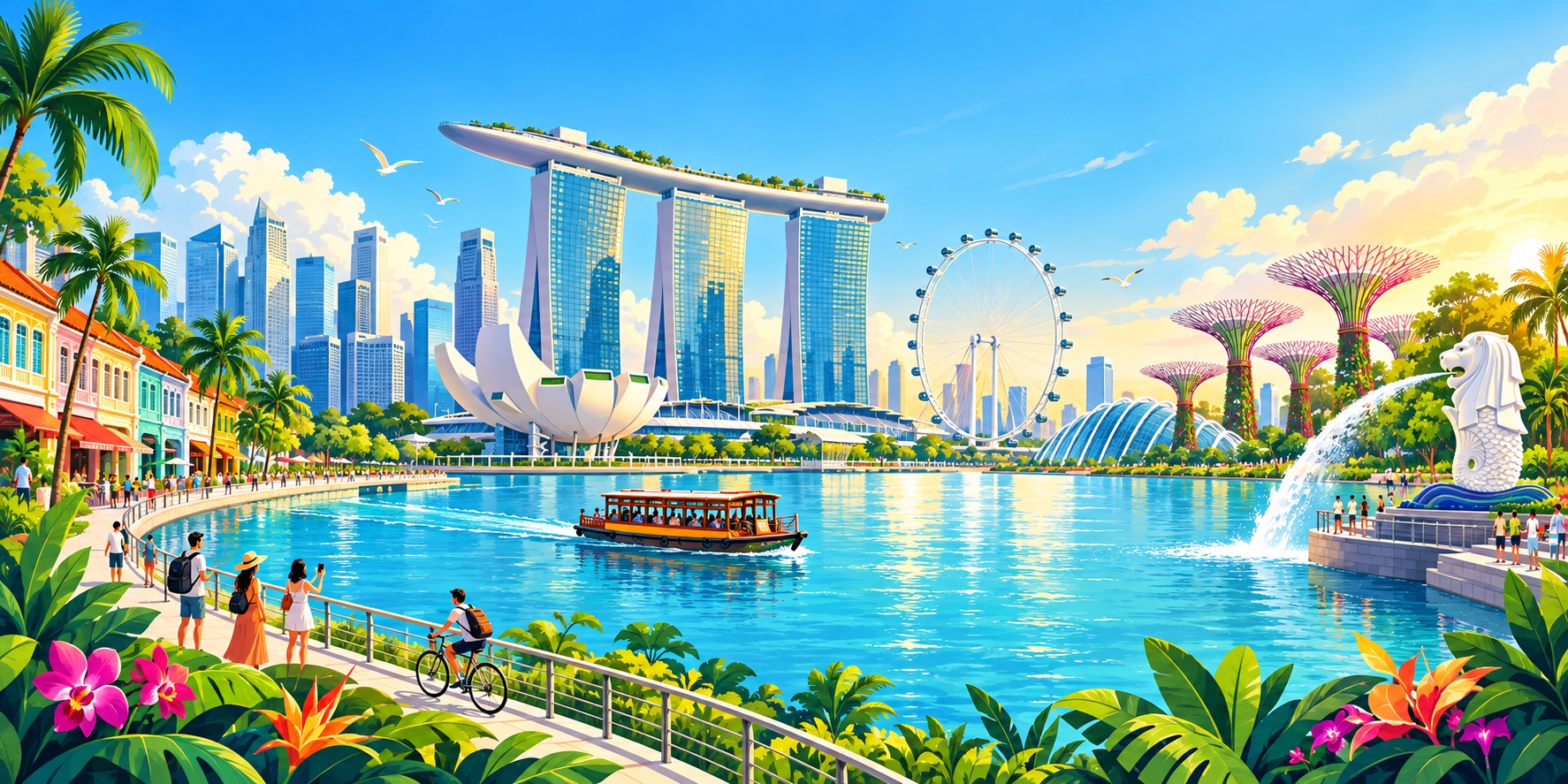
Gardens by the Bay provides the clearest expression of Singapore’s “City in Nature” ambition. During the day, visitors wander beneath the vertical gardens of the Supertrees or enter the cool mist of the Cloud Forest. After sunset, the illuminated grove transforms into a theatrical landscape framed by the Marina Bay skyline.
The same philosophy appears at Jewel Changi Airport, where the HSBC Rain Vortex descends through an indoor forest, and at the Singapore Botanic Gardens, established in 1859 and inscribed on the UNESCO World Heritage List in 2015. The Botanic Gardens remains more than a visitor attraction: residents come to exercise, picnic and enjoy concerts among orchids, lakes and tropical trees.
Travellers can discover a less manicured side of the city along the Southern Ridges or among the mangroves of Sungei Buloh Wetland Reserve. At Mandai Wildlife Reserve, the completion of Rainforest Wild Adventure East in May 2026 expanded a nature precinct that already includes Singapore Zoo, Night Safari, River Wonders and Bird Paradise. The precinct has also received Global Sustainable Tourism Council certification.
These attractions demonstrate how Singapore treats greenery as part of the visitor experience rather than decoration placed around it.
Heritage Experienced Street by Street
Singapore’s cultural story is best explored at walking pace. In Chinatown, restored shophouses and the Buddha Tooth Relic Temple stand beside contemporary restaurants and independent businesses. Little India brings together flower garlands, spice shops, textile merchants and the richly ornamented Sri Veeramakaliamman Temple. In Kampong Glam, the golden dome of Sultan Mosque rises above streets filled with Malay restaurants, fabric stores, cafés and the murals of Haji Lane.
These districts are not static museum pieces. They are working neighbourhoods where places of worship, family businesses and new creative ventures continue to shape the city’s identity.
Food provides the most accessible route into that story. A traveller might begin with kaya toast and kopi, stop for chicken rice or laksa at Maxwell Food Centre, and finish the evening with satay beside the Victorian ironwork of Lau Pa Sat. Depending on the neighbourhood, the next meal could be nasi padang, roti prata, fish-head curry or Peranakan dishes fragrant with coconut milk and spices.
Singapore’s hawker culture was inscribed on UNESCO’s Representative List of the Intangible Cultural Heritage of Humanity in 2020. The recognition celebrates not only individual dishes but also the shared dining spaces where people from different communities and income groups eat side by side.
Global Events in a Compact City
Singapore’s physical compactness gives it an advantage as an entertainment and business-events destination. A visitor can attend a conference in the morning, explore Marina Bay in the afternoon and eat at a neighbourhood hawker centre that evening, often using the MRT for the entire journey.
Marina Bay Sands remains the city’s most recognisable expression of architectural luxury, while Sentosa brings together beaches, resorts, family attractions and Universal Studios Singapore. The annual Formula One Singapore Grand Prix turns the downtown streets into a night-racing circuit accompanied by concerts and citywide programming.
In 2025, the Grand Prix drew more than 300,000 spectators over three days. Singapore’s meetings, incentives, conventions and exhibitions sector also generated S$2.3 billion in tourism receipts, an increase of more than 35 per cent from 2024. These results reflect the city’s strategy of combining large international events with dining, culture and precinct-based experiences.
Growth Anchored in Local Identity
Singapore’s next tourism chapter will include expanded attractions, rejuvenated districts and new facilities around Sentosa, Orchard Road and Marina Bay. However, infrastructure alone cannot create a memorable destination.
“We must continue to rejuvenate our cityscape with refreshed products and experiences that reflect Singapore’s unique character,” said Grace Fu, Singapore’s Minister-in-charge of Trade Relations.
For visitors, purposeful travel can be as simple as taking public transport, eating at independently operated hawker stalls and spending time beyond the famous landmarks. An afternoon along the Rail Corridor, a meal in Geylang Serai or a walk past the Peranakan façades of Joo Chiat can reveal dimensions of Singapore that a skyline photograph cannot.
Singapore’s appeal ultimately comes from its contrasts: rainforest beside railway tracks, century-old shophouses beneath glass towers and inexpensive hawker meals within sight of luxury hotels. The city may operate with remarkable precision, but its enduring tourism story is warmer and more personal—a compact island continually finding new ways to connect innovation, culture and nature.


