


Beneath the waters of eastern Indonesia, branching corals shelter young fish while reef slopes support a remarkable variety of marine life. Above the surface, these ecosystems sustain fishing families and tourism businesses. Protecting them now requires cooperation that can keep pace with warming seas and mounting local pressures.
Connecting Six Nations Through One Ocean
Indonesia helped launch the Coral Triangle Initiative on Coral Reefs, Fisheries, and Food Security, or CTI-CFF, in 2009. Together with Malaysia, the Philippines, Timor-Leste, Papua New Guinea and Solomon Islands, it established a partnership connecting Southeast Asia and the Pacific through shared marine priorities. The permanent regional secretariat has been based in Manado since 2015.
The ecological stakes are extraordinary. The initiative describes the Coral Triangle as home to more than 600 reef-building coral species, approximately 76% of the world’s known total, and 37% of reef-fish species. Its marine resources support food security and livelihoods for more than 130 million people.
Hosting the secretariat gives Indonesia an enduring coordinating role. Yet regional leadership ultimately depends on what happens underwater: effective protection, healthier fisheries and coastal communities equipped to manage change.
Giving Reefs a Better Chance
The recent global bleaching crisis underlines the urgency. NOAA reported in June 2026 that bleaching-level heat stress affected approximately 84% of the world’s coral-reef area between early 2023 and mid-2025. That measures exposure to dangerous temperatures, not the percentage of reefs that died.
Local damage compounds that pressure. Research published in August 2026 documented almost 3,570 bomb-fishing incidents in 3,650 hours of underwater recordings from Indonesia’s Spermonde Archipelago. The findings show why planting corals must be accompanied by preventing further destruction.
“Restoration efforts struggle to keep up with such rapid rates of destruction caused by bombing,” Hasanuddin University coral researcher Jamaluddin Jompa said in the research announcement.
Restoration can support recovery, but it cannot substitute for addressing destructive fishing, pollution and greenhouse-gas emissions. Protecting surviving reefs remains essential.
Putting Coastal Knowledge at the Centre
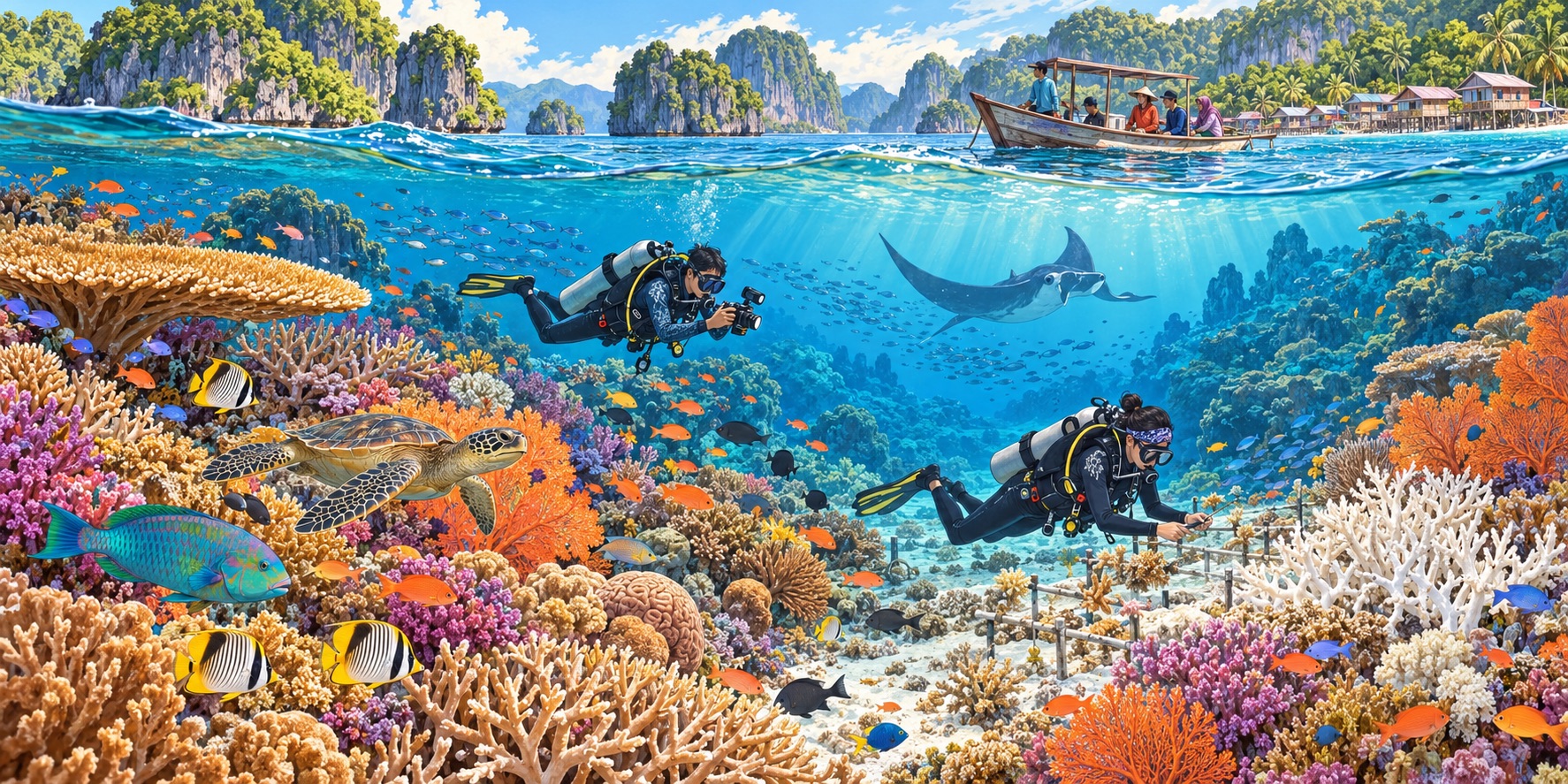
Indonesia’s contribution also includes practical learning. In February 2026, the Bali-based Coral Triangle Center brought together 25 community-surveillance representatives from five countries. Participants studied monitoring and reporting methods used in Nusa Penida’s marine protected area, including engagement with fishers and coordination between agencies.
Such exchanges make regional cooperation tangible. A community patrol needs clear responsibilities, reliable equipment and a functioning reporting system. Fishers need confidence that conservation rules are fair and that their knowledge influences management.
“MSP is not only about maps, policies and technical processes—it is fundamentally about people,” marine conservationist Rili Djohani said during an August 2026 workshop on marine spatial planning. Her message places participation at the heart of deciding how ocean space is used.
Protecting Connections Beyond Boundaries
Raja Ampat illustrates why conservation must follow ecological evidence. Research announced in 2024 tracked more than 70 adult reef manta rays using over 30 acoustic receivers, identifying important connections and habitat beyond existing protected areas. Protection on a map must account for where animals actually travel.
Across the Sulu-Sulawesi Seascape, Indonesia, Malaysia and the Philippines are exploring coordinated planning around shared habitats and competing marine uses. At their August 2026 workshop, participants identified a preliminary focus area of approximately 370,000 square kilometres. They acknowledged that comprehensive, legally coordinated planning would be complex; the proposed approach remains collaborative rather than binding.
This is meaningful progress, although it should not be mistaken for seamless joint enforcement or proof that illegal fishing has been eliminated.
Investing in Protection That Lasts
Sustained conservation also needs sustained funding. In July 2026, CTI-CFF countries and partners examined mechanisms including the Coral Triangle Conservation Fund and outcome-based financing. The practical test is whether financing supports lasting management, monitoring and community benefits.
Indonesia’s strongest leadership opportunity is to connect regional ambition with everyday stewardship. Success will be measured in reefs that retain life, fisheries that sustain households and coastal people who help shape the future of their seas.


