


In the seventh century, India was an important destination for Buddhists seeking to study the religion from its original sources. For a Chinese monk named Yijing, that meant making a long journey to India to learn from its major Buddhist centers.
But Yijing did not go straight to India.
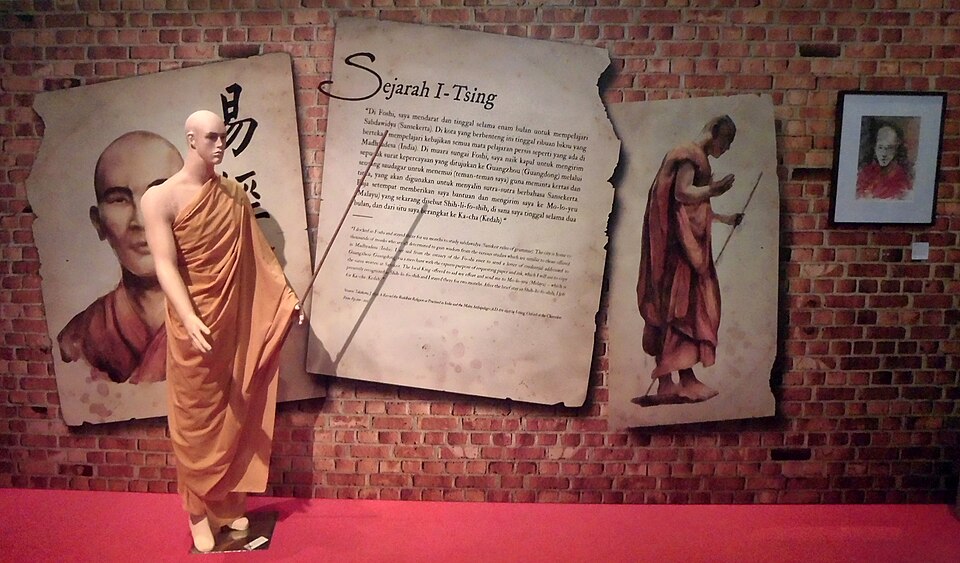
In November 671, he left Guangzhou aboard a Persian ship and sailed with the monsoon winds. About 20 days later, he arrived at a place he called Bhoga, the center of the Srivijaya kingdom around present-day Palembang.
Yijing stayed there for six months to study Sanskrit. The decision may seem unusual. If India was his destination, why did he need to learn Sanskrit in Palembang first?
Srivijaya as a Place to Prepare for India
The answer lies in Srivijaya's religious life at the time.
In his account, Yijing wrote that more than 1,000 Buddhist monks lived in the fortified city of Bhoga. They studied subjects similar to those taught in Central India, while their religious rules and ceremonies were also said to be much the same.
Yijing himself studied Śabdavidyā, the study of Sanskrit grammar, for six months. The skill was important because many of the Buddhist teachings and texts he wanted to study in India were written in Sanskrit.
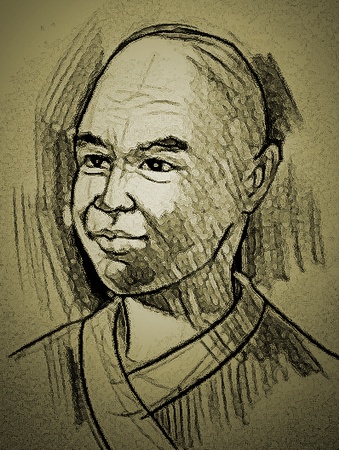
The experience later shaped Yijing's advice to other Chinese monks hoping to study in India. In his account, he recommended that they spend one or two years in Srivijaya first to learn the proper rules and prepare themselves before continuing to India.
Researcher Andrea Acri has also noted that Yijing recommended that prospective students of Nalanda learn Sanskrit in Srivijaya beforehand.
For Yijing, then, Palembang was more than a stop along the way. It was a place where monks could prepare themselves before entering India's major centers of Buddhist learning.
From Palembang, Yijing Continued to India
After six months in Bhoga, Yijing received help from the local king to continue his journey. He was sent to Malayu, a region along the eastern coast of Sumatra, where he stayed for two months.
From Malayu, he stopped in Kedah before boarding a royal ship bound for eastern India. In 673, Yijing arrived at Tamralipti, a port in the Ganges delta.
In India, he studied Sanskrit and grammar again for about a year. He then continued overland to Nalanda, one of the major centers of Buddhist learning at the time.
The journey was not easy. Yijing fell ill, became separated from a group of merchants, and was even robbed by mountain bandits who took his robes. He continued on and eventually reached Nalanda around 675.
For about ten years, he studied various branches of Buddhist knowledge, including logic, the Vinaya or monastic discipline, and the philosophies of Madhyamaka and Yogācāra.
After Studying in India, He Returned to Palembang
After years of study, Yijing left India in 685. This time, he was carrying a vast collection of manuscripts.
According to his account, they contained more than 500,000 śloka. If translated into Chinese, the texts would have filled around 1,000 volumes.
Yijing traveled back through Tamralipti and Kedah before reaching Malayu. By then, according to his account, Malayu had become part of Bhoga.
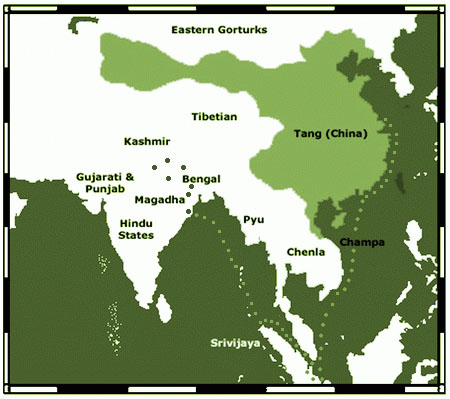
In 687, Yijing arrived in Srivijaya again. This time, he had a different purpose. He had first come to Palembang to prepare for his studies in India. Now he returned to translate the manuscripts he had brought back from India.
The work required large amounts of paper, ink, and scribes. When his supplies ran out, Yijing tried to travel to Guangzhou to obtain more. However, the merchant ship he was traveling on departed before he could disembark, carrying him all the way to Guangzhou in 689.
In Guangzhou, Yijing sought help to continue his work. Monks and laypeople recommended Zhenggu, a monk who had long studied the Vinaya. Zhenggu agreed to join him, along with Daohong and two other monks.
On November 1, 689, they sailed back to Srivijaya.
Srivijaya in Yijing's Journey
Yijing eventually spent more than six years in Srivijaya. From Bhoga, he also sent manuscripts and translations back to China through monks who returned earlier, including Nanhai jigui neifa zhuan, his account of travel and Buddhist life across the Southern Seas.
He finally reached Luoyang in May 695, where he was received by Wu Zetian, the ruler of China at the time. Yijing's translations later became an important source on Buddhist life and networks across seventh-century Asia.
References:
- Jan, Y. (1987). Yijing. Dalam L. Jones (Ed.), Encyclopedia of religion. Macmillan. https://www.encyclopedia.com/environment/encyclopedias-almanacs-transcripts-and-maps/yijing
- Ooi, H. C. (2019). I-Tsing at the South Sea: The Buddhist learning journey [Disertasi doktoral, Burapha University]. https://digital_collect.lib.buu.ac.th/dcms/files/58810157.pdf
- Takakusu, J. (1896). A record of the Buddhist religion as practised in India and the Malay Archipelago (A.D. 671-695), by I-Tsing. Clarendon Press.
- Wolters, O. W. (1983). A few and miscellaneous pi-chi jottings on early Indonesia. Indonesia, 36. https://ecommons.cornell.edu/server/api/core/bitstreams/3d746278-58b1-4f1c-8dac-0e6be19b8dea/content


