


The dominant narrative of world history has long associated great power with advancing armies and conquered territories. We read about Roman legions that subdued Europe and North Africa, Mongol cavalry that swept across Asia into Eastern Europe, or Napoleon's infantry that redrew the map of a continent within a matter of years.
Within that framework, kingdoms that left behind no great walls, legions, or pyramids are almost invisible.
Sriwijaya was one of them. This maritime kingdom, centered in Palembang in present-day South Sumatra, built no stone monuments. What it possessed instead were straits, monsoon winds, and a remarkably sophisticated understanding of how the world worked.
For roughly 6th centuries, from the 7th to the 13th century, Sriwijaya controlled the Strait of Malacca. The strait connected the Indian Ocean and the South China Sea and served as the meeting point of the world's two largest civilizations.
A Geographic Bottleneck Turned Into Power
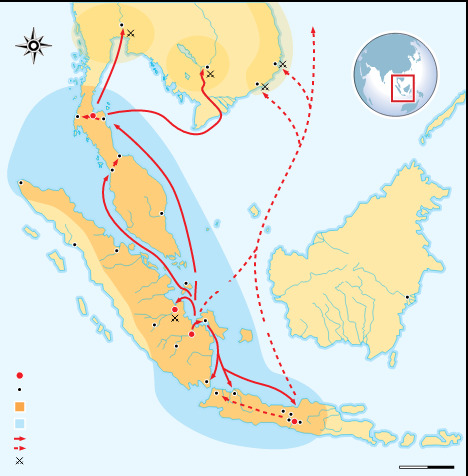
Sriwijaya's position was not merely a matter of luck. Because of the monsoon wind system, merchants traveling between China and India often had to stop in the region for months while waiting for the winds to change direction.
This condition helped transform Sriwijaya into a major international trading hub, complete with markets and infrastructure serving merchants from across Asia.
The foundation of Sriwijaya's power was not conquest, but control over the choices available to traders. The kingdom ensured safe maritime routes and adequate port facilities, while also leading military expeditions against potential rivals.
Arab records make no mention of piracy at the southern entrance of the Strait of Malacca, suggesting that the maritime communities of the region identified their interests with those of the Maharajas.
Rather than disrupting merchant vessels, they cooperated in suppressing Sriwijaya's competitors and maintaining the kingdom's dominance over regional trade.
Tribute as Diplomacy, Not Submission
In its relations with China, Sriwijaya played an exceptionally sophisticated game. Chinese records document tribute missions from Sriwijaya between the sixth and eleventh centuries.
Yet these "tributes" consisted of pepper, resin, rattan, ivory, and bird's nests, while the "gifts" returned by the Chinese emperor included industrial dyes, iron, ceramics, and silk. This was not submission. It was trade framed as tribute, a diplomatic fiction that benefited both sides.
Sriwijaya also expanded its influence through religious networks. The Chinese Buddhist monk Yijing, who stayed in Sriwijaya in the late seventh century, wrote:
"In the fortified city of Bhoga, there are more than 1,000 Buddhist monks. If a Chinese monk wishes to travel westward to study the original scriptures, it would be better for him to stay here for one or two years first."
Sriwijaya even financed a monastery at Nalanda in India. It was medieval soft power in one of its most sophisticated forms.
Why Sriwijaya Is Largely Absent from World History
Unlike Majapahit, which left behind stone temples, Sriwijaya was a kingdom of wood and water. Its capital most likely consisted of floating settlements along the Musi River, structures that could not survive the tropical climate.
A kingdom whose power rested on networks and flexibility rather than monuments and borders is inherently more difficult to fit into conventional historical narratives, which tend to favor stories of conquest and territorial expansion.
Yet its legacy remains remarkably relevant. In the sixteenth century, after Portugal captured Malacca, the explorer Tomé Pires wrote:
"Whoever is lord of Malacca has his hand on the throat of Venice."
At the time, Venice was Europe's principal center of the spice trade, and its entire supply depended on routes passing through the Strait of Malacca. To control the strait was to control the lifeline of the richest city in Europe.
Without realizing it, Pires was describing the very reason Sriwijaya endured for six centuries. Today, the Strait of Malacca remains one of the busiest shipping routes in the world. The logic has not changed.
References:
- Leira, H., & de Carvalho, B. (2015). Thinking through Srivijaya: Polycentric networks in traditional Southeast Asia. ISA Global South Caucus Conference. https://web.isanet.org/Web/Conferences/GSCIS%20Singapore%202015/Archive/23e81aa1-2e38-42a5-86f5-d95c45e4d9ce.pdf
- Wikiratne, S. (2024, August 21). Srivijaya: Trade and connectivity in the pre-modern Malay world. Academia.edu. https://www.academia.edu/108035173/Srivijaya_Trade_and_Connectivity_in_the_Pre_modern_Malay_World


