Imagine a sacred religious sanctuary built entirely from discarded glass beer bottles. Wat Pa Maha Chedi Kaew in Sisaket province, Thailand, stands as a very unique temple complex crafted from over 1.5 million recycled glass containers.
Local Buddhist monks started collecting discarded glass bottles in 1984 to clean up growing litter polluting the surrounding rural landscape. Community residents, local tavern owners, and regional government authorities regularly brought empty bottles to the monastery grounds to support the ongoing construction efforts.
The ambitious building initiative quickly expanded from a modest wooden pavilion into a massive spiritual sanctuary containing more than twenty distinct structures. This recycled glass architecture includes spacious prayer halls, a grand stupa, monk living quarters, water towers, public restrooms, and a crematorium.
The innovative design demonstrates how core Buddhist values of mindfulness and environmental conservation can transform everyday garbage into timeless sacred beauty.
History of the Bottle Temple
Abbot Phra Khru Vivek Dharmajahn and his devoted monastic followers founded the sanctuary in 1984 after witnessing severe trash accumulation across the local countryside. Regional folklore also describes an abbot dreaming of a celestial heavenly temple shining brilliantly with precious diamonds and radiant gemstones.
Since real gemstones cost far too much money, the resourceful monks chose glossy glass bottles as a practical and beautiful building substitute. The monks encouraged local villagers to donate empty beer bottles rather than discarding glass containers along public roadsides, forests, or agricultural fields.
Collecting the initial million bottles required steady community teamwork and patient collection efforts over several continuous months of recycling drives. The dedicated monks spent two full years constructing the central ordination hall after accumulating their first massive stockpile of recycled glass.
Unique Architecture and Structural Features
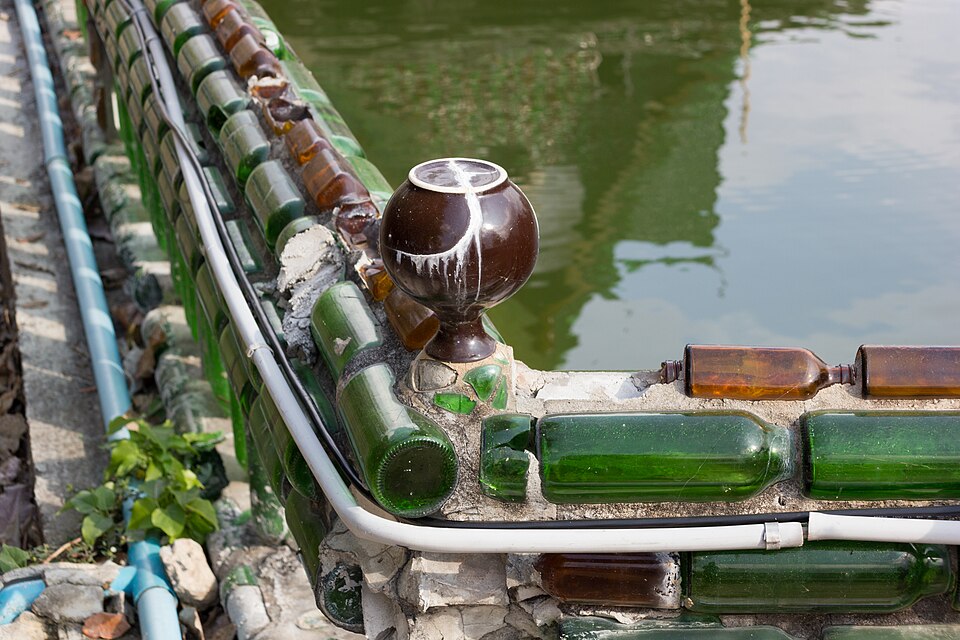
Master builders artfully combined green Heineken bottles and brown Chang beer bottles to create striking geometric patterns across outer walls and high roofs. Sturdy concrete mortar binds the glass containers together securely, replacing traditional clay bricks while constructing durable structural enclosures for every building.
The monks embedded thousands of shiny metal bottle caps into wet wall plaster to craft elaborate mosaic artwork depicting sacred Buddha figures. Natural tropical sunlight passes through the translucent glass walls throughout the day, illuminating interior prayer spaces with soft jade and amber tones.
Air trapped inside the sealed hollow bottles serves as natural thermal insulation that shields indoor rooms against severe tropical summer heat. These smooth glass surfaces naturally resist harsh weather damage, maintain vibrant colors over decades, and simplify routine maintenance for resident monks.
Floating above a scenic water pond, the central ubosot hall features a serene white jade Buddha statue that creates a tranquil spiritual centerpiece. Intricate bottle caps cover the base of statues and wall borders, creating detailed religious motifs without using standard commercial paint.
Environmental Impact
The monastery serves as a functional global model for upcycling unconventional solid waste into long-lasting public architecture. Reusing over 1.5 million glass containers saved substantial industrial manufacturing energy while diverting hundreds of tons of refuse away from regional landfills.
The project reflects the resourceful spirit of local Isan communities, who deeply value environmental stewardship, simple living, and community cooperation. Renowned global travel publications and architectural research studies celebrate the site as a top international benchmark for sustainable green design.