Every wedding has its costs, but in one of Viet Nam’s folk prints, the celebration appears to go ahead only once the offerings reach a cat. The bride, groom, musicians and gift bearers are all rats.
Known as Đám cưới chuột or “The Rat’s Wedding”, the print has been read as a pointed commentary on power, privilege and corruption. Its humour lies in the uncomfortable bargain at the centre of the celebration, where the rats appear to offer gifts to a larger cat, hoping to avoid trouble.
The work is one of many prints in Viet Nam’s Đông Hồ folk woodblock printing tradition, an art form that has used everyday scenes, familiar animals and playful imagery to communicate ideas about society for generations.
A Wedding Read as a Bribe
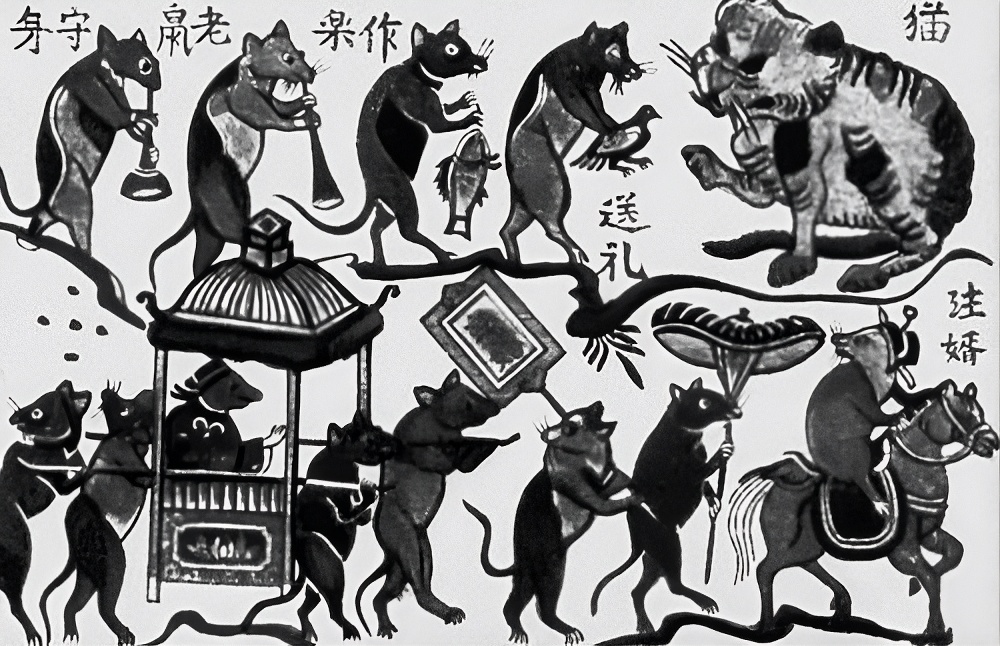
The cat sits in the upper right, larger than the rats, facing the ones who bring offerings that include a fish and a bird.
Đông Hồ painter Nguyễn Đăng Dung reads the scene as a social hierarchy, with the rats representing ordinary people and the cat representing mandarins or officials. Viet Nam’s National Authority of Tourism has documented this interpretation, in which the rats must bribe those in authority to get permission for their wedding.
The Ferenc Hopp Museum of Asiatic Arts in Hungary reads the print along similar lines in its collection record for a Rat’s Wedding. It describes the cat as a symbol of the ruling class and the offerings as “gratitude money”, suggesting that ordinary people’s happiness depends on the goodwill of those above them.
Together, these readings treat the print as a satire of bribery and unequal power relations, though its meaning is not universally agreed upon.
Humour as Social Criticism
The Rat’s Wedding is not the only Đông Hồ print with a social message. The tradition covers animals, children, festivals, folk tales, historical scenes and everyday life, and its familiar characters and visual humour were also used to comment on social problems.
A study titled “Art at the Crossroads: Lacquer Painting in French Vietnam” published in Transcultural Studies notes that animals in these prints often act like humans to critique social ills such as corruption and adultery.
In this print, a long procession of rats follows the couple, who ride on horseback and in a palanquin. The same study also notes that some interpret the scene as a parody of Sino-Vietnamese relations, while others see it as a criticism of graft and corruption.
Hand-Carved, Hand-Printed, and Now Endangered
Đông Hồ prints, including The Rat’s Wedding, have traditionally hung in homes during Tết, the Lunar New Year, when families express hopes for prosperity, happiness and good fortune. The prints are also associated with the Mid-Autumn Festival and rituals honouring ancestors and deities.
Every print is made by hand. Artisans carve designs into wooden blocks, prepare natural pigments and print on paper coated with scallop-shell powder, applying each colour in a set order and adding the black outlines last. The skills can take years to master, and the blocks themselves are family heirlooms passed down through generations.
In 2025, UNESCO inscribed the craft on its List of Intangible Cultural Heritage in Need of Urgent Safeguarding. Its decision cited a sharp decline in skilled practitioners, limited interest among younger generations, difficulties sustaining artisans’ livelihoods and reduced use of the prints during traditional holidays.
Reference
Safford, L. B. (2015). Art at the crossroads: Lacquer painting in French Vietnam. The Journal of Transcultural Studies, 6(1), 126-170. https://doi.org/10.11588/ts.2015.1.16061