Thailand’s population peaked at an estimated 71.76 million in 2022, and it could keep falling for the rest of the century.
Under the medium projection scenario in the UN’s World Population Prospects 2024, it would reach 64.94 million by 2054 and 45.73 million by 2100, a loss of roughly 26 million people from the peak.
These figures are projections, not guaranteed outcomes, but they raise a bigger question about how Thailand will support an aging society with a smaller workforce.
Fewer Births, More Deaths
Civil registration data from Thailand's Department of Provincial Administration, published in the National Statistical Office's Statistical Yearbook Thailand 2026, recorded 416,574 births and 559,684 deaths in 2025.
That is a gap of about 143,000, meaning deaths ran roughly 34% above births. It was the fifth year in a row that deaths outnumbered births. Births also dropped by nearly 10% from 2024, when 462,240 babies were registered.
The crude birth rate went from 10.2 per 1,000 people in 2021 to 6.2 in 2025, while the crude death rate climbed from 8.3 to 9.3. Over the same period, the registered population fell from 66.17 million to 65.81 million.
Fertility has dropped sharply too. World Bank data show Thailand's total fertility rate falling from approximately 6.3 births per woman in 1960 to 1.2 in 2024. Estimates from Mahidol University's Population Gazette put the rate even lower, at 1.0 in 2024 and 0.93 in 2025.
In a population with low mortality, replacement level sits at around 2.1 births per woman. If fertility stays below that for long enough, each generation ends up smaller than the last unless migration makes up the difference.
The decline took decades to unfold. The government officially launched its National Family Planning Programme in 1970, which widened access to contraception nationwide. Economic development, urbanization and shifting family patterns pushed fertility down further.
The outcome is a country with fewer newborns and a growing share of older people. In 2025, about 14.29 million people were aged 60 or over, or 21.7% of the population, up from 18.5% in 2021. Some 41.91 million people (63.7%) were aged 15 to 59, and children aged 0 to 14 made up only 14.6%.
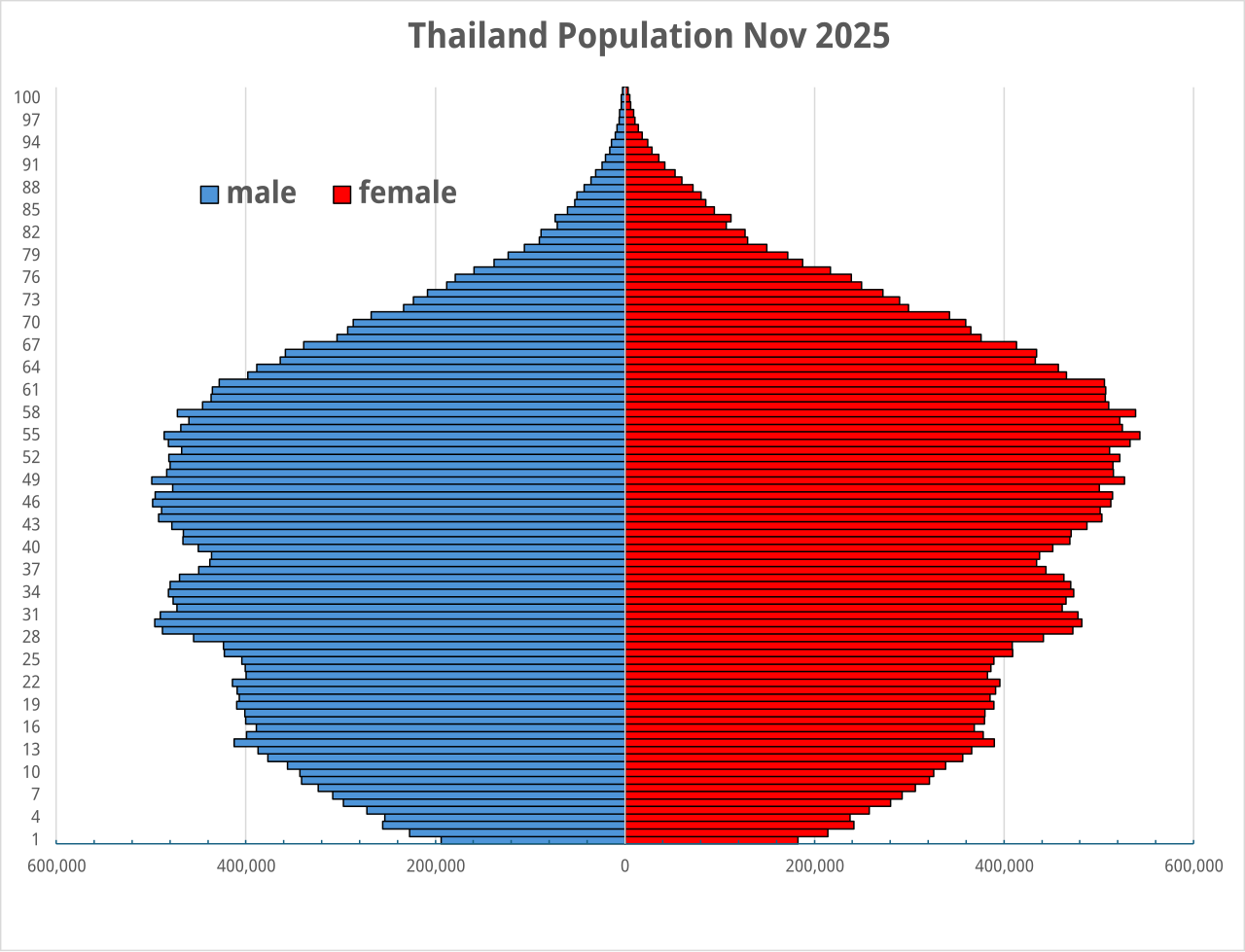
The Northeast has been hit hardest. It recorded 32.5% of all deaths nationwide, and deaths there exceeded births by 71.1%.
Fewer Workers, Rising Costs
The World Bank estimates that the old-age dependency ratio had already reached about 31% by 2024, which works out to roughly three working-age people for every person aged 60 and over.
A smaller younger generation means fewer future entrants to the workforce, while an aging population will likely push up demand for healthcare, long-term care, and financial support. The World Bank projects that the number of Thais needing long-term care will more than double, from about 421,000 in 2020 to about 930,000 in 2040. It also expects age-related public spending to rise by about 5 percentage points of GDP by 2055.
UNFPA calls Thailand’s demographic transition a structural challenge for the economy, the labor market, and the health and welfare systems.
The World Bank projects that average annual GDP growth could slow from 3.6% to 2.4% between 2020 and 2050, with demographic change accounting for more than half of the drop. It also flags deepening skills mismatches, with about 74% of youth and adults below the threshold for foundational digital skills.
The economic equation is a difficult one. With fewer working-age people for every older resident, Thailand may have to raise productivity, bring more people into the labor force, or adapt its social protection systems. Businesses could also struggle to fill vacancies, especially in labor-intensive industries.
What Can Thailand Do About It?
Higher birth rates are one possible response, but a slow one. Children born today will not reach working age for years, even if fertility rebounds.
UNFPA emphasizes that population policy should focus on individual choice rather than birth targets, ensuring that pregnancies are planned and wanted. Its recommendations include expanding access to family planning and infertility treatment under universal health coverage, as well as supporting parental leave and family rights for LGBTQ+ couples following Thailand's 2024 Marriage Equality Act.
Getting more out of the current workforce could pay off sooner. The World Bank estimates that about 200,000 older Thais are healthy and willing to work, but existing programs reach only around 6,000. It recommends flexible work arrangements, retraining, and a phased increase in the formal retirement age toward 65.
Earlier modeling cited in its report suggests that gradually raising the official retirement age from 60 to 65 by 2050 could add about 0.3 percentage points to annual GDP growth, and that higher female labor-force participation could add 0.1 to 0.2 points.
Migration is another option. Thailand already hosts about 5.3 million foreign nationals, roughly 7.5% of its population as of 2024. Most of the workers among them are low-skilled, concentrated in construction, manufacturing, and agriculture.
The World Bank suggests balancing low and high-skilled immigration, with visa pathways tied to particular sectors and to regions outside Bangkok. Robotics and AI could also help older workers stay productive.
Taken together, a package of reforms across six areas could offset around half of the projected slowdown in growth, and possibly more once the measures reinforce one another.
References
National Statistical Office. (2026). Statistical yearbook Thailand 2026. https://www.nso.go.th/public/e-book/Statistical-Yearbook/SYB-2026_webPage/Page_SYB_EN.html
United Nations, Department of Economic and Social Affairs, Population Division. (2024). World population prospects 2024. https://population.un.org/wpp/
United Nations Population Fund Thailand. (2026, March 24). Policy brief and recommendations for sustainable population and development in Thailand. https://thailand.unfpa.org/en/UNFPA-Thailand-Policy-Brief-English
World Bank. (2026). Thailand country aging report: A contract across generations-Thailand’s path to an age-ready society. https://documents.worldbank.org/en/publication/documents-reports/documentdetail/099101426124536228