The city of Hanoi houses a historical cultural heritage site named the Temple of Literature. Among Vietnamese, the name of the historical site is Văn Miếu – Quốc Tử Giám.
Initial construction of the site took place in the 11th century under the rule of the Lý Dynasty. The area stands on land spanning tens of thousands of square meters in the city center.
Since its initial establishment, the location has combined two primary functions. The grounds were designed as a ritual space for honoring knowledge as well as the center of an imperial educational institution.
Establishment of the 11th Century Imperial Academy
The construction of the Văn Miếu area began in 1070 by order of Lý Thánh Tông. The initial building was designated specifically as a venue for ritual tribute to Confucius along with his disciples.
Six years later, Lý Nhân Tông expanded the function of the area. The ruler established the Quốc Tử Giám facility in the rear area of the temple in 1076.
The establishment of the new facility marked the founding of the first imperial academy in Viet Nam. The institution was tasked with educating crown princes and children from high-ranking royal official backgrounds.
The teaching curriculum focused on Confucian teachings and East Asian classic literature. Learning materials were prepared to form bureaucrats who mastered law alongside administrative governance.
The educational process at the academy connected directly to the imperial state examination system. Passing the examination served as the main prerequisite for acquiring bureaucratic positions within the dynastic government structure.
The administration of state examinations took place periodically under royal authority. The selection path opened opportunities for scholars from various regions to enter the ranks of dynastic officials.
Layout of the Five Main Courtyards
The architecture of the Temple of Literature was designed stretching symmetrically from south to north. The entire grounds are divided into five main courtyard sections separated by red brick walls.
The entrance on the outer side is marked by the main gate named Văn Miếu Môn. Behind the main gate, a stone pathway connects the open garden area to the second gate named Đại Trung Môn.
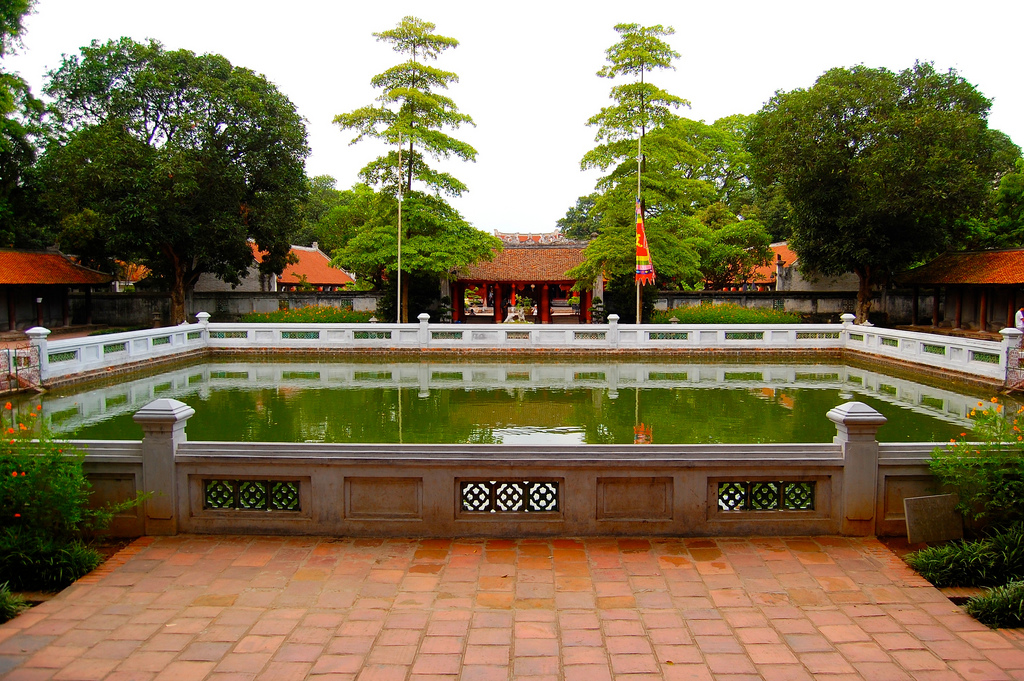
The third courtyard area contains a two-story historical wooden structure named the Khuê Văn Các Pavilion. In the middle of the courtyard lies a large square water pond named the Well of Heavenly Clarity.
Rows of structures protecting stone stelae stand on the left and right sides of the water pond. The spatial layout separates the open front area from the main section at the rear.
The two rearmost courtyards contain the main buildings for honoring historical figures as well as the former academy classrooms.
Presence of 82 Turtle Stone Stelae
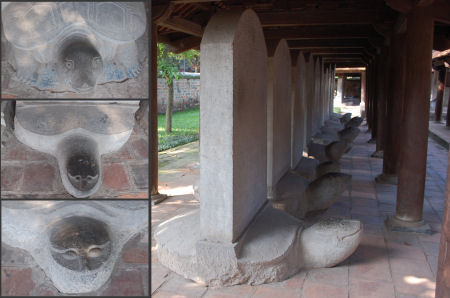
The third courtyard area houses a collection of stone stelae recording imperial state examination graduates. The collection of historic stelae is recorded internationally as the Stelae of Doctors.
The carving of the stelae began during the reign of King Lê Thánh Tông in 1484. Each stone surface bears engravings of full names, examination dates, and origin regions of the graduates.
The stone stelae sheets stand upright on bases shaped like turtles. In Vietnamese cultural tradition, the turtle represents a symbol of endurance, wisdom, and the longevity of knowledge.
Out of hundreds of stelae originally erected throughout dynastic history, a total of 82 stelae remain fully intact. UNESCO designated the collection of stone stelae as part of the Memory of the World Register in 2011.
The engravings on the stelae serve as primary data sources regarding the history of Vietnamese bureaucracy and administration. The historic records immortalize the identities of intellectuals who passed state examinations over several centuries.