

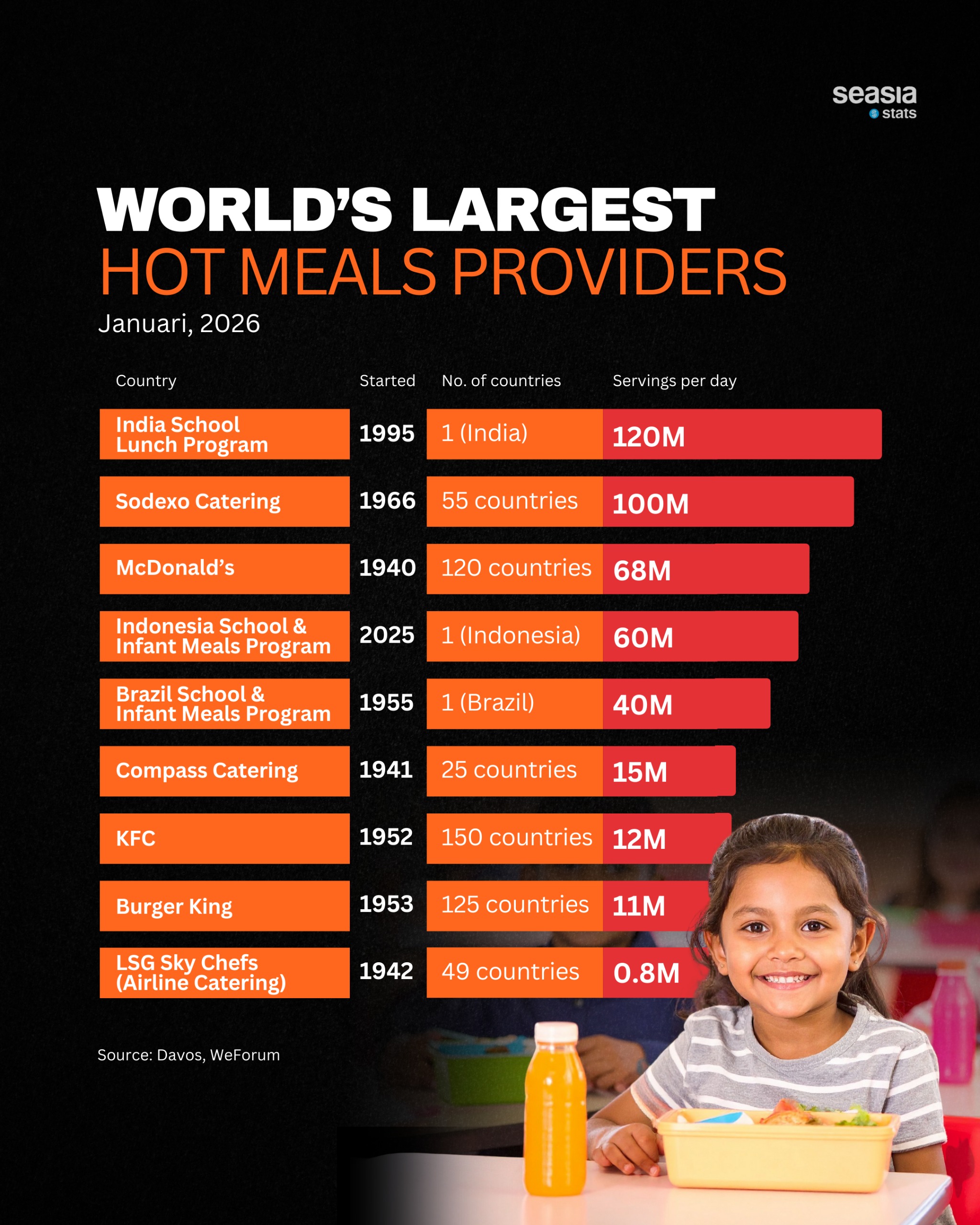
Every day, long before restaurants open and dinner tables are set, an invisible army of cooks, drivers, and food planners goes to work feeding the world. These are not celebrity chefs or luxury brands, but massive public programs and global catering operations that deliver hot meals at a scale almost impossible to imagine. In 2026, as new data reveals who feeds the most people daily, a clearer picture emerges of how governments, institutions, and corporations quietly keep billions nourished.
A Quiet Global Giant: Mass Meal Providers
Every day, hundreds of millions of people around the world eat a hot meal not from a restaurant or home kitchen, but from vast public programs and industrial-scale food providers. From school cafeterias to airline kitchens, these systems operate largely out of sight—yet they shape nutrition, education, and social stability on a global scale. As of January 2026, new data highlights just how massive these operations have become.
India’s School Lunch Program: The World’s Largest
At the top of the list stands India’s School Lunch Program, also known as the Midday Meal Scheme. Serving more than 120 million hot meals every day, it is officially the largest food program in the world. Designed to improve child nutrition and boost school attendance, the program reaches children across India’s vast rural and urban landscapes. Its scale is unmatched—and its impact extends beyond hunger to education, health, and gender equality.
Global Catering Giants: Feeding Institutions Everywhere
Behind India’s public initiative are powerful multinational catering firms. Sodexo, founded in 1966, delivers an estimated 100 million meals daily across 55 countries, serving schools, hospitals, offices, and military facilities. Meanwhile, Compass Group operates in 25 countries, and LSG Sky Chefs prepares airline meals in nearly 50 nations, demonstrating how institutional food has become a global industry.
Fast food also plays a role. McDonald’s, operating in around 120 countries, serves approximately 68 million meals a day, making it one of the world’s largest commercial hot-meal providers. While different in mission from welfare programs, its logistical scale rivals that of national food systems.
Southeast Asia Rising: Indonesia’s Expanding Role
Southeast Asia is emerging as a major force in large-scale meal provision, led by Indonesia. In 2025, the country launched the Free Nutritious Meal Program (Makan Bergizi Gratis, or MBG), a nationwide initiative aimed at improving child and maternal nutrition. Within its first year, the program scaled rapidly, placing Indonesia among the world’s top public meal providers by daily volume.
Indonesia already had experience feeding millions through school and community programs, but MBG represents a new level of ambition—positioning food policy as a cornerstone of national development. The country’s logistics, agricultural base, and population size make it a key player in the future of global food provisioning.
Other Southeast Asian nations are also expanding school and social feeding programs. Thailand, Vietnam, and the Philippines operate large government-supported meal schemes, though on a smaller scale, often focused on rural nutrition and disaster response.
Beyond Governments: Nonprofits and Commercial Innovators
Not all large-scale meal providers are governments or fast-food chains. India’s Akshaya Patra Foundation, for example, delivers over 2 million free school meals daily, operating one of the world’s most advanced nonprofit food logistics systems.
On the commercial side, companies like Qatar Airways Catering produce more than 200,000 fresh meals a day, while HelloFresh leads the global meal-kit sector. Nestlé, present in 191 countries, influences billions of meals indirectly through ingredients and prepared foods.
Feeding the Future
Together, these programs and companies reveal a powerful truth: the future of food isn’t only about fine dining or viral trends. It’s about scale, access, and impact. From India’s classrooms to Indonesia’s school kitchens, the world’s largest hot meal providers are quietly shaping global well-being—one plate at a time.


